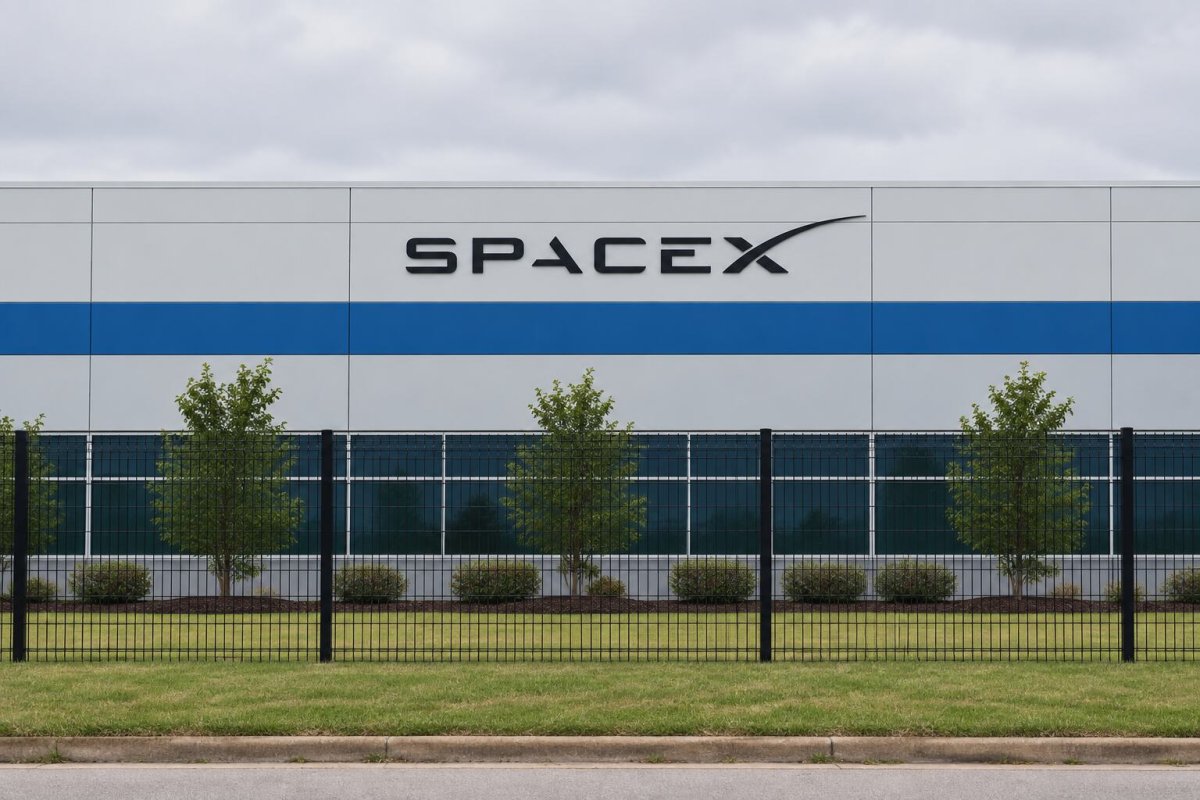
SpaceX shares slipped 1.77% to $152.08 by mid-afternoon Friday, but the day's more consequential signal came not from the tape but from the company's chief executive. Elon Musk, appearing by video at the All-In Summit, revealed he was speaking from an Airstream trailer on-site at SpaceX's Memphis artificial-intelligence campus, where he is personally overseeing the installation of graphics processing units and construction progress.
The disclosure, confirmed by SpaceX President Gwynne Shotwell, underscores the strategic priority placed on the AI infrastructure buildout, a division that is consuming capital at a pace far exceeding its revenue generation. For shareholders, Musk's physical presence is a practical operating update: senior management is concentrating on a capacity ramp that already dominates the company's investment budget.
AI Segment Financials Highlight Capital Intensity
SpaceX's latest quarterly filing reveals the scale of the AI investment. The AI segment, which includes Grok, X, customer AI products, and computational infrastructure, generated $2.56 billion in revenue during the second quarter but posted a $1.26 billion operating loss. Adjusted EBITDA was positive at $1.15 billion, reflecting the add-back of significant depreciation and stock-based compensation charges.
Capital expenditure for the AI segment reached $15.83 billion in the quarter, more than six times segment revenue. While that spending may appear aggressive, revenue surged by $1.82 billion year-over-year, driven largely by new infrastructure contracts. The division also swung from a negative $276 million adjusted EBITDA a year earlier to a positive $1.15 billion, suggesting the ramp is beginning to attract contracted workloads.
Execution Risks and Balance Sheet Strength
SpaceX's balance sheet is well-equipped to fund the expansion. The company ended June with $93.52 billion in cash plus $6.49 billion in marketable securities, bolstered by $85.68 billion in net proceeds from its June initial public offering. Outstanding indebtedness stood at $38.43 billion, leaving ample headroom.
However, the company's own filings caution against complacency. Risks include power constraints, GPU supply shortages, construction delays, workforce disruptions, and permit delays. Additionally, losing a major AI-infrastructure customer or seeing clients move workloads in-house could materially impact revenue and cash flow. These disclosures temper the narrative that executive intensity alone guarantees a profitable ramp.
Regional and Regulatory Exposure
The Memphis buildout is part of a broader regional cluster. An adjacent Mississippi project, MACROHARDRR, was announced in January as a $20 billion investment aimed at achieving 2 gigawatts of computing power. The Associated Press reported both tax incentives and community opposition tied to power and air-pollution concerns. Regulatory friction could transform a fast build into an expensive idle asset, adding another layer of risk.
Friday's modest decline is small relative to the stakes involved. Volume had not yet reached a normal full-day level, and the market appears to be taking a wait-and-see approach. The next meaningful evidence will be quantitative: AI revenue per dollar of new capex, segment operating losses as capacity comes online, progress toward the stated 1 million GPU target for 2026, and any power or permit delays.
Musk's move to Memphis signals that the buildout has his personal attention. Whether that translates into returns above SpaceX's cost of capital on the $15.83 billion quarterly AI investment remains an open question.