Nuclear energy developer NANO Nuclear Energy Inc. (NASDAQ: NNE) ended Friday's session at $15.91, down 4.6%, placing the stock just 8.2% above its 52-week low of $14.71. The decline came despite the company's substantial liquidity position, which stands at $568.7 million in cash, equivalents, and short-term investments as of March 31. That figure represents 66.6% of its $854.3 million market capitalization as of Friday's close.
The gap between the company's market value and its liquid assets is approximately $285.6 million. However, this difference does not directly translate to enterprise value, as it does not account for liabilities, other assets, or future cash flows. The company also disclosed a cash outlay of about $5.2 million for STS during May.
Over the past week, NANO's shares have been volatile. The stock closed at $16.79 on July 27, up 7.7%, but then fell 4.35% to $16.06 on July 28, dropped 7.35% to $14.88 on July 29, surged 12.10% to $16.68 on July 30, and finally slipped 4.62% to $15.91 on July 31. Compared to the prior Friday, the stock was up 2.1%, but it finished 5.2% below Monday's close.
The week began with news that NANO's KRONOS MMR had secured an AFWERX Phase I award, with work starting on July 21. The company did not disclose the contract's value, but CEO James Walker called it "another meaningful step in the continued advancement of NANO Nuclear's defense commercialization strategy."
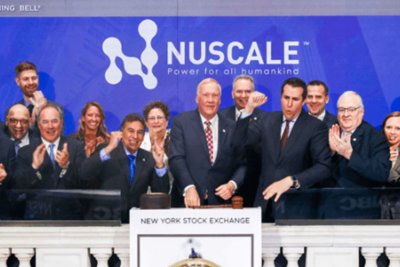
Pressure is mounting across the publicly traded reactor developer sector. On Friday, all three major listed developers—NANO, Oklo Inc. (NYSE: OKLO), and NuScale Power Corp. (NYSE: SMR)—saw their shares decline. NANO has the largest disclosed short interest at 31.35% of its float, which could amplify both selloffs and rebounds. Oklo has a 19.13% short float, while NuScale's is 20.78%.
Comparing liquidity, NANO's cash-to-market-cap ratio (66.6%) is more than double that of Oklo (32.7%) and NuScale (28.9%). However, in absolute terms, Oklo holds $2.21 billion in near-term liquidity, and NuScale has $890.1 million, both exceeding NANO's $568.7 million. This data suggests NANO has higher cash support relative to its size, but not necessarily lower execution risk.
NANO's operating cash outflow over the six months ended March was $9.3 million, meaning its liquidity is roughly 61 times that outflow. Yet this measure does not indicate how long the company can sustain operations, as spending could rise significantly due to reactor licensing, acquisitions, or construction.
Regulatory advancement remains the key driver for valuation. The Nuclear Regulatory Commission began a formal review of the KRONOS design in June. NANO believes that regulatory clearance could allow initial construction to begin in the second half of 2027, though the timeline is subject to change.
Investors will get more sector insight this week. NuScale is scheduled to report second-quarter earnings on Wednesday at 5:00 p.m. ET, with focus on cash spending, contracts, and project expenditures. Oklo will follow on Friday before the market opens, with a call at 8:30 a.m. ET, where investors will scrutinize cash management, fuel strategy, and construction progress. These reports will provide the most direct comparison for NANO's liquidity advantage.
Risks remain, including the use of March balance sheet data against July market values, potential licensing delays, higher construction costs, share dilution, and significant short positioning that could trigger large price swings. While NANO's financial buffer mitigates some risk, it does not address the core concern: investors need evidence that regulatory progress will translate into signed commercial agreements.