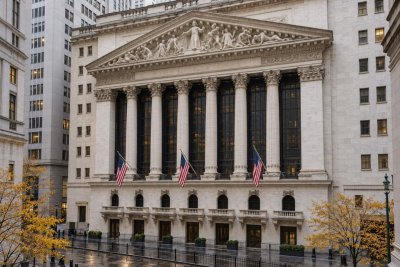
U.S. stocks experienced a significant downturn on Thursday, with major indices falling sharply as a surge in oil prices and concerns over heavy capital spending in artificial intelligence weighed on market sentiment. The Nasdaq Composite led the decline, dropping 2.15% to close at 25,137.69, while the S&P 500 fell 1.21% to 7,408.30, and the Dow Jones Industrial Average shed 0.97% to 51,711.65.
The catalyst for the selloff was a jump in crude oil prices, with Brent crude settling 7% higher at $100.69 per barrel, its first close above $100 in over a year. The increase followed attacks on tankers in the Middle East, which heightened risks to key supply routes. West Texas Intermediate (WTI) crude rose 6.2% to $92.19. The 10-year Treasury yield also climbed, nearing 4.7%, its highest level since January 2025, as rising energy costs fueled inflation and interest rate concerns.
The combination of higher energy prices and rising yields put pressure on growth stocks, particularly those with heavy exposure to artificial intelligence. Alphabet Inc. (GOOGL) and Tesla Inc. (TSLA) reported strong quarterly revenue growth of 24% and 26%, respectively, but both companies spent more on capital projects than they generated from operations. Together, they generated $43.8 billion in operating cash flow but spent $50.7 billion on capital expenditures, resulting in negative free cash flow of $6.9 billion. This meant they invested $1.16 for every dollar of operating cash flow.
The market's reaction was swift and severe. Alphabet's shares fell 7.2%, while Tesla's stock plummeted 14.5%. A preliminary calculation based on closing values places their combined one-day market cap loss near $490 billion, roughly 70 times their quarterly cash deficit. The scale of the decline reflects investor concern over the long-term returns on these massive investments. Alphabet's cloud revenue surged 82% to $24.8 billion, but quarterly capex reached $44.9 billion, exceeding cash from operations. CFO Anat Ashkenazi noted that "demand still outpaces that investment," as the company raised its 2026 capex guidance to $195 billion-$205 billion. Tesla's revenue beat forecasts, but adjusted earnings missed, and capital spending more than doubled. Automotive gross margin came in at 16.3%, below expectations.
Energy stocks provided a narrow hedge against the broader selloff. Exxon Mobil (XOM) rose 1.6%, and Chevron (CVX) gained 0.8%, though these gains were modest relative to crude's 7% jump. The selloff extended beyond megacaps, with decliners outnumbering advancers by nearly three-to-one on the New York Stock Exchange. The CBOE Volatility Index (VIX) closed at 18.7, after reaching a monthly high of 20.3 during the session.
Looking ahead, the market's focus will shift to the Federal Reserve, which concludes its July 28-29 meeting next Wednesday. Rate futures currently imply a 64% chance of no change in interest rates. Additionally, Microsoft (MSFT) and Meta Platforms (META) are scheduled to report earnings after the close on Wednesday, followed by Amazon.com (AMZN) on Thursday. Investors will closely compare their capital expenditure levels with operating cash flow and revenue growth, as the theme of AI-driven spending continues to dominate market narratives.
The risks remain two-sided. A de-escalation in Middle East tensions could reverse the oil price surge and ease yield pressures, while further shipping disruptions could deepen inflation concerns. Meanwhile, faster-than-expected monetization of AI investments could restore support for megacap stocks. For now, the market is grappling with the tension between strong revenue growth and the heavy cash demands of AI infrastructure.