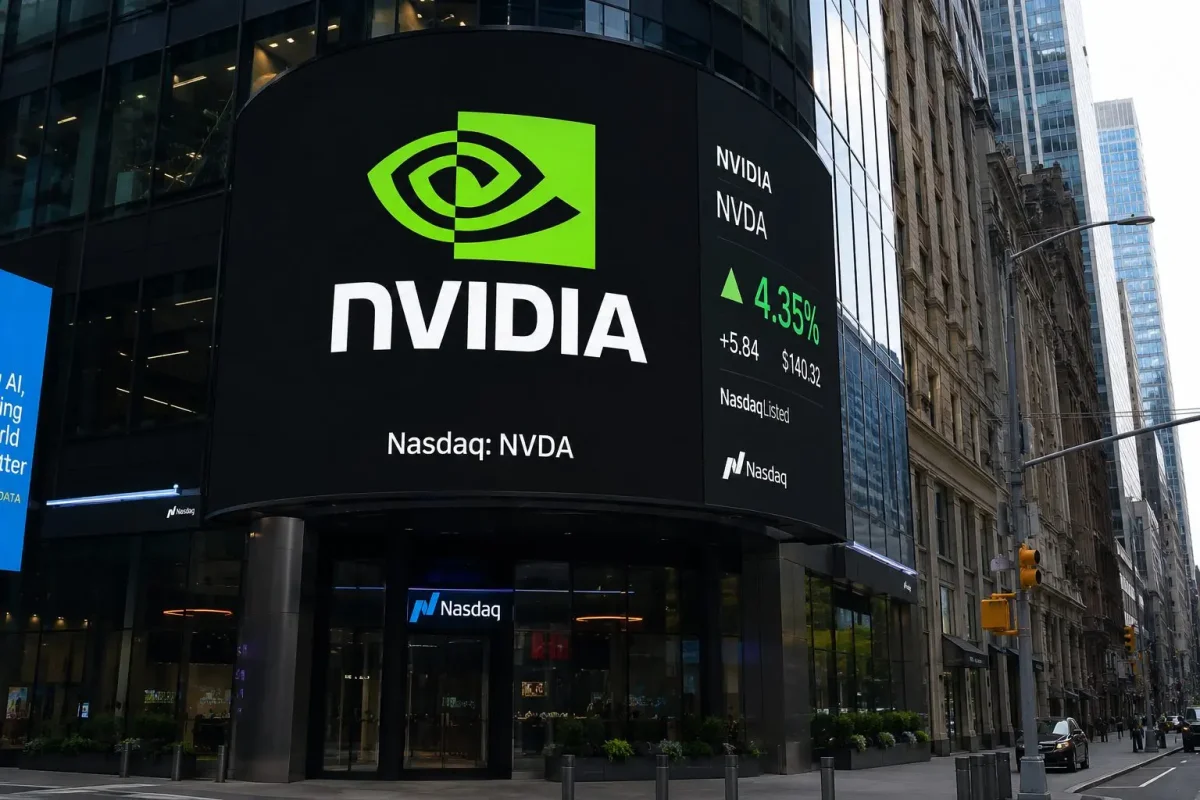
Nvidia shares surged 6.2% in afternoon trading Monday, reaching $224.27, after the company unveiled RTX Spark, a new AI-focused chip designed for Windows PCs. The announcement propelled Nvidia's market capitalization to approximately $5.47 trillion, while competitors Intel, Qualcomm, and AMD saw their shares decline 3.7%, 7.3%, and 0.5%, respectively.
RTX Spark, developed in collaboration with MediaTek, is slated for release this fall in systems from major brands including ASUS, Dell, HP, Lenovo, Microsoft Surface, and MSI, with Acer and Gigabyte offering models later. The chip delivers up to one petaflop of AI performance—a quadrillion operations per second—and supports up to 128GB of unified memory, positioning it as a direct challenger to Intel, AMD, and Qualcomm in the PC processor market.
Nvidia CEO Jensen Huang declared that "the PC is being reinvented," while Microsoft CEO Satya Nadella emphasized the shared goal of bringing "unmetered intelligence to every home and every desk with Windows." Analysts view the launch as a strategic pivot beyond gaming and creator chips, targeting the growing demand for personal AI agents that operate directly on local hardware, bypassing cloud servers.
"For consumers, it means more choices," said Lian Jye Su, chief analyst at Omdia. Neil Shah, co-founder of Counterpoint Research, described RTX Spark as potentially "revolutionizing how PCs would look like in the next 10 years," shifting from app-driven machines to "Agentic AI personal computers."
The announcement comes less than two weeks after Nvidia reported fiscal first-quarter revenue of $81.6 billion, up 85% year over year, with data-center revenue hitting $75.2 billion, up 92%. The company guided second-quarter revenue to $91 billion, plus or minus 2%, while noting the outlook assumes no data-center compute revenue from China.
Despite the bullish sentiment, analysts caution that AI PC demand has been uneven. HP reported that AI PCs boosted quarterly sales, but Dell indicated weaker-than-expected demand. Additionally, ongoing U.S. export restrictions on China continue to cloud Nvidia's outlook, and any tightening of those rules could pressure the stock, which already trades at a high valuation.
Nvidia's move represents a strategic attempt to extend its AI growth story beyond data centers into the consumer PC market. Investors appeared willing to bet on that transition, driving the stock higher even as broader U.S. indexes traded near record levels, with tech names leading the charge.
The launch intensifies competition with Intel, AMD, and Qualcomm, all of which have been pushing their own AI PC initiatives. Nvidia's entry into this space underscores the company's ambition to dominate not only the data center but also the personal computing segment, where AI agents could become a standard feature in the coming years.