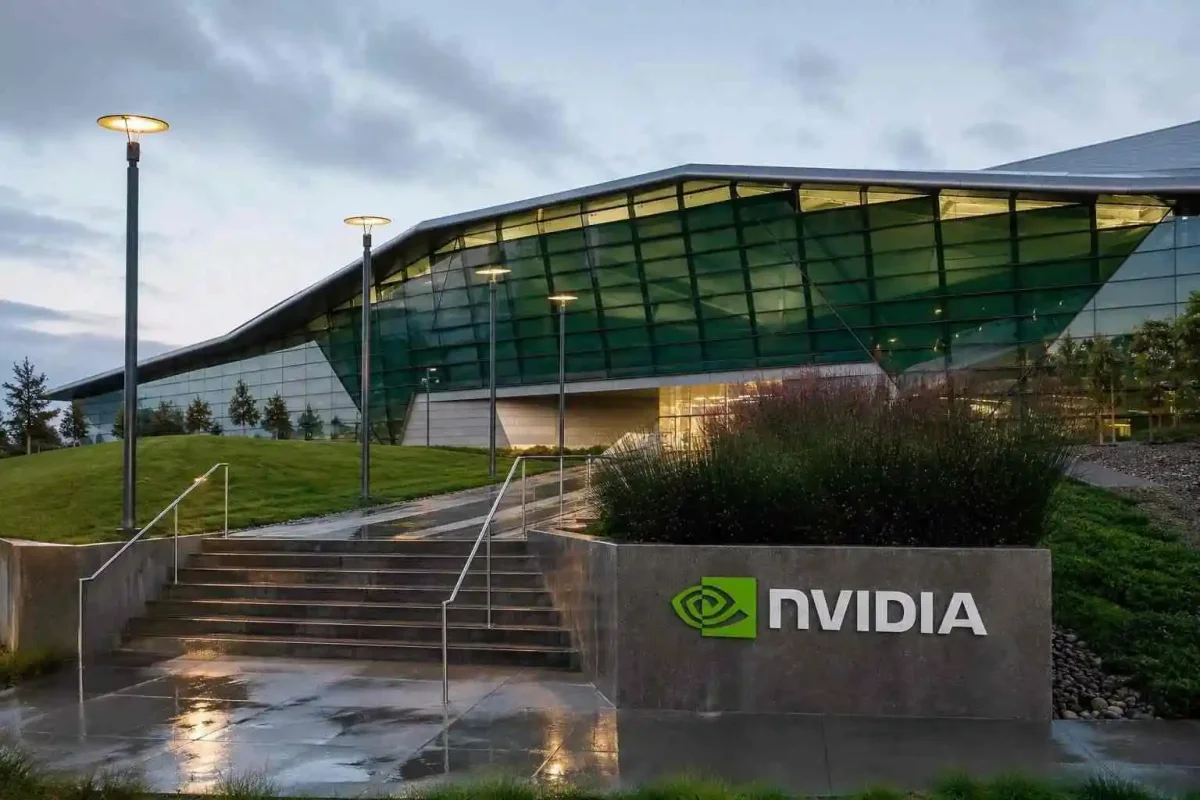
Nvidia (NASDAQ:NVDA) shares are testing a critical technical level, trading near their 200-day moving average as market participants assess the growing threat of substitution in the artificial intelligence chip sector. The stock slipped 1.53% in premarket trading to $193.92, following a modest 0.71% gain at Tuesday's close of $196.93.
From a technical perspective, Nvidia sits above its 200-day moving average of $191.26 but remains below both its 20-day average of $201.92 and its 50-day average of $209.60. The 14-day relative strength index stands at 43.53, indicating the stock is not yet oversold but is under significant selling pressure. A break below the 200-day moving average would signal a potential shift in medium-term trend and could trigger further selling from portfolio managers who use that level as a risk management trigger.
DeepSeek's Custom Chip Plans Add to Margin Concerns
Recent reports that DeepSeek is developing its own inference chip have intensified scrutiny on Nvidia's pricing power. According to Reuters, three sources confirmed DeepSeek's plans to design custom silicon for AI inference workloads. Richard Windsor of Radio Free Mobile noted that "Nvidia is at zero in China and staying there," suggesting that the direct revenue impact from China is already capped. However, the broader risk lies in the potential acceleration of custom inference chips, which could erode Nvidia's high-margin dominance over time.
Strong Fundamentals but Concentrated Revenue
Nvidia's fiscal first-quarter results remain robust, with revenue surging 85% year-over-year to $81.6 billion. Data-center sales, which account for 92.2% of total revenue, jumped 92% to $75.25 billion. The company guided for second-quarter revenue of $91.0 billion, plus or minus 2%, and reiterated that its outlook excludes any China data-center compute sales. CEO Jensen Huang highlighted that "Agentic AI has arrived," underscoring the company's bullish narrative.
However, the revenue concentration raises concerns. Three customers accounted for 21%, 17%, and 16% of last quarter's sales, a level of dependency that becomes more significant with Nvidia's market capitalization near $5 trillion. While the company's balance sheet is strong—with $50.3 billion in cash and equivalents and an $80 billion buyback authorization—these measures can only slow multiple compression, not prevent it if investors begin to price in margin erosion.
CPU Expansion and Vera Demand Provide Some Support
Nvidia is not solely reliant on GPUs. The company is aggressively expanding into CPUs, networking, and software. Perplexity AI has announced it will use Nvidia's Vera CPU, with Vice President Nate Kupp calling it "a dead-on fit" after tests showed Nvidia's CPU ran AI agent coding about 1.5 times faster than standard chips. Nvidia is guiding for $20 billion in Vera CPU sales by fiscal year-end, a positive signal but one that does not fully address the bear case, as the volume of Perplexity's order remains undisclosed.
Zachary Hill of Horizon Investments summarized the challenge: "Expectations have gotten to be almost impossible to beat for these companies."
Broader Market Weakness Adds Pressure
The broader market is also weighing on chip stocks. Nasdaq 100 futures dropped 1.12% early Wednesday, while S&P 500 futures fell 0.84% amid rising oil prices due to Middle East tensions. On Tuesday, the Nasdaq Composite lost 1.16%, and the PHLX chip index slid 4.65%. Among peers, Micron Technology (NASDAQ:MU) fell 4.7%, and Sandisk (NASDAQ:SNDK) dropped 7.3%. Intel (NASDAQ:INTC), Advanced Micro Devices (NASDAQ:AMD), and SK Hynix (KRX:000660) all underperformed Nvidia.
For now, Nvidia's stock remains in a critical zone. Holding above the 200-day moving average keeps the broader uptrend intact, while a decisive break below would signal that the market is beginning to price in a scenario where AI growth continues but Nvidia's profit margins shrink due to increasing competition and custom silicon adoption.