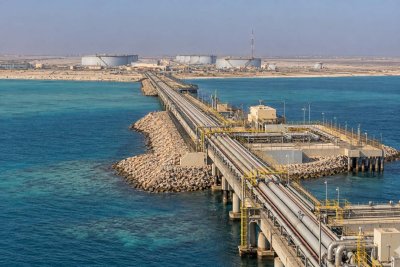
International oil markets closed the week with Brent crude settling at $88.52 per barrel on Friday, a 5.9% gain over the past five sessions. The advance was driven by escalating geopolitical tensions after the United States threatened an indefinite blockade of Iran and both Washington and Tehran issued conflicting claims over control of the strategic Strait of Hormuz.
The premium embedded in current prices is notable. Goldman Sachs estimates Brent's spot fair value at approximately $80, meaning Friday's settlement carries a preliminary risk premium of $8.52, or 10.7%. This places Brent near the upper boundary of Goldman's projected $80-to-$90 trading range, a level that has historically signaled heightened market anxiety.
Market Performance and Investor Signals
West Texas Intermediate (WTI) crude also advanced, settling at $82.40 per barrel, up 5.4% for the week, maintaining a $6.12 spread under Brent. The United States Oil Fund (USO) outperformed both benchmarks, rising 7.3% to $126.60, reflecting strong investor interest in oil exposure.
Energy equities mirrored the rally. The Energy Select Sector SPDR Fund (XLE) climbed 7.7% over the week to $61.91. Chevron Corporation (CVX) gained 7.2% to $200.00, while Exxon Mobil Corporation (XOM) rose 4.6% to $160.10. These moves underscore the sector's sensitivity to supply disruptions in the Middle East.
Analyst Perspectives and Market Drivers
SEB Research's Bjarne Schieldrop attributed the price surge directly to the U.S. stance, noting that there is little immediate optimism for a return to normal flows through the Strait of Hormuz. In contrast, Julius Baer's Norbert Rucker pointed to stronger-than-expected storage levels as a potential offsetting factor that could exert downward pressure on prices.
The supply-demand outlook remains a key battleground. The International Energy Agency (IEA) projects a third-quarter shortfall of 1.8 million barrels per day, with a full-year deficit of 1.27 million barrels daily. However, OPEC's demand forecast diverges sharply, expecting an increase of 580,000 barrels per day in consumption, while the IEA anticipates a decline of 1.6 million barrels per day—a 2.18 million-barrel discrepancy that leaves oil prices highly sensitive to supply news.
Physical Flows and the Strait of Hormuz
Physical throughput through the Strait of Hormuz remains the primary limiting factor. According to the U.S. Energy Information Administration (EIA), oil shipments through the strait averaged 14.6 million barrels per day in the first quarter of 2026, a 28.4% drop from 20.4 million barrels per day in the same period of 2025. Crude and condensate flows fell 25.2% to 10.7 million barrels per day, while petroleum product shipments declined 36.1% to 3.9 million barrels per day. LNG flows also contracted sharply, down 37.6% to 7.3 billion cubic feet per day.
The political rhetoric has been intense. The head of Iran's Basij force declared that the strait is "under Iran's control and management," while U.S. President Donald Trump asserted that the United States had "total control." Iran's joint command has stated that vessels require Tehran's approval to transit, but neither claim has resolved the underlying operational uncertainties.
Risks and Key Levels to Watch
Goldman Sachs maintains that Brent will likely stay within the $80-$90 range unless a fresh agreement emerges or significant escalation occurs. SEB Research sees short-term upside with no expectation for a return to usual Hormuz flows soon, while Julius Baer warns that strong storage levels could weigh on prices.
Key risks include confirmation of a shipping agreement or a persistent increase in tanker flows, which could sharply reduce Brent's current 10.7% premium. Conversely, additional vessel attacks or stricter enforcement of the blockade could push prices above Goldman's range. Downward pressures remain subdued demand and a substantial build in U.S. inventories.
When trading resumes, the $90 level will be the critical threshold to monitor. Market participants are closely tracking vessel movements through the Strait and awaiting U.S. economic actions scheduled for next week. At this stage, price direction hinges more on the volume of barrels actually moving through the waterway than on territorial claims to it.