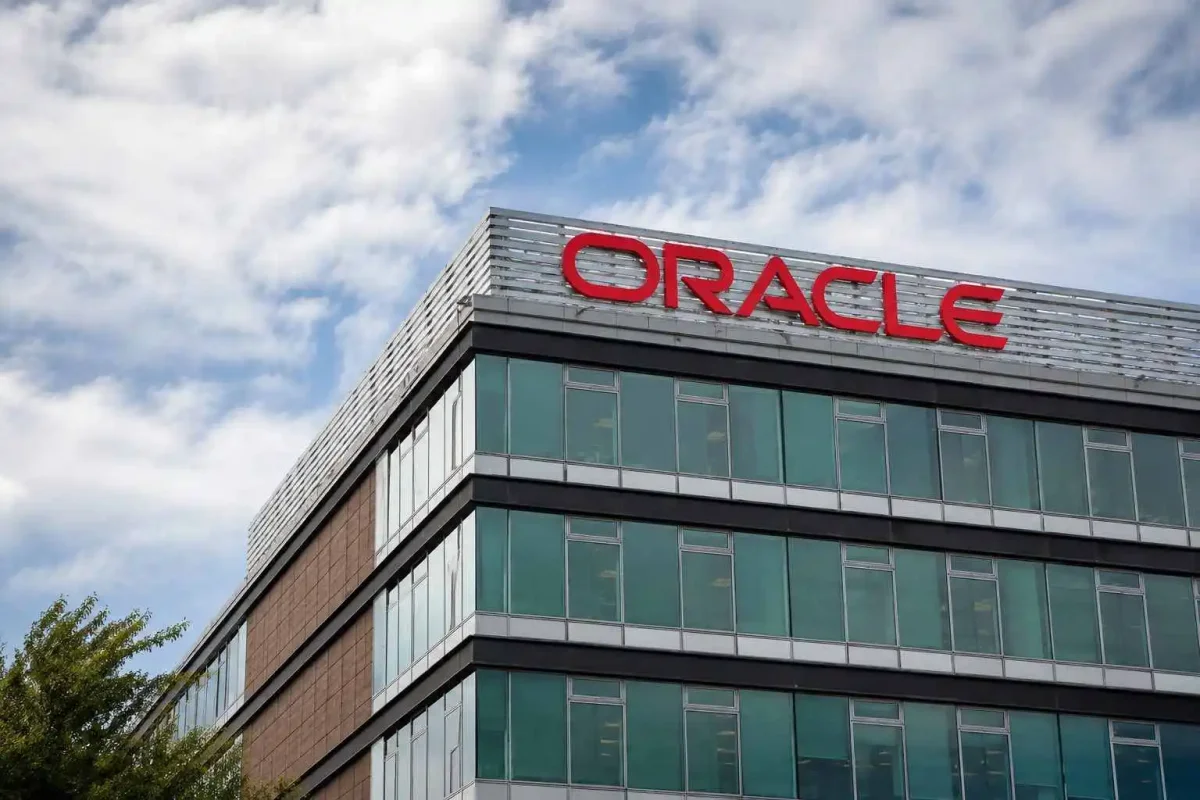
Oracle (NYSE: ORCL) shares fell 2.7% to $170.32 in late-morning trading on Tuesday, following the release of its annual report that revealed a significant workforce reduction of approximately 21,000 employees for fiscal 2026. The stock touched an intraday low of $165.00, with the company's market capitalization now hovering around $496 billion.
Workforce Cuts and AI Spending Concerns
The layoffs, detailed in Oracle's annual filing, have amplified investor anxiety regarding the substantial costs associated with its aggressive artificial intelligence (AI) expansion plans. Oracle is heavily investing in cloud infrastructure to compete with industry giants like Amazon and Microsoft, but the financial toll is becoming a focal point for shareholders.
The broader technology sector also faced headwinds, with U.S. tech stocks declining as investors rotated out of semiconductor and AI-linked names. The Nasdaq and S&P 500 both traded at more than one-week lows. Nigel Green, CEO of deVere Group, commented that the AI trade had become so crowded that "the exit door becomes very small very quickly."
Financial Pressures and Capital Raising
Oracle reported negative free cash flow of $23.7 billion for fiscal 2026, driven by capital expenditures totaling $55.66 billion. To fund its cloud expansion, the company raised $43 billion in debt and $5 billion in equity during the fiscal year. Looking ahead, Oracle plans to secure approximately $40 billion more in fiscal 2027 through a combination of debt and equity offerings, including a previously disclosed $20 billion at-the-market stock sale. This financing strategy has become a key concern among investors.
Despite these challenges, Oracle's remaining performance obligations (RPO) reached $638 billion at the end of the quarter, a 363% increase year-over-year, indicating strong customer demand. However, the company's ability to convert this backlog into revenue without further straining its balance sheet remains under scrutiny.
Market Response and Analyst Views
AI stocks showed mixed performance on Tuesday. Nvidia (NASDAQ: NVDA) fell 3.7% amid a broader chip sell-off, while Microsoft (NASDAQ: MSFT) gained 1.9% and Amazon (NASDAQ: AMZN) rose 0.6%, suggesting that investor sentiment is not uniformly negative across the cloud and AI space.
Ross Mayfield, investment strategy analyst at Baird, characterized the recent tech pullback as "highly concentrated and flow-driven," but not a complete reversal of the AI growth narrative. However, risks remain elevated for Oracle. If customer payments lag, AI demand growth decelerates, or the company requires additional capital, the stock could face further downside due to increased debt, thinner free cash flow, and potential dilution from equity sales.
Jacob Bourne, analyst at eMarketer, summed up the situation succinctly: "The demand is real, but the funding question is getting harder." Oracle's ability to execute on its data center buildout while managing cash flow and margins will be critical in the coming quarters.