Long Beach, CA – Orbital Operations has secured a prototype agreement from the U.S. Department of Defense valued at up to $35 million to conduct an in-orbit demonstration of its Astraeus cryogenic spacecraft. The company confirmed the award in an announcement on October 23, 2026, with Payload reporting that the contract funds a full-scale flight demonstration.
The company’s published mission specifications reveal a significant payload trade-off inherent in its reusable design. The Astraeus Flagship configuration is projected to deliver 3,200 kilograms to geostationary orbit (GEO) while retaining the ability to return to low Earth orbit (LEO). In contrast, a one-way mission without return capability would deliver 6,600 kilograms—representing a 51.5% reduction in payload capacity when recovery is included.
This trade-off underscores the engineering challenges of reusable spacecraft. “In a sense, we’re looking to be that reusable third stage,” said CEO Ben Schleuniger in an interview with Payload. The return-capable mission requires 8.8 kilometers per second of delta-v, compared to 4.4 km/s for a one-way flight, highlighting the substantial propellant reserves needed for recovery.
Beyond propulsion, cryogenic propellant storage presents a separate hurdle. Astraeus relies on liquid hydrogen and liquid oxygen for maneuvers over multi-year missions. The company’s Boreas cooling system is designed to prevent boil-off during extended waits in orbit. Flight testing will need to validate the integrated performance of the propulsion and cooling systems.
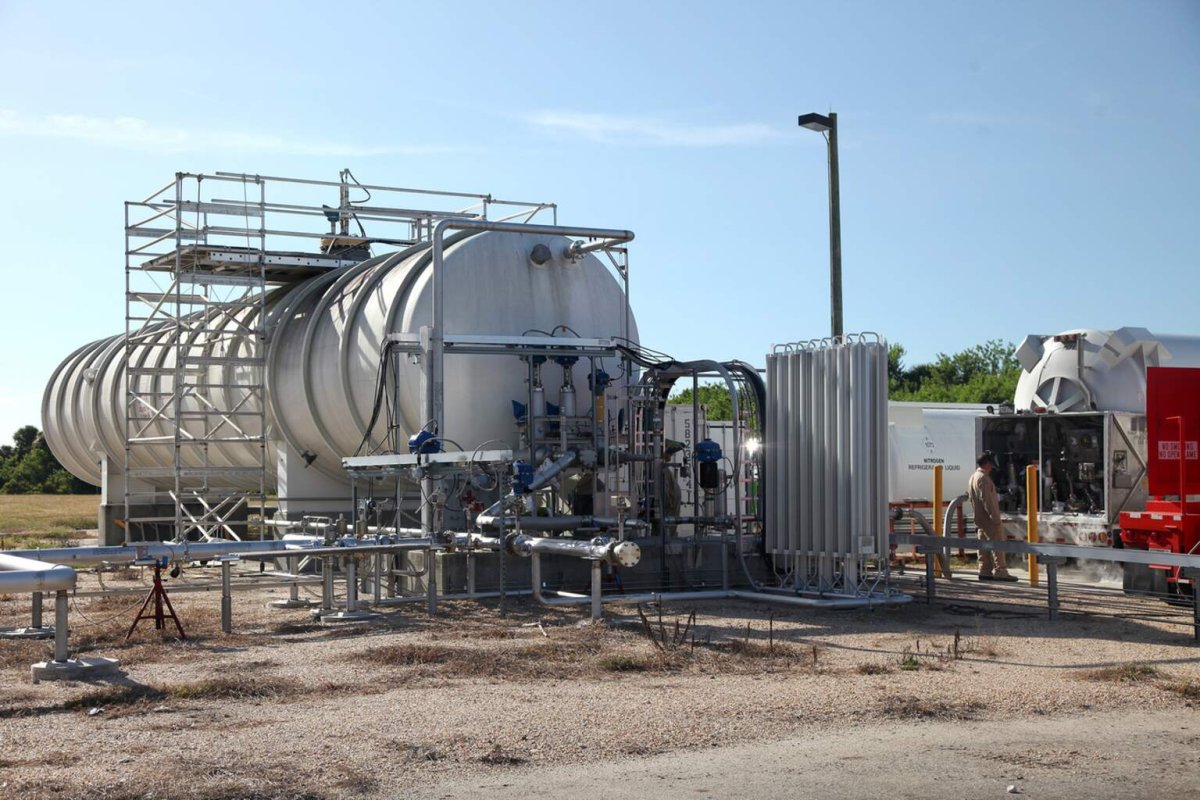
NASA’s engineering research illustrates the difficulty: hydrogen requires refrigeration at approximately 20 kelvin, while oxygen needs about 90 kelvin. Colder systems demand more mass and electrical power per watt of cooling, though these general findings do not directly measure Astraeus’s performance. NASA has demonstrated similar refrigeration technology on the ground, including an 18-month test of a 33,000-gallon hydrogen tank ending in September 2016, but Orbital Operations must prove its own integrated system in space.
The Boreas system uses a reverse turbo-Brayton refrigeration cycle, developed under a Space Act Agreement with NASA. However, the company has not disclosed the cooling system’s mass or electrical consumption, preventing independent assessment of the full spacecraft’s storage penalty.
In addition to the government award, Orbital Operations announced a $7 million seed extension led by DTX Ventures, bringing total private capital raised to approximately $16 million. The government contract is a ceiling for prototype work and does not guarantee production orders or set commercial pricing.
Schleuniger noted that military operators require a 48-hour response window, with the company aiming to execute maneuvers within single-digit hours of a command. These remain targets, and the flight demonstrator’s payload configuration has not been specified.
Risks remain in long-duration cooling, hydrogen containment, and repeated engine operation. The published mission capacities depend on a spacecraft and propellant budget that have yet to be demonstrated together in orbit. Payload identifies further engine firings, refrigeration-cycle work, and qualification as next steps, but no launch date has been announced.