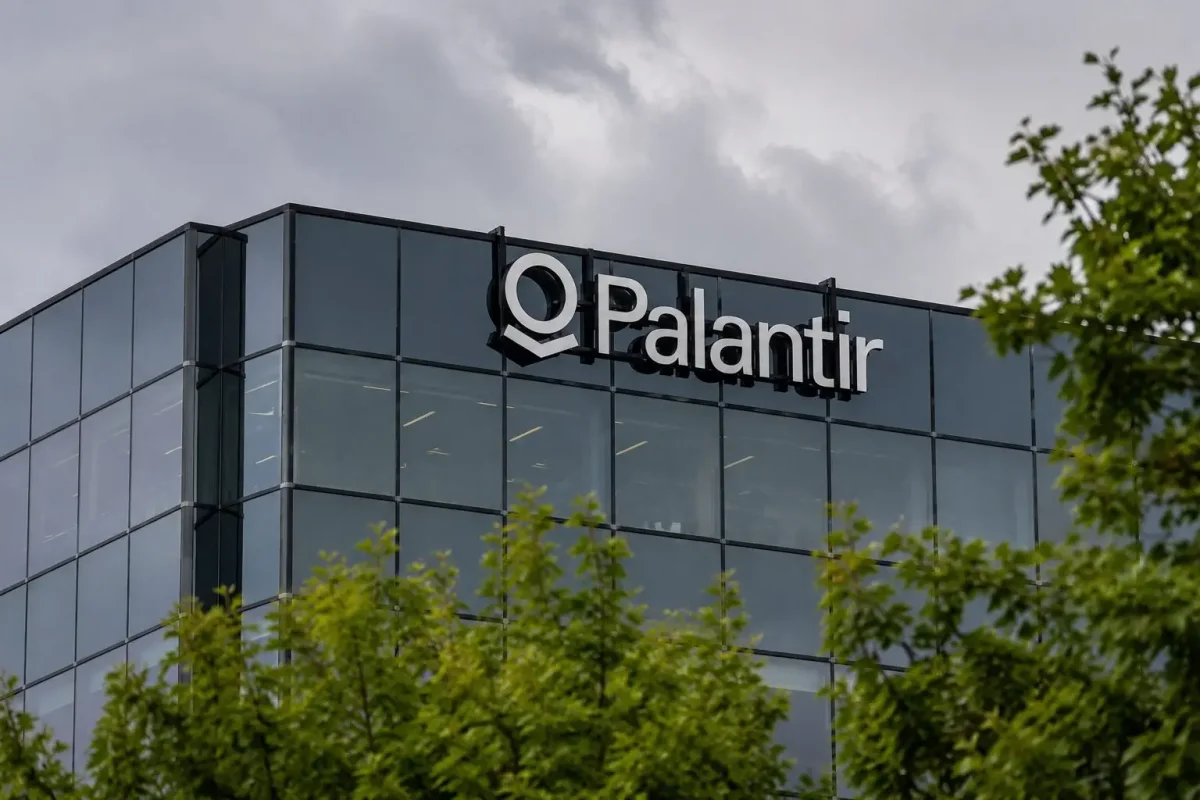
NEW YORK, July 25, 2026 – Palantir Technologies (NASDAQ:PLTR) saw its shares decline 7.1% over the past week, significantly underperforming the broader market as the Nasdaq Composite fell just 2.1%. The selloff was triggered by a combination of valuation concerns and CEO Alex Karp's cautionary remarks about the societal implications of artificial intelligence-driven wealth concentration.
Karp, speaking on the MDMeets podcast, acknowledged that while AI has the potential to dramatically improve living standards, it may also accelerate wealth accumulation for those at the forefront of the technology. "That's a problem for society," he stated, according to Fortune. The magazine estimated Karp's personal fortune at approximately $15 billion and projected a hypothetical 20-fold increase to around $300 billion—a figure that nearly matches Palantir's entire market capitalization of $294.7 billion as of Friday's close.
Valuation Metrics Under Scrutiny
Palantir ended the week at $122.92 per share, down from $132.38 on July 17, erasing roughly $23 billion in market value. The stock trades at approximately 38.5 times the midpoint of management's 2026 revenue guidance of $7.650 billion to $7.662 billion. Adjusted free cash flow forecasts for the year range between $4.2 billion and $4.4 billion, placing the current valuation at 68.5 times the midpoint of that range—a multiple that reflects expectations of sustained high growth.
Despite the stock's recent weakness, the underlying business continues to demonstrate robust performance. First-quarter revenue surged 85% year-over-year to $1.633 billion, with U.S. commercial revenue jumping 133%. Adjusted free cash flow reached $925 million, representing a 57% margin. These figures underscore the company's operational strength even as investors reassess its premium valuation.
Analyst Divergence and Earnings Preview
Citigroup analyst Tyler Radke maintained a buy rating on Palantir on Friday but lowered his price target to $200 from $225, suggesting a potential 62.7% upside from current levels. However, analyst targets for the stock span a wide range from $70 to $230, highlighting significant uncertainty about the company's fair value.
Palantir is scheduled to report second-quarter results after the market close on August 3. The company has guided for revenue between $1.797 billion and $1.801 billion, a figure that will be closely scrutinized by investors looking for evidence of sustained growth momentum. The company's U.S. government segment contributed $687 million in revenue last quarter, underscoring the importance of policy and regulatory developments for its financial performance.
Broader Market Context
The selloff in Palantir comes amid a broader reassessment of technology sector valuations, particularly for companies with long-duration cash flows. Investor attention is now turning to the Federal Reserve's meeting on July 28-29, which could influence market sentiment toward high-growth stocks. Additionally, Microsoft (NASDAQ:MSFT) is set to report earnings after Wednesday's close, with its enterprise-AI performance viewed as a bellwether for the software sector.
Regulatory risks also loom for Palantir, as increased oversight could delay product rollouts or raise compliance costs. Softer second-quarter performance could further pressure the stock's already elevated sales multiple. Karp's cautionary words have become a tangible concern for investors, as Palantir's current valuation implies that shareholders will capture an unusually large portion of the financial gains from AI adoption.