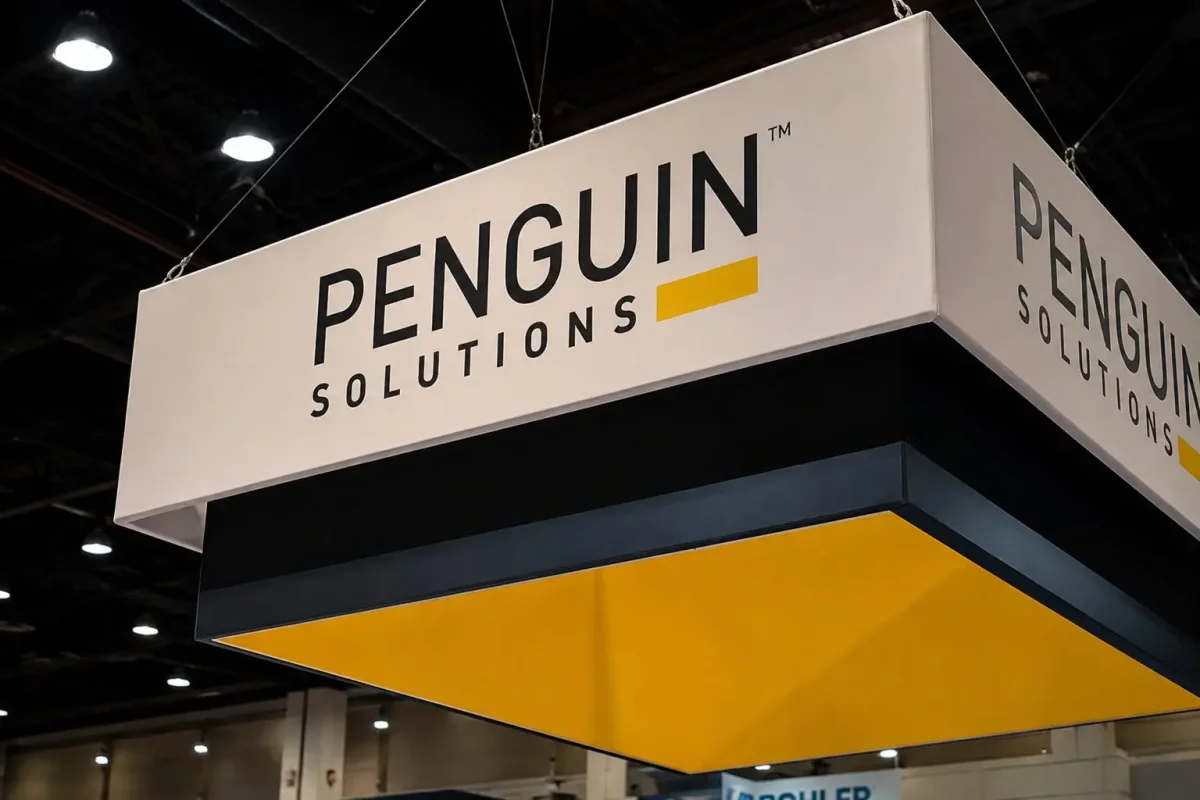
Penguin Solutions (NASDAQ:PENG) saw its shares climb 23.3% to $77.31 by early afternoon trading on July 8, 2026, just shy of its 52-week high of $77.40. The rally followed a fiscal third-quarter earnings report that significantly exceeded analyst expectations, fueled by a surge in memory sales tied to artificial intelligence infrastructure.
For the quarter ended May 29, 2026, Penguin reported revenue of $478.7 million, a 48% jump from the prior year. Non-GAAP earnings per share came in at $0.84, well above consensus. The company also raised its full-year guidance, now projecting fiscal 2026 revenue growth of 22%, plus or minus 2%, making its previous forecast obsolete in just three months.
Memory Business Drives Growth
The standout performer was the Integrated Memory segment, where sales more than doubled year over year and rose 60% sequentially to $275.1 million. In contrast, the Advanced Computing segment grew just 4% year over year to $137.6 million, indicating that the company's momentum is narrowly concentrated in memory rather than a broad-based recovery.
CEO Kash Shaikh attributed the strength to 'very strong AI-driven customer demand,' noting that memory has become 'one of the primary performance and scalability bottlenecks' as inference and agentic AI workloads expand. The memory market's tightness, with DRAM and NAND average selling prices surging 44% and 53% quarter over quarter respectively according to Citi Research, has been a tailwind for Penguin, which now derives 57% of its revenue from Integrated Memory.
Analyst Upgrades but Stock Near Targets
Several analysts raised their price targets following the report. Citizens analyst Rustam Kanga increased his target to $85 from $65, maintaining a Market Outperform rating, noting that about 75% of Penguin's revenue now comes from AI and is growing at a triple-digit pace. Stifel's Brian Chin raised his target to $75 from $66, keeping a Buy rating, while Needham's Matthew Calitri set a target of $80 with a Buy rating.
However, with the stock trading at $77.31, shares are already near or above several of these new targets, limiting further upside potential. At current levels, Penguin's market capitalization stands at approximately $4.24 billion, with a trailing P/E of 55.1. Based on the new fiscal 2026 non-GAAP EPS guidance of $2.60, the stock trades at roughly 30 times that figure.
Cash Burn and Balance Sheet Concerns
Despite the strong top-line growth, the company's cash flow situation remains a red flag. Penguin burned through $74.8 million in operating cash flow during the quarter, even as it reported net income of $46.2 million. Accounts receivable ballooned to $703.0 million, up 128% from $307.9 million a year ago, while inventories surged 95% to $498.3 million. Cash and cash equivalents slipped to $440.3 million from $453.8 million.
The company also took on additional short-term debt, with current debt rising to $148.4 million from $19.9 million, although long-term debt declined to $294.8 million from $441.9 million. The rapid growth in receivables and inventory raises questions about the quality of earnings and the sustainability of the cash conversion cycle.
CFO Departure Adds Uncertainty
Adding to the uncertainty, CFO Nate Olmstead's departure was announced in June, with an effective date of July 8. Aaron Johnson will take over as interim CFO on July 9. Penguin stated that Olmstead's exit is not related to any disputes over operations, financial reporting, or controls, but the timing during a period of rapid growth and cash burn may give some investors pause.
Looking ahead, the fourth quarter will be a critical test. The company will need to demonstrate that it can convert its strong demand into actual cash flow, rather than just swelling receivables and inventories. Until then, the stock's valuation leaves little room for error, especially with multiple analyst targets already in the rearview mirror.