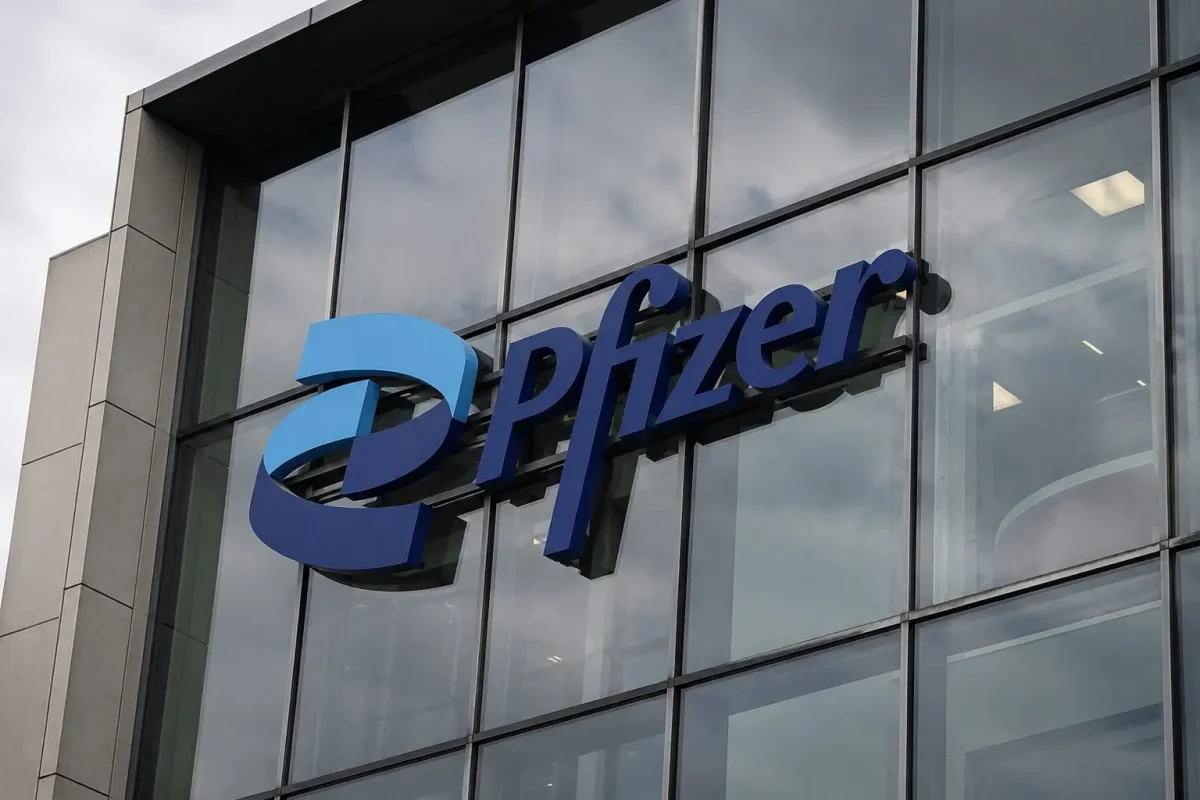
Pfizer Inc (NYSE:PFE) shares continue to trade near the lows of last week's selloff, as investors digest the implications of Chief Financial Officer Dave Denton's planned departure and await concrete signs of a growth catalyst. The stock was last quoted at $25.21 ahead of Monday's regular session on the New York Stock Exchange, following a 70-cent decline on Thursday that erased approximately $4 billion in market capitalization.
The selloff was triggered by the announcement that Denton will step down on August 15 to take a role in the consumer goods sector. Cecile Guegan, currently senior vice president of finance for Pfizer's global biopharmaceutical business, will assume the role of interim CFO on August 16 as the company conducts a search for a permanent successor. CEO Albert Bourla praised Denton as a 'steady and trusted steward' and expressed confidence in Guegan's ability to lead the finance team.
Scotiabank analyst Louise Chen noted that the departure raises questions about Pfizer's 2026 financial forecast, succession planning, and the timing of the move as the company prepares to enter the competitive obesity drug market. The stock's decline on Thursday, which brought it to $25.10, reflects a valuation of approximately 8.7 times the midpoint of Pfizer's 2026 adjusted earnings per share guidance of $2.80 to $3.00.
The market's reaction suggests investors are applying an execution discount to Pfizer shares, viewing the CFO exit as a potential risk to the company's strategic initiatives rather than a routine personnel change. Pfizer's market value stands at roughly $144.5 billion based on its 5.74 billion share count assumption for 2026.
Growth Strategy Under Scrutiny
Pfizer's 2026 revenue guidance ranges from $59.5 billion to $62.5 billion, but the company faces headwinds from declining COVID-19 product sales, expected to drop by about $1.5 billion from 2025 levels, and another $1.5 billion hit from loss of exclusivity on certain drugs. These factors underscore the urgency for Pfizer to demonstrate growth from its pipeline, particularly in the obesity drug space.
CEO Albert Bourla told Reuters in May that Pfizer was surprised by the size of the international weight-loss market following Eli Lilly's (NYSE:LLY) recent report. Pfizer is seeking to establish a foothold in this space after acquiring Metsera, while Lilly already has significant scale. Aamir Malik, Pfizer's U.S. commercial chief, highlighted that the company has 'unique capabilities' and already works with nearly 60% of doctors who are likely to prescribe obesity medications.
Analyst Views and Market Context
Wall Street analysts remain cautious but not dismissive of Pfizer's story. J.P. Morgan's Chris Schott indicated in May that investors require more clinical data and lower pipeline risk before sentiment can improve. RBC Capital's Trung Huynh characterized Pfizer as a 'catalyst story, not an earnings story,' suggesting that near-term financial results may not drive the stock. Citi's Geoff Meacham pointed to 22% growth in newly launched and acquired products as evidence that the commercial portfolio could help offset COVID-related revenue declines.
Broader market conditions provided little support for Pfizer shares. U.S. stock index futures were muted early Monday following the Juneteenth holiday on Friday, with investors monitoring U.S.-Iran talks and Thursday's release of the Personal Consumption Expenditures (PCE) price index, the Federal Reserve's preferred inflation measure. This context makes Pfizer's decline appear company-specific rather than part of a broader market weakness.
Risks Ahead
The key risks for Pfizer include disappointing clinical data for its obesity drug candidates, slower-than-expected scaling of recently acquired cancer and migraine assets, or a prolonged search for a permanent CFO that extends into budget season. If these risks materialize, Pfizer's already low earnings multiple may remain compressed. While a higher dividend yield can provide some support for the stock in the near term, it does not address the fundamental question of whether post-COVID Pfizer can return to sustainable growth.