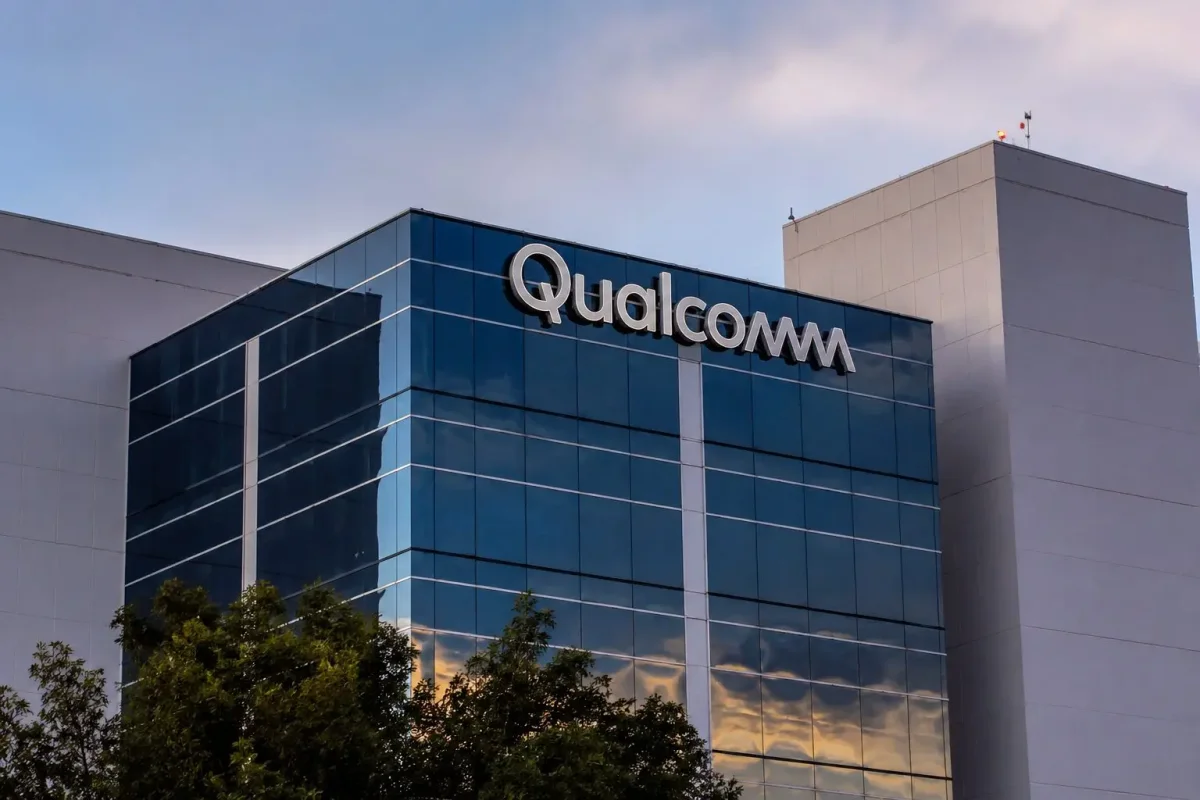
Shares of Qualcomm (NASDAQ: QCOM) surged more than 12% in after-hours trading on Wednesday following the company's investor day, where it unveiled ambitious revenue targets for its data center and non-handset chip businesses. The move came after the stock closed the regular session at $197.41, down 3.3% and just below the $197.50 average analyst price target tracked by MarketWatch.
Qualcomm now expects data center revenue to exceed $15 billion by fiscal 2029, a significant jump from prior forecasts. The company also raised its non-handset chip revenue goal to $40 billion by the same year, nearly double its earlier target. On a non-GAAP basis, Qualcomm guided for earnings per share above $18 in fiscal 2029.
The bullish outlook was bolstered by news that Microsoft (NASDAQ: MSFT) will use Qualcomm's new High Bandwidth Compute (HBC) chips, designed to deliver higher data throughput with lower power consumption. Separately, Meta Platforms (NASDAQ: META) announced it will deploy Qualcomm's Dragonfly C1000 CPU in its next-generation AI data center servers, with production slated to begin in the second half of 2028. Qualcomm also disclosed it has secured two additional hyperscaler customers for custom chips, with revenue from those deals expected before the end of the current fiscal year.
Qualcomm CFO Akash Palkhiwala told investors that the company aims to be "truly diversified," projecting the data center segment alone to reach $5 billion in fiscal 2027, with $1 billion coming from new custom-chip clients. The company's data center lead, Tony Pialis, noted that hyperscale customers are actively pulling Qualcomm into their supply chains, rather than the company having to push its way in.
The after-hours rally erased the regular-session losses, which had wiped out about $7.2 billion in market value. At a 12% gain, Qualcomm shares would trade above $221, surpassing the average analyst target and approaching levels expected by more bullish analysts. The stock currently carries a Hold consensus rating from the 39 analysts tracked by MarketWatch.
Qualcomm also provided updates on its acquisition of Modular, an AI software firm. The company plans to issue up to 19.2 million shares to complete the deal, valued at roughly $3.92 billion based on Tuesday's closing price. Modular's inference software is designed to run AI models efficiently across CPUs, GPUs, NPUs, and custom ASIC architectures, a move that analysts say could help Qualcomm carve out a niche in the data center market dominated by Nvidia's CUDA platform.
While Qualcomm is taking aim at Nvidia's (NASDAQ: NVDA) stronghold on AI software and chips, it acknowledges it cannot win on all fronts. Nvidia remains the leader in AI accelerators and software, while Broadcom (NASDAQ: AVGO) has become a major player in custom AI chips. Qualcomm is differentiating itself by focusing on power-efficient solutions, claiming its HBC technology will deliver six times the bandwidth per watt compared to competing high-bandwidth memory solutions.
However, timing and proof points remain key challenges. Qualcomm's HBC Gen 1 chips are expected to sample in mid-2027, with the Dragonfly AI300 accelerator arriving in 2028. Meta's CPU program will not begin production until the second half of 2028. Bank of America analysts had cautioned ahead of investor day that Qualcomm is re-entering a crowded AI sector where Nvidia, Cerebras, and custom chips from Amazon and Google are already well established.