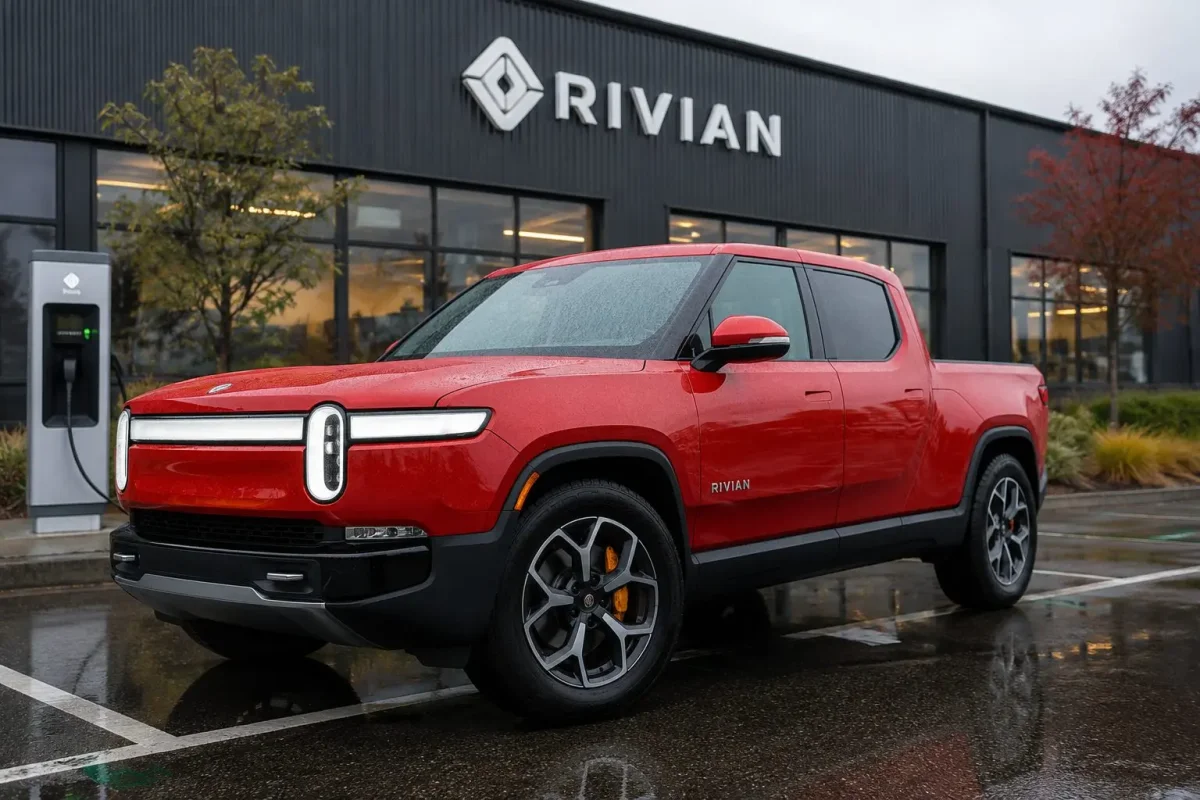
Rivian Automotive (NASDAQ: RIVN) closed the holiday-shortened week at $18.63, surging 8.44% after the electric vehicle maker reported second-quarter deliveries that exceeded its own expectations and raised its full-year delivery guidance. The stock gained $1.45 on July 2, adding approximately $1.83 billion to the company's market capitalization based on its 1.26 billion outstanding shares.
The Nasdaq Composite slipped 0.8% during the session, while Rivian's rally stood out among EV peers. Tesla (NASDAQ: TSLA) fell 7.5% despite a delivery beat, and Lucid Group (NASDAQ: LCID) dropped 8.3% as pressure on the EV sector persisted. Rivian traded 78.27 million shares, more than 2.6 times its 65-day average volume.
Q2 Deliveries Beat Guidance
Rivian reported it built 12,613 vehicles and delivered 12,194 in the second quarter, surpassing its own forecast of 9,000 to 11,000 deliveries. The company attributed the outperformance to quarter-over-quarter growth in its EDV and R1 vehicle lines, as well as the start of R2 shipments. This marks a significant improvement from the first quarter, when Rivian delivered 10,365 vehicles.
The company also raised its full-year 2026 delivery guidance to a range of 65,000 to 70,000 vehicles, up from the previous range of 62,000 to 67,000. The midpoint of the new guidance stands at 67,500 deliveries, an increase of 3,000 vehicles from the old midpoint of 64,500. With first-half deliveries totaling 22,559 vehicles, Rivian now needs to deliver between 42,441 and 47,441 units in the second half to meet its targets. That equates to an average of roughly 22,471 vehicles per quarter in the back half of the year, nearly 84% higher than the Q2 output.
Market Reaction and Valuation Math
The market's response to the guidance raise was dramatic. The $1.83 billion increase in market cap for an additional 3,000 vehicles in the midpoint works out to approximately $609,000 in added market value per vehicle in the updated forecast. While a rough calculation, it underscores the premium investors are placing on Rivian's growth narrative, particularly around the R2 platform.
Shares gained 19.2% in the holiday-shortened week, climbing from $15.63 at the June 26 close to $18.63 on July 2. The rally sets the stage for a key test as trading resumes after a three-day U.S. market break for Independence Day. The Nasdaq was closed on July 3 and remained shut on July 4 for the federal holiday. Regular Nasdaq trading hours are 9:30 a.m. to 4 p.m. Eastern on weekdays.
Analyst Outlook and Earnings Expectations
Barron's reported that Cantor's Andres Sheppard maintained a Hold rating on Rivian with a $19 price target. In his note, Sheppard suggested that the R2 could "materially boost sales" due to its pricing and autonomous driving features. However, he cautioned that the stock's current valuation already reflects much of the optimism.
Rivian continues to report negative earnings, with trailing earnings per share of negative $2.92, leaving no trailing price-to-earnings ratio. The company's market cap stands at roughly $23.48 billion. Investors are betting on future growth and margin expansion from the R2 platform before profitability is proven.
Looking Ahead
The next major catalyst for Rivian is its second-quarter earnings report, scheduled for July 30 after the market close, followed by a webcast at 5 p.m. ET. Traders will be watching closely to see if the stock can hold its July 2 gains and whether the company can execute on its ambitious second-half delivery targets. The second-half goal remains daunting: Rivian must nearly double its first-half delivery pace to hit the midpoint of its revised guidance.