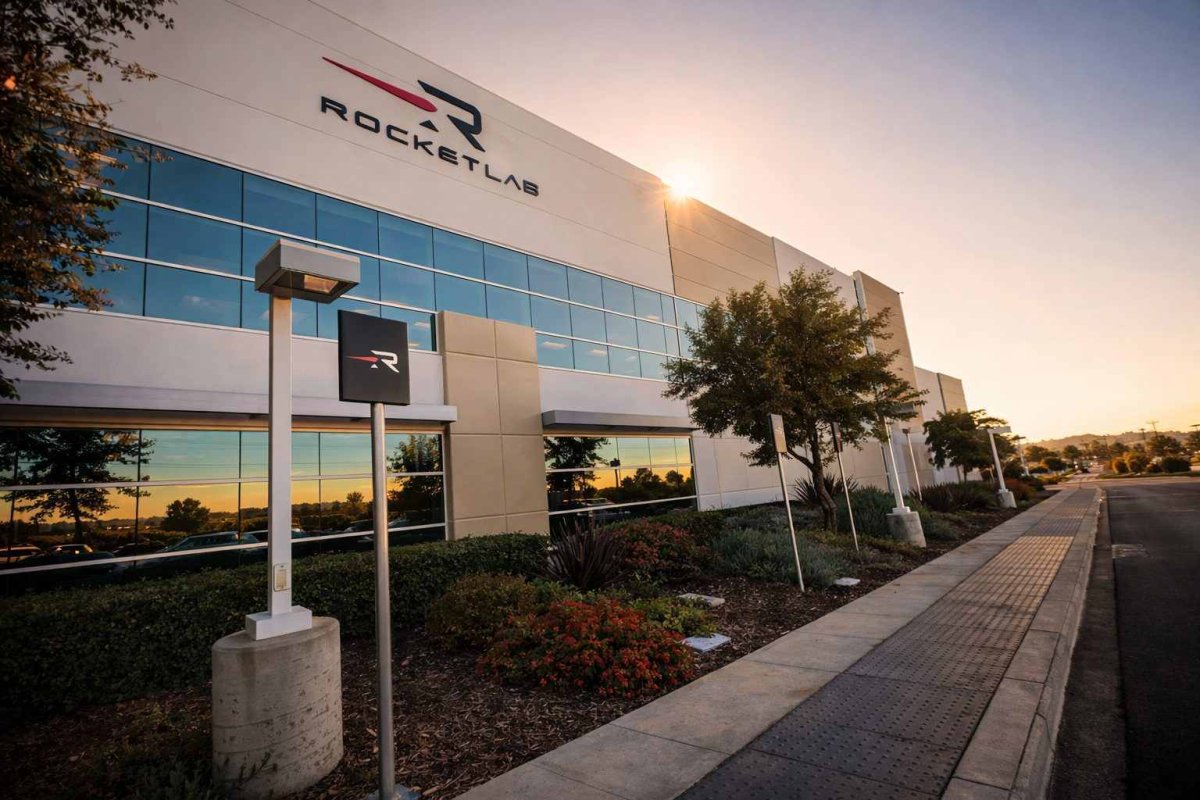
Shares of Rocket Lab experienced a significant uptick on Thursday, rising approximately 9% in morning trading to $80.39 by 11:30 a.m. EDT. The surge follows two key strategic announcements from the aerospace company this week, which analysts suggest could mark an inflection point for the stock after a recent period of volatility.
Strategic Moves Broaden Business Scope
The company confirmed the official closure of its $155.3 million acquisition of Mynaric, a specialist in laser communication terminals. This technology is critical for enabling high-speed data transfer between satellites, addressing a known bottleneck in the growing satellite constellation market. Rocket Lab CEO Peter Beck emphasized the strategic importance, stating, "that changes today," in reference to persistent industry shortages of such laser links. Mynaric is already a supplier for Rocket Lab's $1.3 billion in prime contracts with the Space Development Agency, covering 36 satellites.
Concurrently, Rocket Lab unveiled Gauss, a new Hall-effect electric thruster designed for satellite maneuvering and orbital station-keeping. The company has established a production line with an annual capacity for over 200 units. Beck positioned Gauss as a solution to a key industry bottleneck, enhancing Rocket Lab's value proposition as a provider of complete spacecraft solutions beyond its core launch business.
Financial Backdrop and Competitive Pressure
The positive market reaction comes despite recent challenges. In January, a tank test failure pushed the inaugural launch of Rocket Lab's larger Neutron medium-lift rocket to the fourth quarter of 2026. The company acknowledged "risk and uncertainty" associated with the new vehicle in a March prospectus. To bolster its balance sheet, Rocket Lab conducted an at-the-market stock offering, which it concluded on April 8.
However, the company's fundamental metrics remain strong. In February, Rocket Lab reported record 2025 revenue of $602 million and a substantial backlog of signed contracts worth $1.85 billion. For the first quarter of 2026, management projects revenue between $185 million and $200 million. The company also announced it has booked three additional dedicated Electron launches for Japanese firm iQPS, bringing the total missions under that contract to 15, with the next flight scheduled no earlier than May 2026.
Analyst Sentiment Shifts Bullish
Wall Street's perspective on Rocket Lab appears to be improving. On April 7, Citizens analyst Trevor Walsh upgraded the stock to Outperform with an $85 price target. Walsh cited the company's expanding launch business, its work in defense space systems, and a "clearer path toward higher-value" services, concluding the risk-reward balance is now "meaningfully in Rocket Lab’s favor." This followed Cantor Fitzgerald's recent reaffirmation of its Overweight rating and $85 price target earlier in the week.
Financial commentary platforms have taken note of the shift. MarketBeat highlighted the stock as reaching a pivotal moment, while a Seeking Alpha piece earlier in the week characterized a recent price drop as a buying opportunity.
Market Context and Competitive Landscape
Rocket Lab's strategic push to become a comprehensive space systems provider comes at a time of intensifying competition. Sector giant SpaceX is preparing for a potential record-breaking IPO roadshow in June. Meanwhile, Blue Origin is gearing up for a pivotal third flight of its New Glenn rocket this Friday, a test focused on reusability that could challenge the dominance of SpaceX's Falcon 9.
For Rocket Lab, the successful and timely development of the Neutron rocket remains a critical long-term swing factor. Further delays could impact the schedule investors are currently anticipating. Nonetheless, Thursday's share price movement indicates traders are weighing whether the company's recent strategic advancements have established a firm foundation for growth, potentially signaling a bottom after its recent slide.