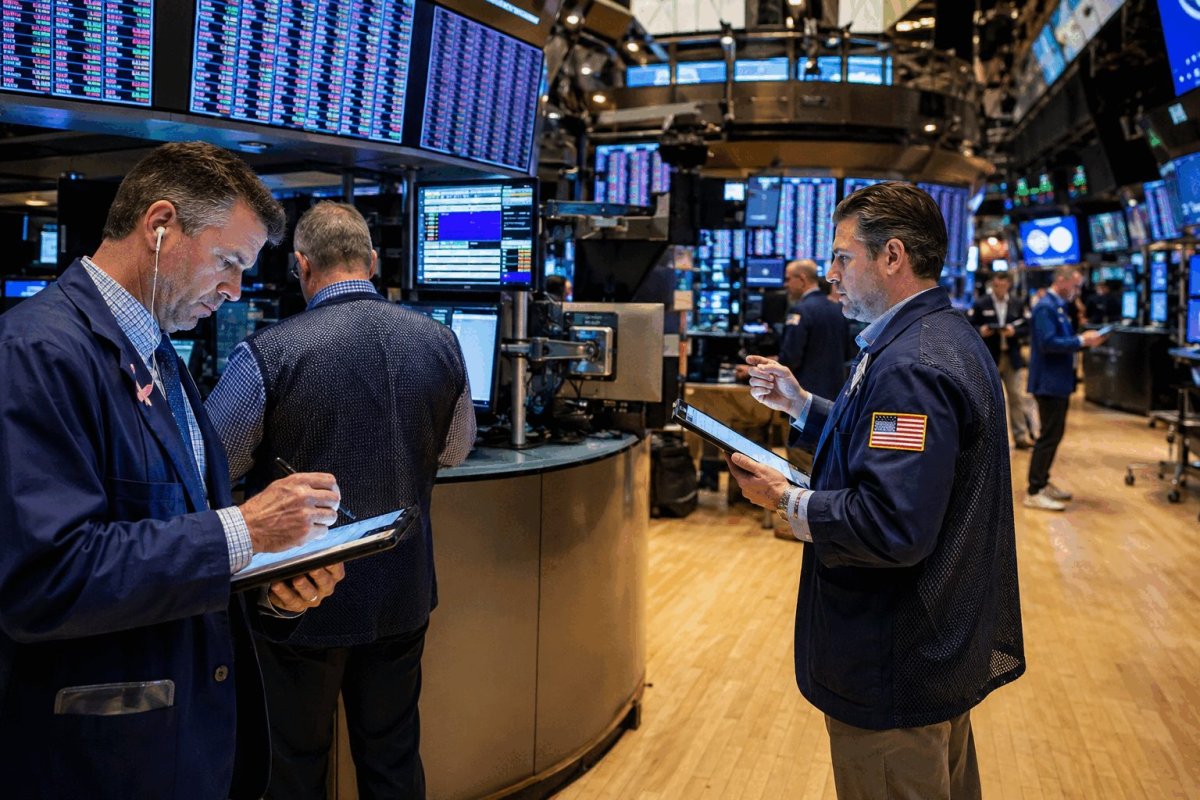
The S&P 500 (INDEXSP:.INX) edged lower by 0.11% to 7,749.24 in late trading on Monday, even as options market sentiment reached its most bullish level in at least four years. The average daily call-to-put ratio over the past month touched 0.9, a reading not seen since 2022, according to data compiled by Reuters and Google Finance.
The index had surged 5.8% over the four trading sessions ending August 4, a rally that surpassed the entire trading range of the previous three months. That rapid advance has left many investors scrambling for upside exposure, but it has also narrowed the room for further gains, with JPMorgan's new 8,000 target representing just a 3.2% potential upside from Monday's close.
Market Snapshot
Late in the session, the Dow Jones Industrial Average (INDEXDJX:.DJI) was off 0.25% at 53,903.90, while the Nasdaq Composite (INDEXNASDAQ:.IXIC) fell 0.45% to 26,569.91. The CBOE Volatility Index (INDEXCBOE:VIX) rose 3.36% to 15.40, a notable divergence as equities declined while volatility climbed.
The previous three-month trading range for the S&P 500 was just 5.7%, which is 54.4% tighter than the 12.5% rolling 20-year average. That compression set the stage for the explosive four-day rally, which equaled 101.8% of the prior quarter's entire range. The move was so sharp that on August 4 alone, the index advanced nearly 2% while the VIX also climbed almost a point, a rare occurrence of both stocks and volatility rising together.
Options Positioning Highlights FOMO
The elevated call-to-put ratio reflects a significant appetite for upside exposure, but it also suggests that many investors are buying calls to hedge against missing further gains rather than expecting a repeat of the recent surge. Mark Hackett, chief market strategist at Nationwide, told Reuters, "There are several factors, but FOMO is a part of it."
Short-term S&P 500 call skew has increased sharply over the past week, reaching its highest level in two years, according to Susquehanna Financial Group. This indicates that participants are paying a premium for quick upside. Meanwhile, the Bullish Percent Index stands above 70%, exceeding the overbought threshold, which signals that the rally is broad but potentially extended.
Steve Sosnick, chief strategist at Interactive Brokers Group (NASDAQ:IBKR), commented, "FOMO never left. It just wasn’t in the forefront of the market."
Wall Street Targets and Earnings Forecasts
JPMorgan Chase & Co. (NYSE:JPM) raised its 2026 S&P 500 target to 8,000 from 7,800, while RBC Capital Markets (NYSE:RY) and Citigroup Inc. (NYSE:C) have targets of 7,900 and 8,100, respectively. At Monday's close, these targets imply upside of 1.9% to 4.5%, a stark contrast to the 5.8% gain already achieved in just four days.
JPMorgan also lifted its 2026 S&P 500 earnings forecast to $365 per share from $350, and its 2027 projection to $420 from $390, while maintaining a forward price-to-earnings multiple estimate of around 20. These fundamentals remain supportive, but the risk of a crowded exit is growing.
Risks Ahead
An uptick in inflation, fresh oil market strain, or disappointing earnings could prompt call buyers to unwind their positions, accelerating a sell-off. With the Bullish Percent Index above 70%, any decline in market breadth would increase reliance on a handful of large-cap stocks to sustain the rally.
The next key catalyst is the July consumer price index, due Wednesday. Economists polled by Reuters expect annual inflation to ease to 3.4% from 3.5% in June. A hotter-than-expected reading would challenge the sustainability of the four-year high in bullish options demand, suggesting it may be a sign of late-cycle buying rather than a durable trend.