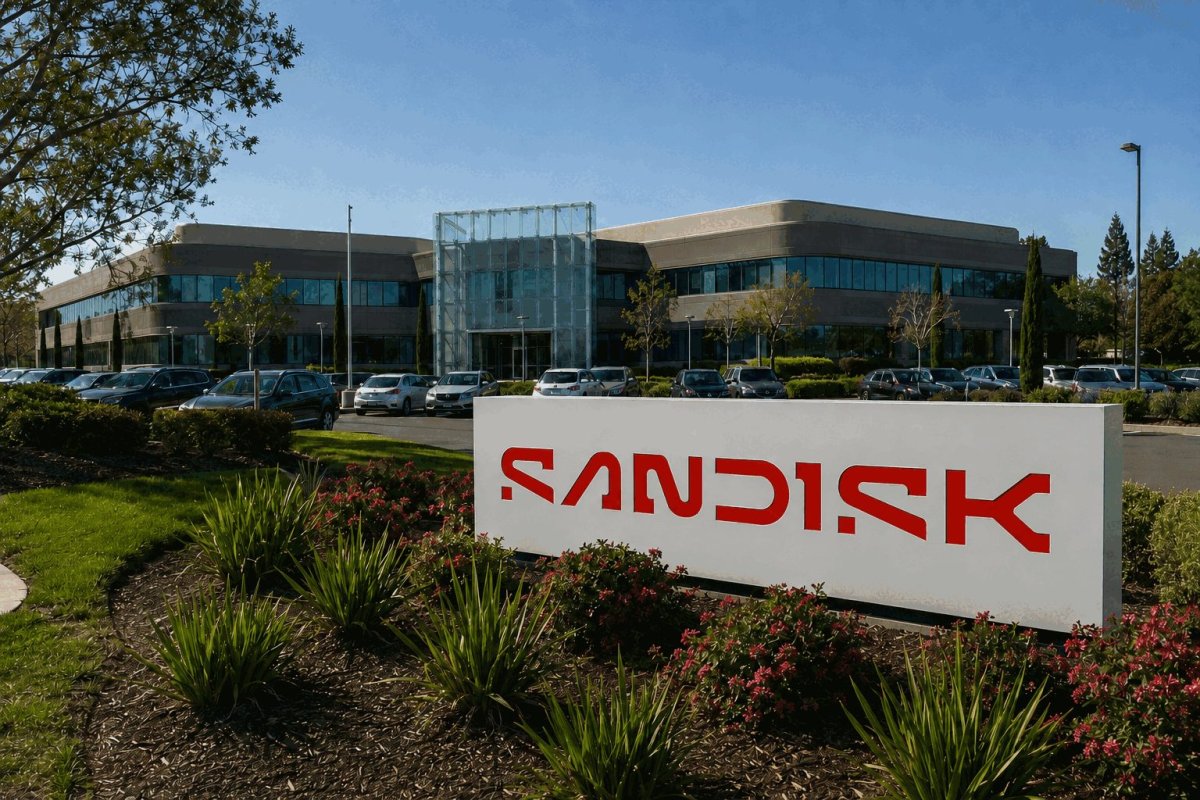
Sandisk Corporation (NASDAQ: SNDK) experienced a sharp decline on Monday, with shares falling 7.27% to $1,480 during the opening session. The drop, which erased approximately $17 billion in equity value, came amid growing investor anxiety over the company's AI-driven valuation and fresh risks to its key Apple supply relationship, as well as potential headwinds in the Chinese memory market.
The selloff reversed much of last week's policy-driven rally, triggered by reports suggesting that Apple Inc. (NASDAQ: AAPL) may be permitted to source DRAM chips from China's CXMT and NAND flash memory from YMTC. Such a move would restore a supply line that Commerce Secretary Howard Lutnick had publicly opposed as recently as last week, although no formal sourcing agreement has been announced.
Sandisk's decline was steeper than that of its storage peers, indicating that investors were specifically targeting NAND pricing risk rather than a broader tech selloff. Micron Technology (NASDAQ: MU) fell 6.11%, Western Digital (NASDAQ: WDC) dropped 5.56%, and Seagate Technology (NASDAQ: STX) slid 6.68% during intraday trading on August 24, 2026.
Despite the significant drop, Sandisk's stock rebounded 4.48% from its session low of $1,416.56, suggesting some buying interest at lower levels. However, the stock remained among the steepest fallers in the memory sector, with trading volume elevated on the Nasdaq.
KC Rajkumar from Lynx Equity Research described the selloff as an "overreaction," noting that current qualification gaps and constrained capacity reduce the immediate risk posed by Chinese suppliers. However, the policy landscape remains uncertain, with Apple reportedly seeking Washington's approval to purchase CXMT chips amid rising memory prices that are pressuring product margins.
Earnings Strength and Contract Backlog
Sandisk's financial fundamentals remain robust. In the fiscal fourth quarter, the company reported revenue of $8.965 billion, up 51% from the previous quarter, with gross margin expanding to 84.6%. Datacenter revenue surged 103% quarter-over-quarter to $2.977 billion. For fiscal Q1 2027, the company guides revenue between $10.3 billion and $10.8 billion, with adjusted EPS in the range of $44 to $46.
Management has taken steps to mitigate the industry's historical boom-bust cycles. Eight separate negotiated business structures account for approximately half of bit shipments projected for fiscal 2027 and nearly two-thirds for fiscal 2028. These agreements feature mechanisms for both volume and pricing, providing some stability.
Chief Financial Officer Luis Visoso reiterated the company's commitment to returning "100 percent of excess cash" to shareholders after investing in the business. Sandisk targets annual revenue growth in the mid-to-high-teens range between fiscal 2028 and 2030.
Analyst Views and Market Outlook
Wall Street maintains a generally bullish stance on Sandisk, though price targets vary widely. The consensus price target from 24 analysts stands at $2,126.17, implying a potential gain of 43.66% from Monday's close. Recent recommendations range from Bernstein SocGen's Buy rating with a $3,000 target to Hold ratings from RBC Capital and Wells Fargo at $1,600 and $1,550, respectively.
The key risk factors include the possibility that Chinese suppliers could qualify sooner, expand capacity, or offer lower contract pricing. A broader slowdown in AI spending could also dampen demand. Sandisk's contracts help reduce volume risk, though they may not shield all products or customers from a decline in NAND prices.
Investors are closely watching whether Sandisk can hold above Monday's low of $1,416.56. A close below that level would nullify the day's recovery. Confirmation that Apple has secured Chinese supply would shift market focus from policy developments to contract prices and client risk.