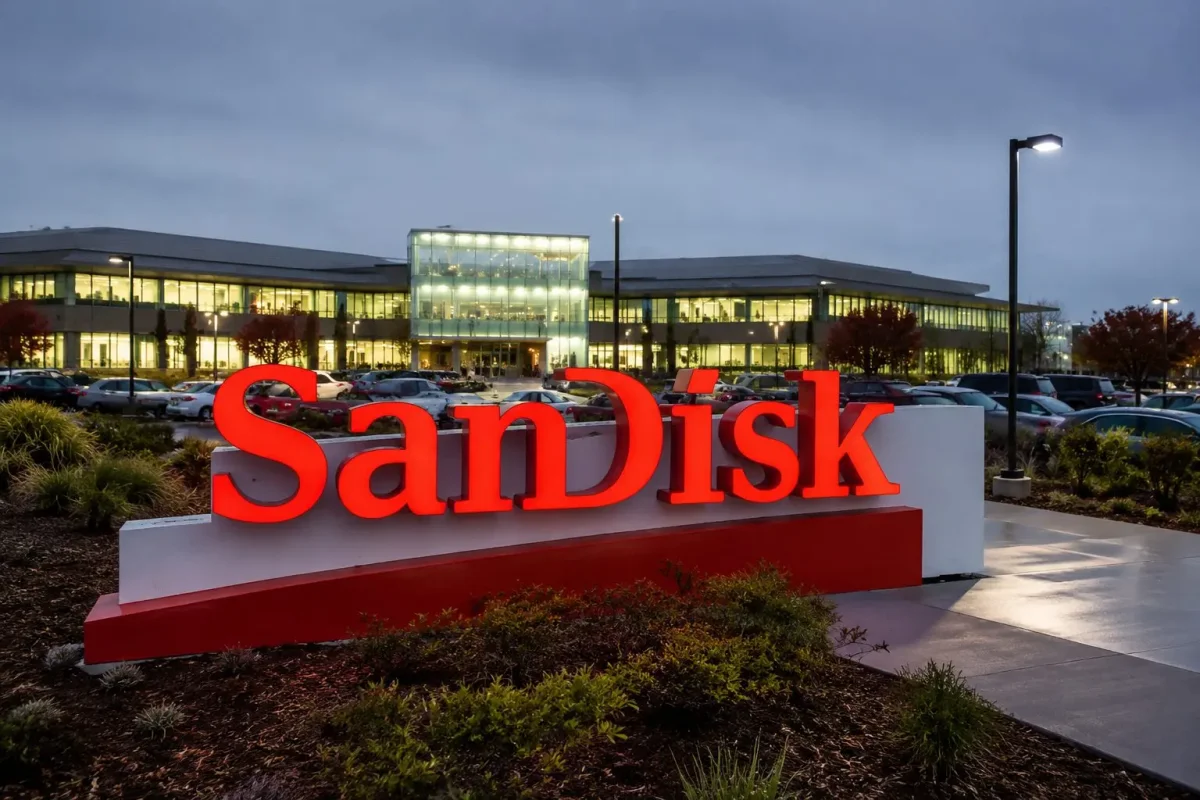
SanDisk Corporation (NASDAQ: SNDK) experienced a significant after-hours rally on Wednesday, with shares climbing 9.5% to $2,097, after peer Micron Technology (NASDAQ: MU) issued a robust fourth-quarter forecast. The move came after the stock closed regular trading down 2.5% at $1,914.46, adding to a year-to-date gain of over 706% and a 12-month surge of nearly 3,952%.
The after-hours action was triggered by Micron's Q4 revenue guidance of $50 billion, which exceeded analyst expectations and pushed memory-sector stocks higher. Micron itself jumped more than 15% in extended trading. The bullish sentiment from Micron, which derives about 61% of its revenue from cloud memory and core data-center operations, has reignited investor interest in SanDisk, but the comparison highlights a key divergence.
Data-Center Revenue Mix Under Scrutiny
SanDisk's most recent fiscal third-quarter results revealed a revenue mix that differs sharply from Micron's. Data-center revenue accounted for just 25% of SanDisk's total $5.95 billion in Q3 sales, while edge computing contributed 62% and the consumer segment made up the remaining 13%. This composition matters for investors who view SanDisk as a pure-play AI data-center beneficiary. With a market capitalization of $291 billion, the company's valuation hinges on whether its data-center segment can accelerate growth enough to justify the premium.
Micron's Q3 results showed data-center-related revenue of $25.29 billion out of total sales of $41.46 billion, or about 61% of the total. The company's Q4 guidance of $50 billion in revenue represents a 21% sequential increase, underscoring its stronger exposure to the AI-driven memory demand cycle.
SanDisk's Growth Trajectory
SanDisk's Q4 guidance calls for revenue between $7.75 billion and $8.25 billion, with non-GAAP earnings per share of $30 to $33. The midpoint of that range implies a 34% sequential revenue jump from Q3. At Wednesday's closing price, the stock trades at just over nine times annualized Q4 guided sales. Bulls argue that earnings estimates are catching up to the stock's performance. According to Motley Fool analyst Keithen Drury, Wall Street projects SanDisk revenue to grow 122% in fiscal 2027, with EPS rising to $183.05 from $65.45 in fiscal 2026. At the close, the stock traded at roughly 10.5 times that 2027 EPS estimate.
Seeking Alpha contributor Danil Sereda, who holds a long position in SanDisk, sees more than 57% upside to $3,089 per share, citing strong demand, long-term contracts, and a high-margin business transition.
Market Volatility and Bearish Concerns
Despite the positive momentum, SanDisk's stock has been volatile. On Tuesday, the shares fell 13%, their biggest one-day drop since February, as a sell-off in South Korean chip stocks dragged down memory names including Micron and Western Digital (NASDAQ: WDC). Traders note that the bear case is not about weak demand but rather about volatility inherent in the sector.
Futurum Group CEO Daniel Newman commented, “The size and scale of the AI buildout has been underestimated at every turn,” adding that memory pricing is likely to remain strong as long as supply stays tight. Micron CEO Sanjay Mehrotra, in prepared remarks, indicated that tight supply conditions could persist beyond calendar 2027. SanDisk CEO David Goeckeler emphasized on the last earnings call that the company is shifting to “the highest-value end markets, led by Datacenter,” with a focus on multi-year customer engagements backed by firm financial commitments.
SanDisk is scheduled to report its fiscal fourth-quarter results in August. Investors will be closely watching whether data-center revenue growth can outpace the stock's recent surge and validate its lofty valuation.