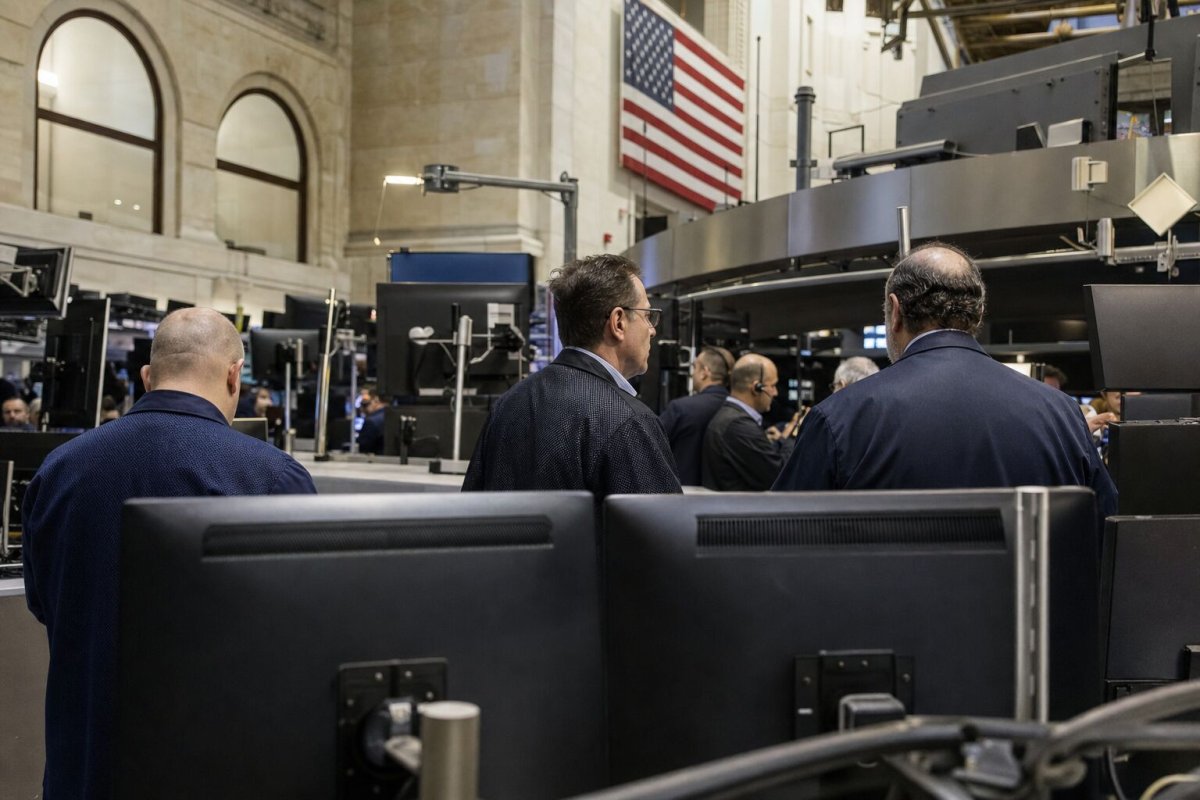
Small-cap equities took the lead on Wall Street during Wednesday's session, as crude oil prices steadied near the $91-per-barrel mark and Treasury yields showed signs of stabilization. At 1:00 p.m. EDT, the Russell 2000 index had climbed 0.93%, comfortably outpacing the S&P 500's 0.45% gain. The advance was broad-based, with advancers outnumbering decliners by a ratio of 1.64-to-1 on the Nasdaq, and advancing share volume running 2.26 times that of declining shares.
The market's recovery comes after two consecutive down days, during which the S&P 500 fell 0.7% and the Nasdaq slipped 1.0% on Tuesday. That selloff was driven by a sharp 4.6% surge in Brent crude and a rise in the 10-year Treasury yield to 4.79%. Wednesday's more benign energy and rates backdrop encouraged investors to rotate into smaller names, a classic risk-on signal that suggests confidence in the durability of the economic expansion.
Fresh employment data reinforced the view of a moderating labor market. ADP reported that private-sector payrolls increased by just 38,000 in August, the slowest gain since January, with the manufacturing sector shedding 17,000 jobs. While a softer jobs number might ordinarily worry investors, in this context it eased concerns about overheating and supported the case for a patient Federal Reserve.
Sector leadership was notably broad. Communication services led the way with a 1.88% gain, followed by materials, which rose 1.69%. Health care added 0.78%. On the downside, real estate slipped 0.78% and technology edged lower by 0.19%, reflecting a cautious stance toward rate-sensitive and high-valuation segments. The divergence between small caps and large caps was evident in the hourly data, with the Russell 2000 holding steady while the S&P 500, Dow, and Nasdaq each gave back roughly 0.12% to 0.14% in the last hour.
Earnings news drove outsized moves in individual stocks. Dell Technologies (NYSE: DELL) surged 7.5% after disclosing an AI-server backlog of $95 billion, a figure that underscored robust demand for its infrastructure products. Nvidia (NASDAQ: NVDA) climbed 4.3%, benefiting from the same AI enthusiasm. GitLab (NASDAQ: GTLB) jumped 12.2% following a 21% increase in quarterly revenue, with CEO Bill Staples calling it "an exceptional quarter" highlighted by all-time high gross bookings.
However, not all earnings were rewarded. Credo Technology (NASDAQ: CRDO) plummeted 19.5% despite a 115% surge in revenue, as investors focused on margin pressures or valuation concerns. MongoDB (NASDAQ: MDB) fell 12.2% even after reporting a 30% increase in sales and raising its annual guidance. The contrasting reactions highlight a market that is increasingly selective, rewarding companies with strong order visibility and penalizing those whose growth may be less sustainable.
The behavior of crude oil remains a key risk factor. WTI crude was trading at $91.00 a barrel, up from $90.61 earlier in the day, while the 10-year Treasury yield hovered near 4.80%. Any further escalation in energy prices or a renewed spike in yields could quickly reverse the broadening trend seen today. Investors are also keeping an eye on upcoming economic data and Fed commentary for clues about the path of interest rates.
Despite the positive tone, the slowdown in large-cap momentum during the last hour suggests that buyers may be losing conviction at the index level. The fact that small caps continue to lead, however, indicates that risk appetite remains intact. For now, the market appears to be in a sweet spot: stable oil prices, moderating inflation pressures, and a labor market that is cooling without collapsing. Whether that balance holds will depend on the data in the weeks ahead.