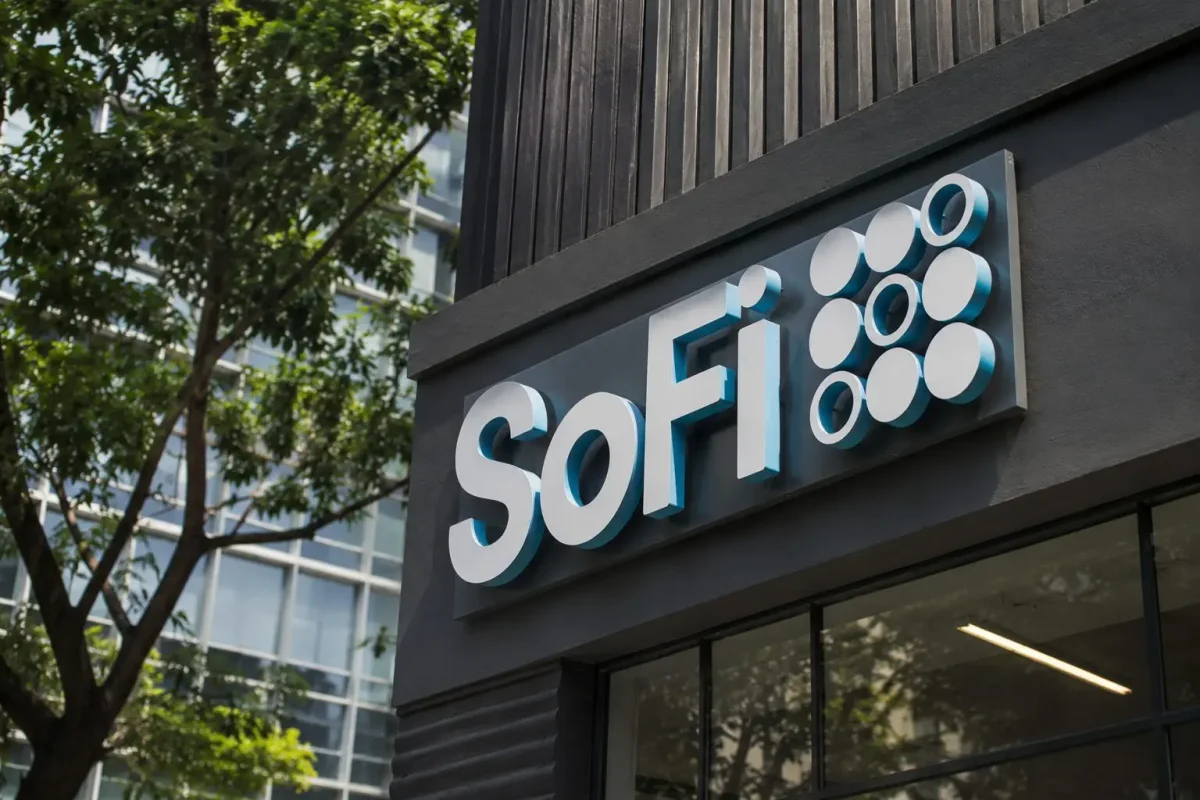
SoFi Technologies Inc. (NASDAQ: SOFI) saw its shares rebound on Thursday, climbing back toward the $16 mark after a sharp decline in the previous session. The stock traded at $15.95 in late morning trading, up approximately 8 cents, after reaching an intraday high of $16.32. Volume exceeded 22 million shares, with the day's range spanning from $15.67 to $16.32.
The bounce came after a volatile Wednesday session when SoFi shares tumbled 3.6% to close at $15.87. Trading volume on that day surged to 85.4 million shares, well above the typical 65.7 million average. The stock had closed at $16.47 on Tuesday before the sell-off.
The broader market provided a tailwind for SoFi as major indices turned positive Thursday morning. The Dow Jones Industrial Average gained 0.90%, the S&P 500 rose 0.81%, and the Nasdaq Composite advanced 1.07% as of 9:56 a.m. ET, according to Reuters. Technology shares led the rebound, benefiting from bargain hunting despite lingering concerns over producer prices and geopolitical tensions in the Middle East.
Exchange-traded funds reflected the risk-on sentiment. The Invesco QQQ Trust (QQQ), which tracks the Nasdaq-100, climbed roughly 1.1%, while the SPDR S&P 500 ETF Trust (SPY) added about 0.3%. The SPDR Dow Jones Industrial Average ETF (DIA) moved up approximately 0.6%.
SoFi remains a high-beta stock, with a beta of 2.14, according to Google Finance. Its price-to-earnings ratio stands at 36.12, and its market capitalization is approximately $20.33 billion. Over the past 52 weeks, the stock has traded between $13.97 and $32.73, still well below its high.
Recent product launches have reignited investor interest in SoFi's long-term fintech strategy. On June 2, the company introduced SoFi Coach, an AI-powered chat tool for personalized financial insights, initially rolling it out to SoFi Plus members. Additionally, on May 27, SoFi launched SoFiUSD, a U.S. dollar stablecoin, allowing members to buy, sell, hold, and convert the digital asset within the SoFi app. CEO Anthony Noto stated, "People no longer have to choose between blockchain technology and regulated banking products."
The company's first-quarter financial results continue to underpin the stock's narrative. SoFi reported GAAP net revenue of $1.1 billion, a 43% year-over-year increase. Adjusted net revenue came in at $1.087 billion, with adjusted EBITDA reaching $339.9 million and net income hitting $166.7 million. Noto described the quarter as "excellent." Member and product growth remained robust, with 1.055 million new members added in Q1, bringing total membership to 14.7 million. Total products climbed to nearly 22.2 million, and loan originations hit a record $12.2 billion, including $8.3 billion in personal loans, $2.6 billion in student loans, and $1.2 billion in home loans.
Analyst sentiment remains mixed. Over the past three months, 18 analysts have provided ratings, with a consensus of Hold, comprising 6 Buy, 9 Hold, and 3 Sell ratings. Price targets for the next 12 months range from $16.00 to $30.00, with an average target of $20.87.
As traders monitor whether SoFi can sustain levels above the $15.87 close from Wednesday, the stock continues to trade far from its 52-week high of $32.73. Investors are balancing the company's operational growth against concerns over valuation, credit cycles, and broader market risks.