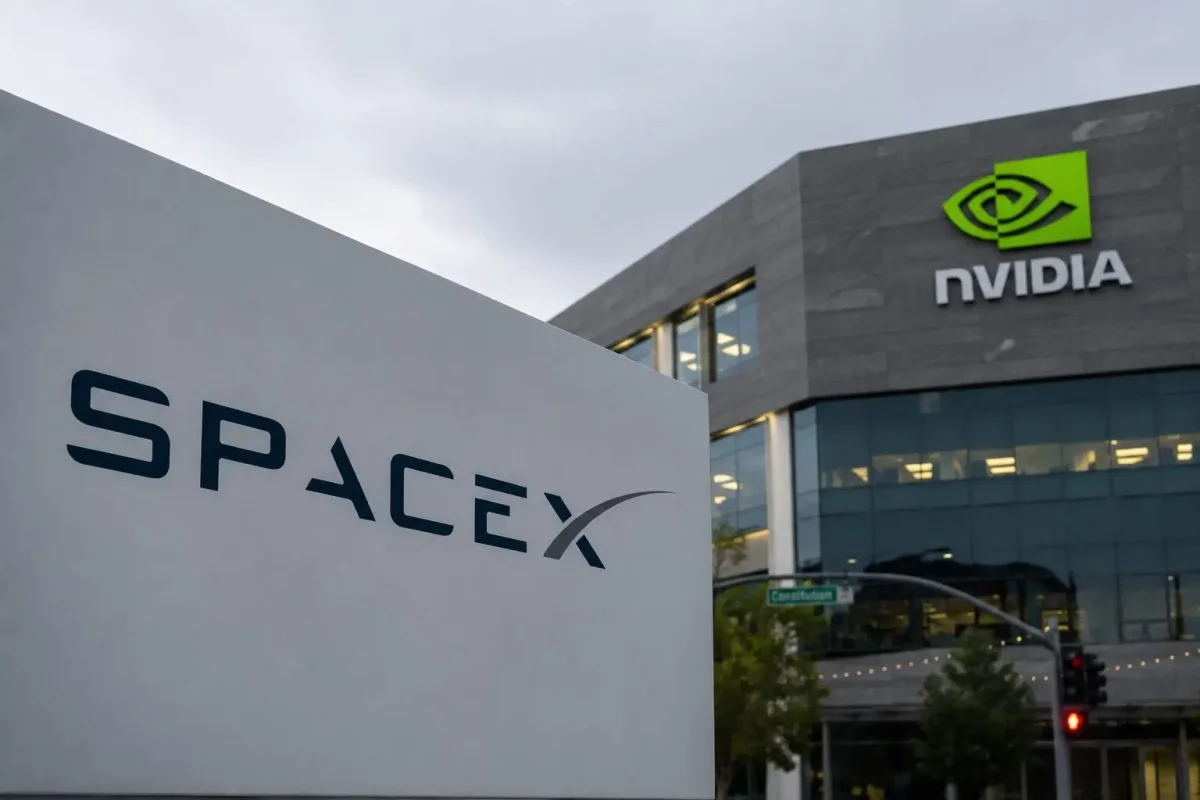
SpaceX shares ended Thursday at $185, down 3.6% from the prior close, as profit-taking and concerns over its exclusion from the Nasdaq-100 weighed on the stock. Meanwhile, Nvidia continued its upward trajectory, gaining 3% to $210.69, further widening the valuation gap between the two tech heavyweights.
Nvidia's market capitalization now stands at approximately $5.14 trillion, more than double SpaceX's estimated $2.4 trillion. The divergence highlights the contrasting investor sentiment: Nvidia benefits from robust demand for AI infrastructure, while SpaceX faces headwinds from limited index inclusion and a small free float that amplifies price swings.
U.S. markets were closed Friday for the Juneteenth holiday, but Thursday's trading action kept the focus on index methodology. SpaceX is listed on the Nasdaq Composite but has not yet been added to the narrower Nasdaq-100, which tracks the 100 largest non-financial companies. This exclusion prevents passive funds that track the Nasdaq-100 from buying the stock, reducing demand and increasing volatility.
"The IPO is the headline, but the real story is about index methodology," said Dina Ting, global index portfolio management head at Franklin Templeton. Nvidia, already a component of the Nasdaq-100, continues to attract passive inflows. SpaceX missed out on a berth in Monday's quarterly reshuffle, while smaller rival Rocket Lab made the cut. Nasdaq's fast-entry process allows a new stock to join if it ranks among the 40 largest by market cap and meets free float requirements, but membership is not automatic.
SpaceX shares remain up 37% from their $135 IPO price, but trading has been choppy. More than 1 million SpaceX options contracts traded on the debut day, reflecting high speculative interest. "It's a $2.5 trillion company, but it certainly feels like one of those meme stocks, the way it's trading," said Joe Saluzzi, co-head of equity trading at Themis Trading. Early investors are likely locking in gains after the listing, and retail buying cooled off Thursday after net retail purchases exceeded $300 million over the previous three days.
Nvidia's valuation rests on a firmer earnings foundation. Revenue for the latest quarter surged 85% to $81.6 billion, driven by data center sales of $75.2 billion. The company is guiding for approximately $91 billion in the current quarter. CEO Jensen Huang described the rapid construction of "AI factories" at "extraordinary speed." In contrast, SpaceX reported $18.7 billion in revenue for 2025 and a net loss of $4.9 billion, underscoring the disparity in profitability.
Both stocks carry risks. SpaceX's small free float could lead to continued price swings, and its ongoing losses and heavy spending on AI projects may delay the cash returns its valuation implies. Nvidia faces competition from AMD and custom chips from Google. Analyst Jacob Bourne of eMarketer noted that another Nvidia earnings beat was "essentially priced in."
Looking ahead, the key question is whether index buying and potential future cash flows can sustain the elevated market values. Nvidia is a profitable giant, while SpaceX remains a rare new entrant awaiting its profit story to unfold.