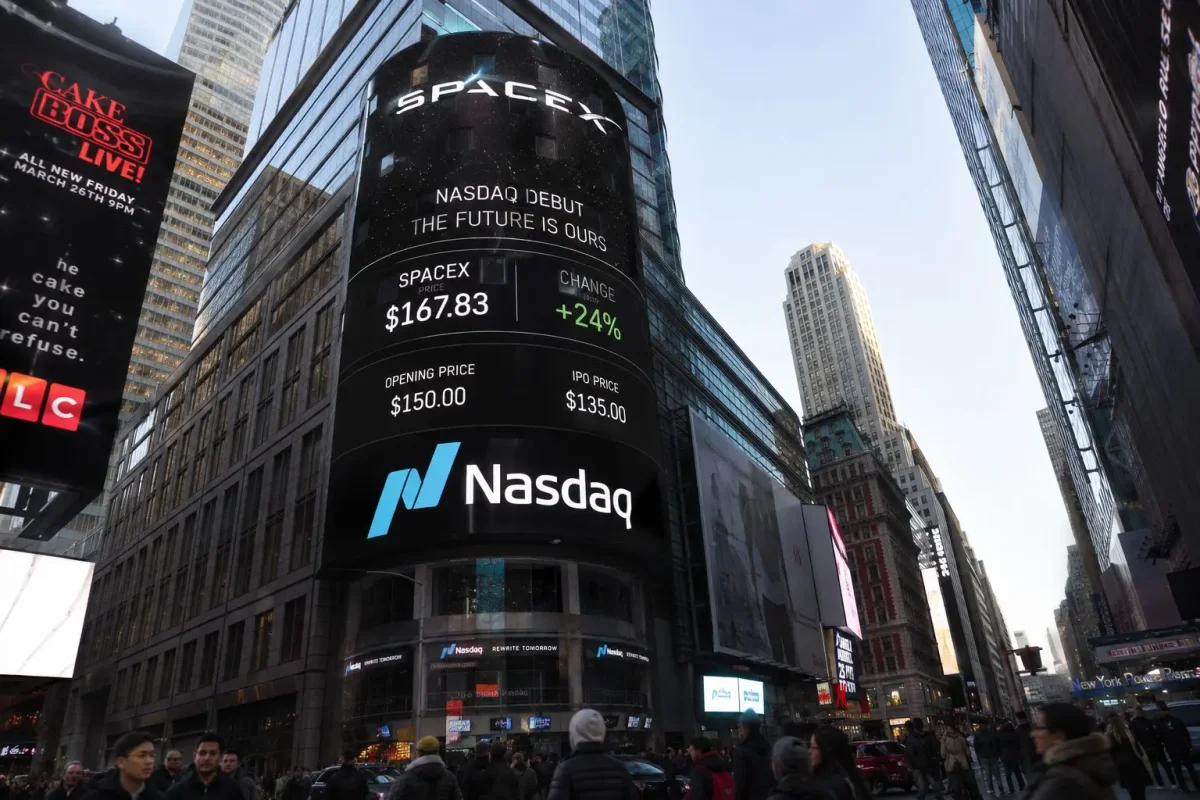
SpaceX began trading on the Nasdaq on Friday under the ticker SPCX, opening at $150 and climbing to $167.83 by midday—a gain of roughly 24% above its $135 initial public offering price. The debut values the company at approximately $2.2 trillion, making it one of the largest IPOs in history.
IPO Details and Market Reception
SpaceX priced its IPO at $135 per share, raising $75 billion through the sale of 555.56 million Class A shares. This deal more than doubles the proceeds from Saudi Aramco's 2019 IPO, underscoring the immense investor appetite for the Elon Musk-led enterprise. With 13.08 billion shares outstanding, the market capitalization at the current price stands near $2.2 trillion.
Catalyst Ahead: Nasdaq 100 Inclusion
The next major catalyst for SpaceX is its expected fast-track inclusion in the Nasdaq 100 index, which could occur after just 15 trading days under new rules. Inclusion would trigger buying from index funds and exchange-traded funds that track the Nasdaq 100, potentially driving further demand for SPCX shares. However, the company must wait before joining the S&P 500.
Financial Performance and AI Spending
SpaceX's financials reveal a mixed picture. Revenue jumped 33% to $18.67 billion last year, with Starlink contributing about 60% of that figure. The satellite internet service now has roughly 10.3 million users on 9,600 satellites. However, the company reported a net loss of $4.94 billion in the same period, largely due to heavy spending on artificial intelligence after its merger with xAI. At the current price, the stock trades at about 118 times trailing sales, a lofty multiple that reflects high growth expectations.
Bull and Bear Arguments
Bulls point to SpaceX's unmatched launch pace—now averaging over two launches per week—and the Starship rocket's capability to haul more than 100 metric tons to low-Earth orbit. These factors position the company ahead of smaller rivals like Blue Origin. On the bear side, critics highlight the valuation risk: at $167.83, the price-to-sales ratio is roughly 118 times 2025 revenue, and the company is still posting losses. Governance is also a concern, as Musk will control 82% of voting power after the IPO, leaving minority shareholders with limited influence.
Market Context and Analyst Views
Adam Sarhan, CEO at 50 Park Investments, noted that the real test will be how the market digests the IPO over the next several weeks. Morningstar's Nicolas Owens remained cautious, stating the company is significantly overvalued and investors may have better entry points later. Morningstar values SpaceX at $780 billion, well below the current market cap.
SpaceX's stock performance will be closely watched as the company navigates the balance between its technological leadership and the need to deliver sustainable profits. The next few weeks will be critical in determining whether the post-IPO rally can be sustained.
