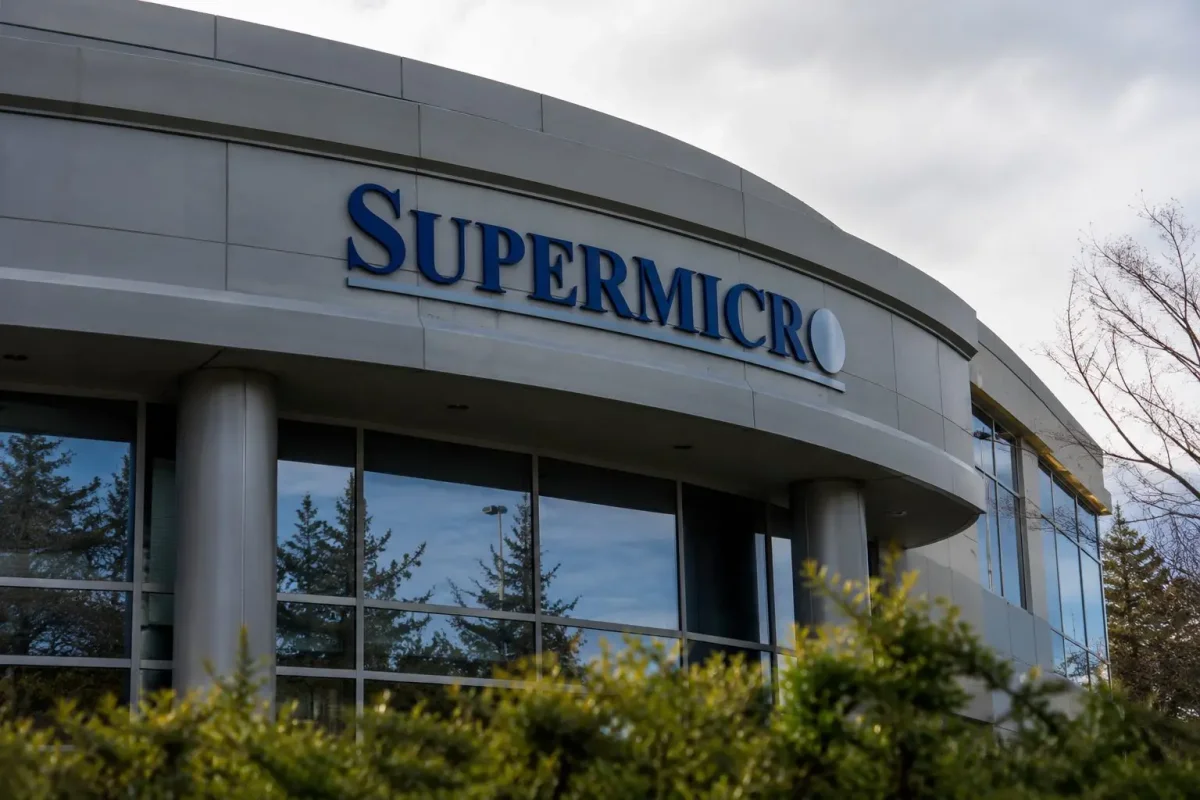
Super Micro Computer, Inc. (NASDAQ:SMCI) experienced a decline of 2.8% in early afternoon trading on Tuesday, July 7, 2026, with shares falling to $26.44 in New York. The stock remained below the $27.50 price point established during its June common stock sale, and even the intraday high of $26.96 failed to surpass that level. This performance contrasts sharply with several key peers in the AI hardware sector, which posted gains during the same session.
Market Context and Peer Performance
While Super Micro slipped, other prominent AI-focused companies moved higher. Dell Technologies Inc. (NYSE:DELL) advanced 2.7% to $422.80, NVIDIA Corp. (NASDAQ:NVDA) added 1.1% to $197.68, and Hewlett Packard Enterprise Co. (NYSE:HPE) rose 2.3% to $44.13. In contrast, Vertiv Holdings Co. (NYSE:VRT), another AI infrastructure player, fell 4.6% to $303.69. The broader market showed mixed results, with the Invesco QQQ Trust (NASDAQ:QQQ) declining 1.4% to $712.78 and the SPDR S&P 500 ETF Trust (NYSEARCA:SPY) edging down 0.3% to $748.88.
Financial Challenges and Fundraising
A significant concern for investors is Super Micro's potential $7.0 billion equity and equity-linked offering, which represents approximately 38% of the company's current market capitalization. This fundraising effort is designed to support roughly $39 billion in recent orders from over 20 customers, as announced by the company on June 9. The company subsequently priced common stock, depositary shares tied to 7.0% mandatory convertible preferred stock, and an at-the-market program that could launch as early as the third quarter.
The need for capital was evident from Super Micro's recent financial results. For the March quarter, the company reported net sales of $10.2 billion and a gross margin of 9.9%, but operating cash burn reached $6.6 billion—almost matching the full $7.0 billion fundraising target. This cash outflow underscores the tension between revenue growth and operational efficiency.
Compliance and Regulatory Issues
Adding to the company's challenges, Super Micro is facing a compliance investigation in Taiwan. In a July 1 letter, Chief Revenue Officer Matt Thauberger stated that "Supermicro is not a target" of the probe and that it has "absolutely no impact" on customer service. However, the company confirmed that authorities detained two of four Taiwan employees questioned in the case, while the other two were released on bail. This development has introduced additional uncertainty for investors.
Valuation and Market Sentiment
Super Micro's current price-to-earnings (P/E) ratio stands at 12.7, significantly lower than peers such as Dell (33.7), Nvidia (30.1), and HPE (40.5). The $39 billion in orders aligns closely with the company's projected fiscal 2026 revenue range of $38.9 billion to $40.4 billion. Yet, the stock continues to trade as though concerns about expenses, execution risks, and compliance issues are weighing on the path to achieving that revenue.
The broader chip sector also faced headwinds, with the Philadelphia Semiconductor index dropping 5.7%, on track to erase approximately $800 billion in market value if the decline persists. "The memory component when it comes to AI is where a great deal of spending is going," noted Todd Schoenberger, chief investment officer at CrossCheck Management, as reported by Reuters.
For investors, the key dilemma remains the disconnect between Super Micro's substantial order book and its ability to finance operations without diluting shareholders. As the company navigates its fundraising and compliance issues, market participants will closely monitor whether it can close the gap between its AI-driven potential and the financial realities it currently faces.