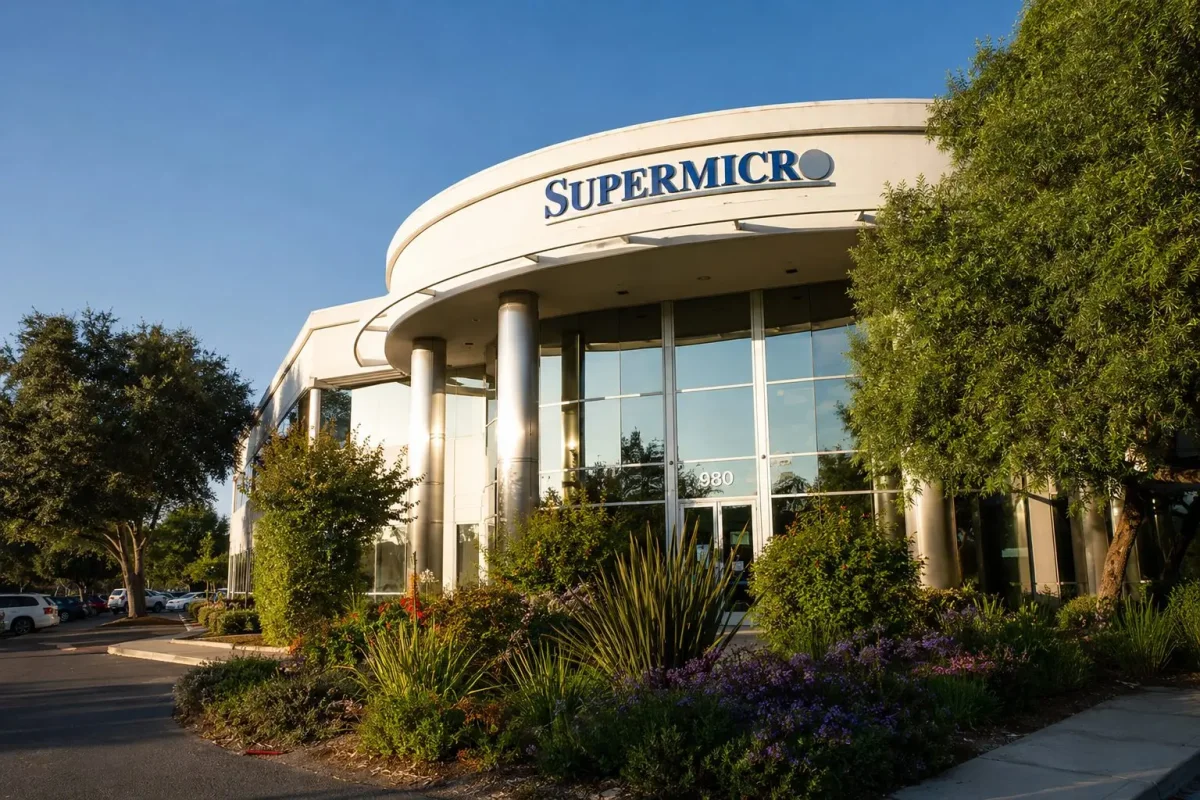
Super Micro Computer (SMCI) heads into a pivotal trading week after its shares suffered a severe 11.22% decline on Friday, closing at $41.64 before slipping further to $40.7075 in after-hours trading. The selloff, accompanied by heavy volume of 49.3 million shares, marks a sharp reversal for the server maker that has become a bellwether for AI infrastructure spending.
Broader Market Rout
The decline was part of a wider tech meltdown triggered by a hotter-than-expected U.S. jobs report, which showed 172,000 jobs added in May. The data reignited fears that the Federal Reserve may delay interest rate cuts, sending bond yields higher and prompting investors to flee growth stocks. The Nasdaq Composite tumbled 4.18%, the S&P 500 fell 2.64%, and the Philadelphia Semiconductor Index suffered its steepest one-day percentage drop since March 2020, losing about $1.3 trillion in market value.
Major chipmakers were hit hard: Nvidia (NVDA) fell approximately 6%, Advanced Micro Devices (AMD) dropped nearly 11%, and Broadcom (AVGO) slid 7.9%. The rout was described by Dennis Dick, a proprietary trader at Triple D Trading, as the end of a period where investors had been “blindly buying the dip.”
Super Micro’s Week in Review
The week began on a more optimistic note for Super Micro. Its stock opened at $50.17 on June 2, then traded at $47.42 on June 3, $46.90 on June 4, before collapsing to $41.64 on June 5. The rapid descent reflected initial enthusiasm over product announcements at Computex, followed by a broad exodus from AI hardware positions by Friday.
At Computex, Super Micro showcased its rack-scale systems, which integrate entire server racks as single managed units. The company announced its AMD Helios platform, a 72-GPU rack powered by AMD Instinct MI455X processors. CEO Charles Liang stated the company is “redefining what is possible in the data center” through a shift to “complete rack-scale architecture.” Additionally, Super Micro unveiled Arm-based AI systems designed for agentic AI, emphasizing efficiency and scalability. The company also presented Nvidia Vera Rubin data-center blueprints, capable of scaling from a 1,152-GPU unit to 1 gigawatt, with direct liquid cooling integrated into the design.
Bull Case vs. Market Reality
Super Micro’s ability to serve multiple chip ecosystems—Nvidia, AMD, Intel, and Arm—is often cited as a key strength, reducing dependency on any single vendor. However, Friday’s selloff highlighted the downside of this exposure: when Broadcom’s AI-chip update disappointed, the entire semiconductor sector suffered, dragging Super Micro down with it.
The week ahead will test whether Friday’s plunge was a crowded-position unwind or the beginning of a more significant reset in expectations for AI hardware spending. Higher bond yields threaten to compress valuations for fast-growing tech stocks, and investors may demand clearer evidence of orders, margins, and deployment speed before re-entering positions.
Outlook
Despite the selloff, a clean rebound in chip stocks could quickly change the tone. For Super Micro, Monday’s open will be a crucial indicator of whether investors remain willing to pay a premium for the physical infrastructure behind artificial intelligence, or if the recent volatility signals a more cautious stance toward the sector.