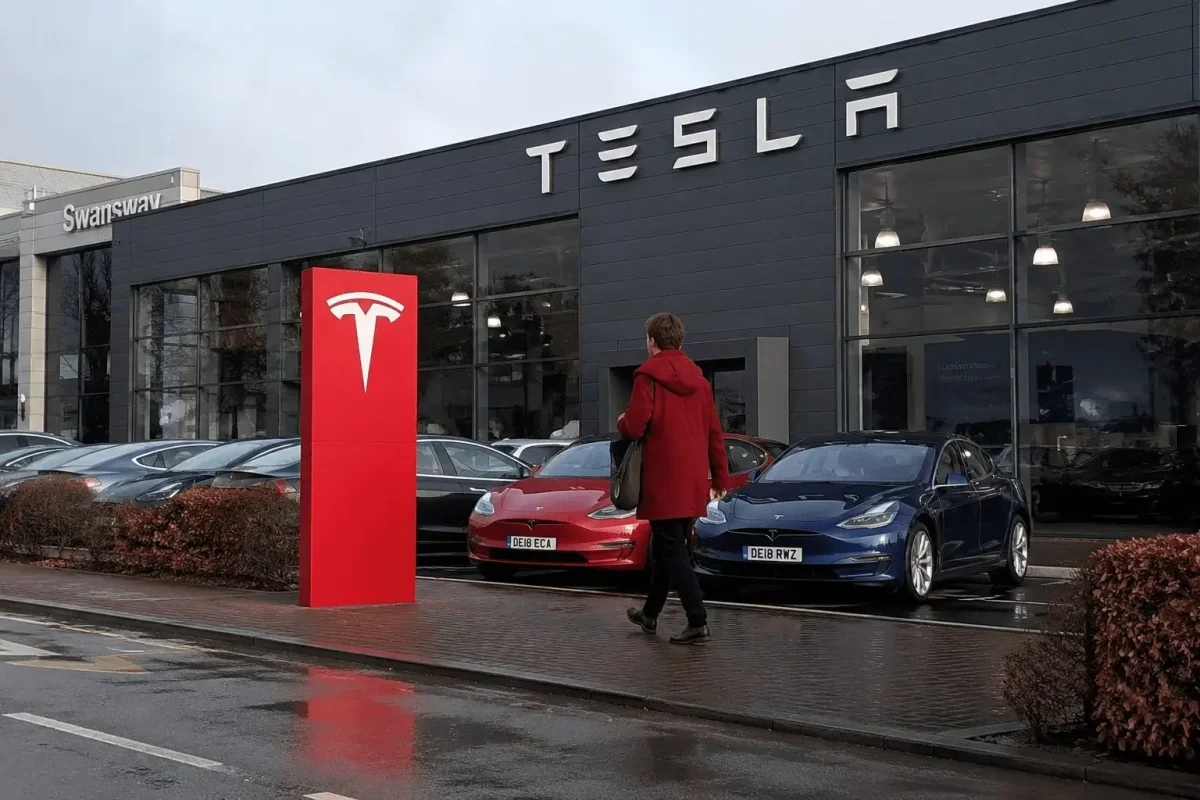
Shares of Tesla (TSLA) slipped about 0.5% to $421.63 on Wednesday afternoon, failing to gain traction after the company announced the launch of unsupervised robotaxis across the Austin, Texas metropolitan area. The move, which marks a key milestone in Tesla's autonomous driving ambitions, was met with a muted response from Wall Street, underscoring the gap between long-term promises and near-term execution.
The broader market also struggled, with the Invesco QQQ Trust (QQQ) falling 0.3% and the SPDR S&P 500 ETF (SPY) declining 0.6%. A jump in oil prices amid fresh Middle East tensions and profit-taking from recent highs weighed on sentiment. "Markets have come so far, so fast that just about any shock could sap momentum from this rally," said Eric Parnell, chief market strategist at Great Valley Advisor Group.
High Valuation Leaves Little Room for Error
Tesla's price-to-earnings ratio remains elevated near 387, making the stock highly sensitive to execution risks. While the company generates the bulk of its revenue from vehicle sales, its premium valuation reflects investor expectations that future software, artificial intelligence, and robotaxi services will unlock higher-margin income streams. However, Wednesday's tepid price action suggests that traders want more than just announcements.
"The Austin rollout is a step forward, but it's not yet a revenue driver," noted one analyst. "Investors need clearer safety data, shorter wait times, and tangible evidence that robotaxis can scale profitably."
China Sales Show Strength, But Caution Prevails
Positive news from China provided some underlying support. The China Passenger Car Association reported that Tesla sold 85,982 China-made electric vehicles in May, including exports, a 39.4% increase year-over-year. This marks the seventh consecutive month of rising sales for the Model 3 and Model Y. Despite this, the stock barely budged, as traders remain focused on the challenges of autonomous driving.
In China, Tesla faces intense competition from BYD, which is also advancing its driver-assistance technology. Tesla is still awaiting regulatory approval to bring its full self-driving features to the Chinese market, a key catalyst that bulls are watching closely.
Robotaxi Race Heats Up
Tesla is not alone in the autonomous vehicle space. Alphabet's Waymo already operates over 250 vehicles in Austin, compared to Tesla's fleet of roughly 50, according to Austin officials. Waymo's more cautious, sensor-heavy approach contrasts with Tesla's vision-based system, and safety experts remain skeptical of Tesla's claims.
Phil Koopman, an engineering professor and autonomous-vehicle safety expert at Carnegie Mellon, criticized Tesla's safety comparisons, stating, "Any new car is dramatically safer than a 12-year-old car." Last week, Reuters reported that former Tesla data labelers and safety researchers doubt the Full Self-Driving system is close to operating safely at scale.
Elon Musk's Ambitious Vision
CEO Elon Musk continues to set lofty targets. Last month, he told reporters that "probably 90% of all distance driven will be driven by the AI" within five to ten years, referring to self-driving car artificial intelligence. However, such projections have yet to translate into consistent investor confidence.
With the stock trading at a high multiple, the market is demanding more than just expanded service areas. Investors are looking for shorter wait times, transparent safety metrics, and concrete signs that robotaxis can contribute to the bottom line—not just extend the narrative of future growth.