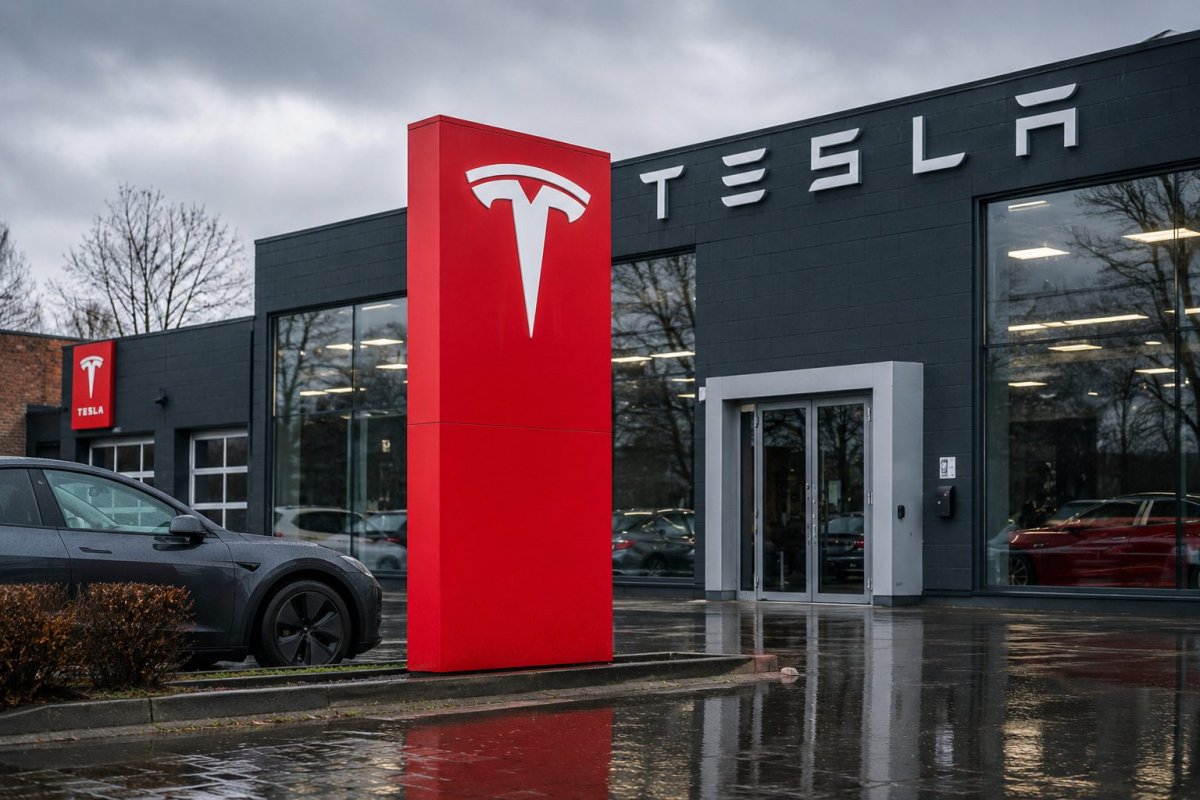
NEW YORK, June 26, 2026, 15:04 EDT — Tesla Inc. (NASDAQ:TSLA) shares closed higher Friday, gaining 1.3% to $380.03 after a turbulent session that saw the stock swing between $368.50 and $387.72. The intraday move of roughly $19.22 per share translated into a $68 billion shift in market value, surpassing Ford Motor Co.’s entire market capitalization of $57.4 billion and nearly matching General Motors Co.’s $72.5 billion valuation.
Despite the late-day recovery, Tesla remains deep in negative territory for June, down approximately 15% — its worst monthly performance since February 2025. The decline has erased roughly $240 billion in market value from the company, which still holds a market cap near $1.34 trillion. Shares are also off about 8.5% for the week, according to Barron’s.
Investor Concerns Mount
The selloff reflects growing unease among investors over several key issues: second-quarter delivery numbers, ongoing investigations into Tesla’s Full Self-Driving (FSD) technology, and soaring capital expenditures tied to artificial intelligence initiatives. Tesla’s premium valuation has long been underpinned by bets on autonomy, software, and robotics rather than its core automotive business, but the stock is now behaving more like an AI name under pressure than a traditional automaker.
The broader market also faced headwinds. The SPDR S&P 500 ETF Trust (NYSEARCA:SPY) slipped 0.3% in afternoon trading, while the Nasdaq Composite headed for a weekly decline as investors reassessed tech and semiconductor stocks after a massive AI-driven rally. Julia Hermann, global market strategist at New York Life Investment Management, told Reuters that higher interest rates could pose a risk to more cyclical areas of technology.
Delivery Data in Focus
Wall Street is closely watching Tesla’s second-quarter delivery numbers, with analysts expecting around 401,120 vehicles, a 4% increase year-over-year, according to Barron’s. While such figures could bolster the core auto story, they may not satisfy investors who have pinned Tesla’s lofty valuation on future revenue from robotaxis and FSD software rather than current automotive profits.
Legal and Regulatory Developments
Legal news continued to weigh on the stock. TechCrunch reported Friday that Tesla settled a lawsuit related to a fatal 2023 crash involving its Full Self-Driving system, though the terms were not disclosed. The National Highway Traffic Safety Administration (NHTSA) is still intensifying its investigation into FSD, and a recall remains a possibility.
Separately, Reuters noted that NHTSA launched a probe into a June 19 crash in Katy, Texas, where a Model 3 struck a house, killing a 76-year-old woman. Tesla’s self-driving lead, Ashok Elluswamy, stated that the driver “manually overrode self-driving” and was traveling at 73 mph. The Harris County Sheriff’s Office indicated the driver claimed some automated assistance was active.
Analyst Views and Spending Risks
Bullish arguments for Tesla remain, though they are increasingly reliant on longer-term catalysts. JPMorgan Chase & Co. (NYSE:JPM) analysts led by Rajat Gupta upgraded Tesla to neutral earlier this month, raising their price target to $475. They described Tesla’s hardware-software integration as “under-appreciated and misunderstood,” but also highlighted high execution risks tied to regulation, safety validation, and technology scaling.
Spending is another concern. Reuters reported in April that Tesla raised its 2026 capital expenditure outlook to over $25 billion and expects negative free cash flow for the remainder of this year after a first-quarter surplus. Seth Goldstein of Morningstar (NASDAQ:MORN) noted that skeptics view this capex as unjustified, while Greg Basich of Counterpoint Research argued Tesla is being stretched in “too many different directions at once.”
With the stock trading at a trailing price-to-earnings ratio of approximately 349, Tesla remains highly exposed to both macroeconomic data and company-specific updates. Doug Huber, deputy chief investment officer at Wealth Enhancement, told Reuters that a strong jobs report next week could pressure the stock if it raises the odds of further rate hikes.