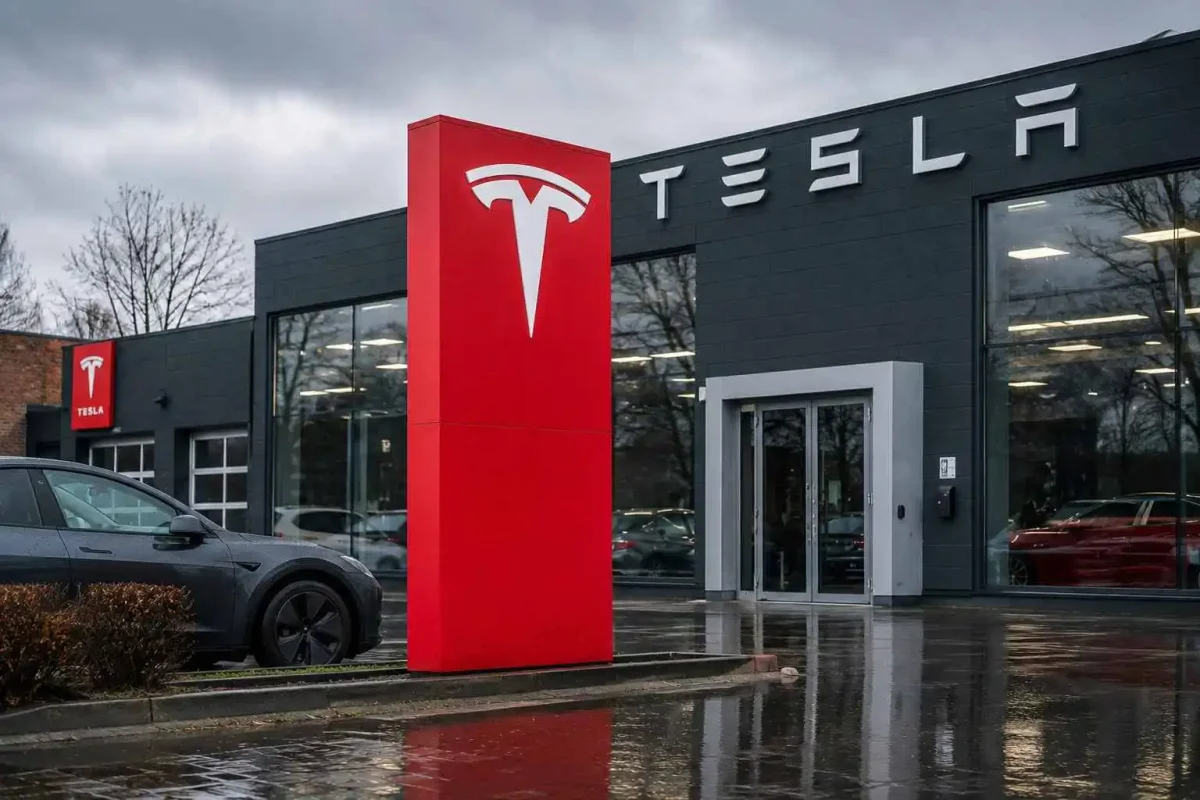
NEW YORK, July 23, 2026 – Tesla (NASDAQ:TSLA) shares fell sharply in premarket trading Thursday as investors focused on the electric vehicle maker's planned $16.7 billion in capital expenditures for the second half of the year, heightening concerns about financial strain. The stock dropped 5.9% to $352.10, extending a 6.6% decline from the prior week.
Tesla's second-quarter revenue of $28.24 billion surpassed the consensus analyst estimate of $27.58 billion, driven by a 26% year-over-year increase and a 25% rise in deliveries to 480,126 vehicles. However, adjusted earnings per share of $0.33 missed expectations by 40%, and operating income plunged 57% to $398 million. The operating margin contracted sharply to 1.4% from 4.1% in the previous quarter, reflecting persistent cost pressures.
Chief Financial Officer Vaibhav Taneja confirmed that total capital spending for 2026 will exceed $25 billion, implying at least $16.72 billion in expenditures from July through December. With $8.28 billion already spent in the first half, the remaining outlay translates to a minimum of $8.36 billion per quarter—a 44% increase over the second quarter's $5.79 billion. Taneja noted that capex will continue to rise over the next two to three years, describing 2026 as “a massive capex year.”
The spending plan raises the specter of significant cash burn. Based on second-quarter operating cash flow of $4.70 billion, if that level persists in the second half, Tesla could face a cash deficit exceeding $7.32 billion by year-end. The company ended June with $43.52 billion in cash and short-term investments, providing a cushion of roughly 17% against the minimum burn rate. Free cash flow in Q2 was negative $1.09 billion, though that was $2.16 billion better than the consensus estimate, partly due to lower-than-expected capital spending that may reflect timing rather than structural savings.
Core automotive economics deteriorated further. The automotive gross margin, excluding regulatory credits, fell to 16.3% from 19.2% in the first quarter. Average vehicle revenue declined 5.8% sequentially to $42,730, while sales of regulatory credits tumbled 67% to $146 million. Research and development expenses surged 49% to $2.37 billion, and other income of $590 million exceeded operating income, underscoring the strain on core operations.
On a positive note, active Full Self-Driving (FSD) subscriptions rose 56% to 1.48 million, and energy storage deployments increased 41% to 13.5 gigawatt-hours. CEO Elon Musk has positioned autonomous driving and energy storage as key growth drivers, but near-term profitability remains under pressure.
Direxion analyst Ryan Lee commented, “Monetization remains the central concern following the earnings miss,” highlighting the challenge of translating technological leadership into sustainable profits. Tesla shares closed Wednesday at $374.01, down 1.3%, and were trading at roughly 342 times trailing earnings—a valuation that leaves little room for execution missteps.
Looking ahead, investors will monitor the Federal Reserve's decision on July 29, advance GDP figures due July 30, and June PCE data for clues on the broader economic environment. Tesla's ability to manage its ambitious capex program while stabilizing margins will be critical in determining whether the stock can regain its footing.