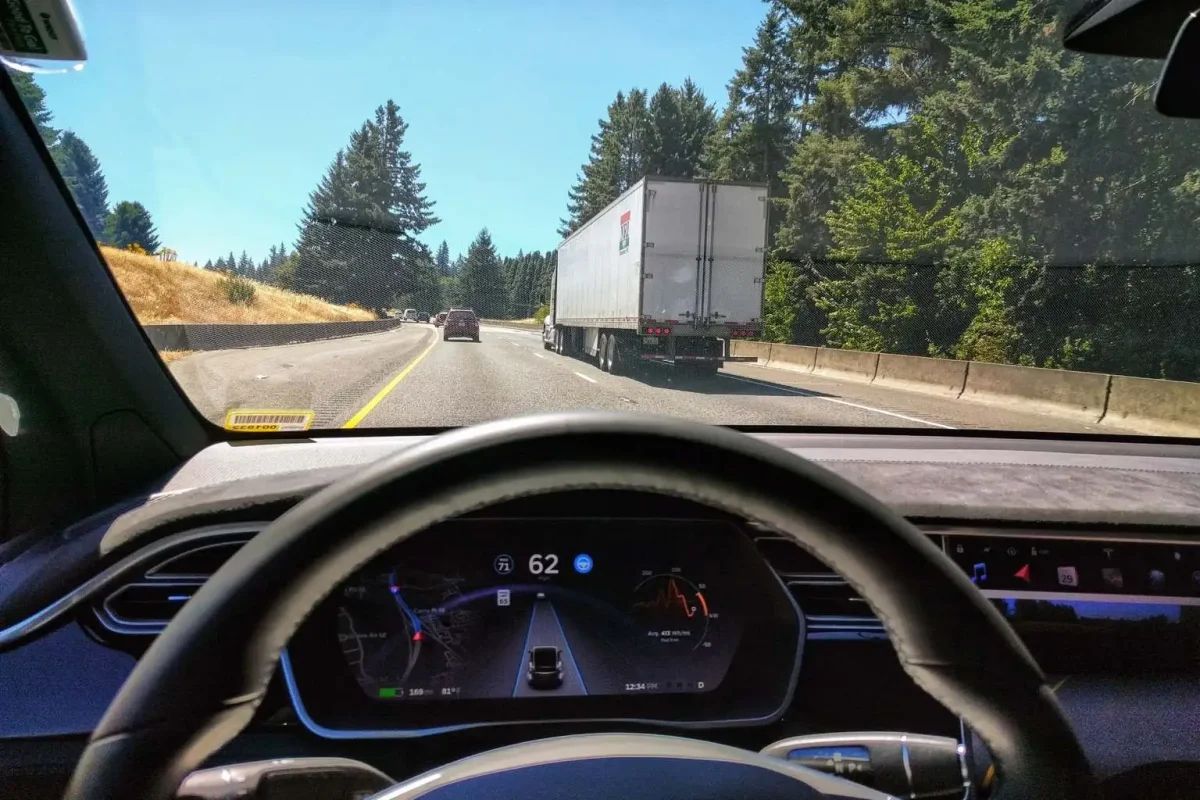
Tesla's stock climbed nearly 5% on Monday, buoyed by investor optimism despite a newly released federal crash report that again placed the company's driver-assistance technology under the microscope. The move underscores the ongoing tension between the allure of autonomous driving revenue and the persistent regulatory and safety challenges that could impact the automaker's lofty valuation.
Shares of Tesla (NASDAQ: TSLA) were trading at $366.05, up 4.96%, with over 45 million shares exchanged by mid-afternoon. The stock's intraday range stretched from $347.15 to $367.80, near the day's highs, reflecting robust buying interest. The company's market capitalization now stands at approximately $1.45 trillion, based on an estimated 3.95 billion shares outstanding.
Crash Report Adds to Safety Scrutiny
The catalyst was a record filed by Tesla with the National Highway Traffic Safety Administration (NHTSA) confirming that its Level 2 driver-assistance system was engaged prior to a fatal crash in Clute, Texas, in May 2026. The filing, part of NHTSA's crash reporting database, noted that the system was "Verified Engaged" at the time, with a pre-crash speed of 104 mph. However, the document does not establish causation, leaving the role of the technology in the incident undetermined.
This latest disclosure comes as NHTSA conducts an engineering analysis (EA26002) into how Tesla vehicles handle reduced visibility conditions, a probe covering roughly 3.2 million vehicles. The agency's documents reference nine crashes, including two with injuries and one fatality, and indicate that Tesla began developing a software update after being notified of a fatal incident. The regulator is still assessing the timeline for the update's rollout and its potential impact on affected vehicles.
Valuation at a Crossroads
The market's reaction highlights a broader debate among investors: the potential for high-margin software revenue from Full Self-Driving (FSD) subscriptions and other AI initiatives versus the risks of regulatory setbacks and consumer trust erosion. Tesla's forward price-to-earnings ratio stands at roughly 183 times expected earnings, a valuation that leaves little room for error. The trailing P/E is even higher at 361.9 times, while the price-to-sales ratio sits at 13.3 times, reflecting expectations of software-like margins.
These metrics suggest that any negative development in autonomy or a decline in consumer confidence could have outsized effects on the stock's fair value. Yet, the recent surge indicates that many investors remain willing to overlook safety concerns in favor of the long-term growth narrative tied to FSD subscriptions, robotaxis, and the Optimus humanoid robot.
Q2 Financials Show Growth Amid Costs
Tesla's second-quarter results, released last month, provide a mixed picture. Revenue surged 26% year-over-year to $28.24 billion, with automotive revenue up 23% to $20.52 billion. Deliveries grew 25% to 480,126 vehicles, and active FSD subscriptions climbed 56% to 1.48 million, underscoring the potential for recurring software income.
However, costs are escalating. Capital expenditures jumped 142% to $5.79 billion, pushing free cash flow to negative $1.09 billion, a sharp reversal from the positive $1.46 billion in the prior-year quarter. Operating income fell 57% to $398 million, and operating margin contracted to 1.4% from 3.2%, despite the revenue growth. Cash and investments remained robust at $43.52 billion, up 19%.
Regulatory Landscape and Investor Implications
The NHTSA crash database, which includes incidents where a Level 2 system was active within 30 seconds of a collision, is designed for monitoring purposes and does not assign fault. The agency cautions against cross-manufacturer comparisons due to differences in fleet size, reporting practices, and miles traveled. Nonetheless, each new entry adds to the narrative that Tesla's driver-assistance features require closer scrutiny.
For investors, the key watch items include updates on NHTSA's EA26002 investigation, supervised FSD miles and intervention rates, subscription growth, and operating margin conversion. The stock's performance will likely hinge on how these factors evolve, as the market balances the promise of autonomy against the reality of regulatory oversight.
As of Monday's close, Tesla shares remain below their 52-week high of $498.83, but the session's rally demonstrates that the market is still willing to bet on the company's ambitious vision, even as safety questions persist.