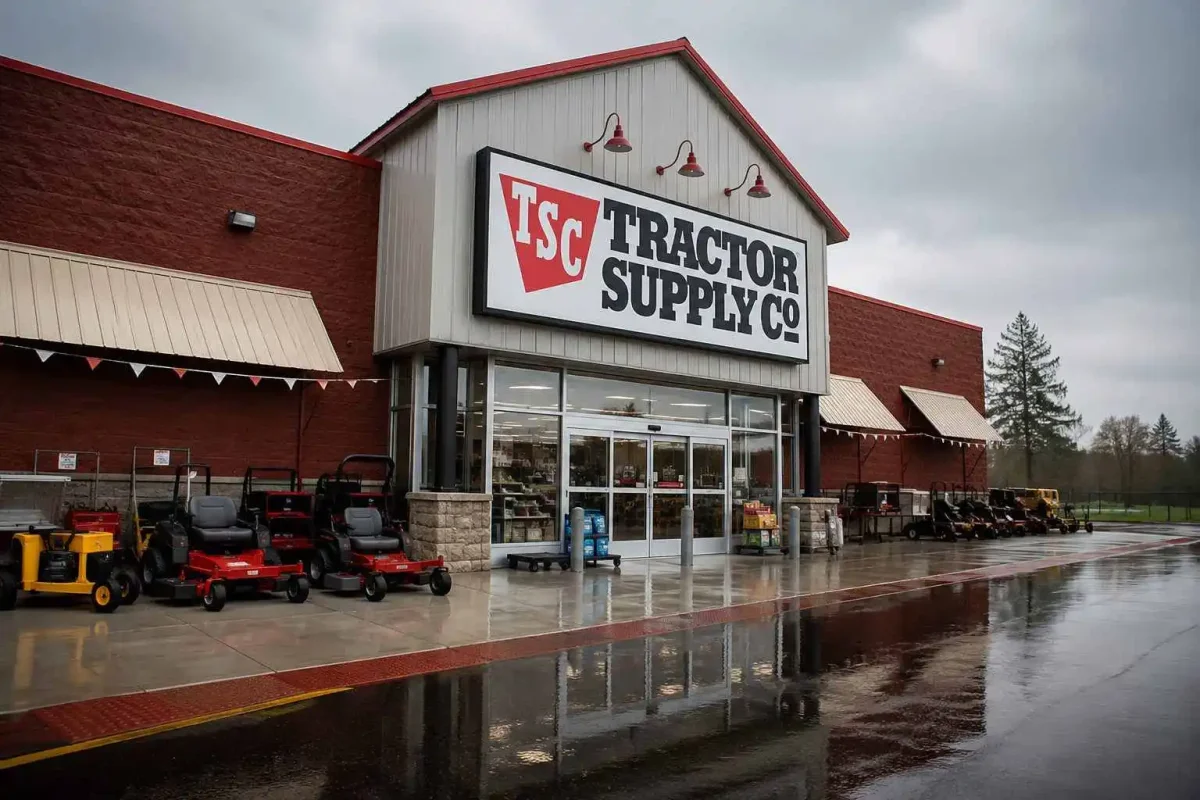
Tractor Supply Company (NASDAQ:TSCO) saw its shares climb 2.9% in premarket trading on Thursday, reaching $30.22 ahead of the regular session. The advance came after the rural lifestyle retailer released quarterly results that showed revenue growth but a decline in comparable store sales and a downward revision to its full-year outlook.
The company reported second-quarter revenue of $4.54 billion, a 2.3% increase from $4.44 billion in the same period last year. However, comparable store sales fell 1.5%, and comparable transactions dropped 1.7%. The average ticket size grew by just 0.2%, highlighting the challenge of driving customer spending.
Adjusted earnings per share came in at $0.81, slightly below the consensus estimate of $0.83 from analysts surveyed by Zacks Investment Research. The miss added to investor concerns about the quality of the company's top-line growth, which has been driven primarily by new store openings rather than improved performance at existing locations.
Tractor Supply reduced its 2026 guidance across key metrics. The company now expects net sales growth of 2.5% to 3.5%, down from its prior forecast of 4% to 6%. Comparable sales are projected to range from a decline of 1% to flat, compared with the earlier expectation of 1% to 3% growth. GAAP operating margin is now seen at 8.0% to 8.3%, down from 9.3% to 9.6%, and GAAP earnings per share are expected between $1.78 and $1.88, compared with the prior range of $2.13 to $2.23. Adjusted EPS is forecast at $1.90 to $2.00.
The company also withdrew its long-term framework established in December 2024, stating that a new framework will be provided alongside fourth-quarter results. This move signals a shift in strategic priorities amid a challenging operating environment.
Chief Executive Officer Hal Lawton attributed the weak quarterly performance to adverse weather conditions in May. “Positive comparable store sales in April and June were more than offset by unusually adverse conditions in May,” he said. Sales of seasonal, big-ticket, and discretionary items were particularly affected. The company also announced plans to close approximately 75 Petsense locations, representing about 36% of its 209 pet stores, as part of a restructuring effort. The quarter included $65.8 million in Petsense impairment and restructuring charges, along with $5.9 million in inventory write-downs and $9.5 million in acquisition expenses related to VIP Petcare.
Despite the negative headlines, the stock's premarket gain suggested a relief rally, as the shares had fallen 41.3% year-to-date through Wednesday's close. The stock remains about 53% below its 52-week high of $63.99. Analysts noted that the lowered guidance may have been anticipated by the market, and the closure of underperforming Petsense stores could improve profitability over time.
Looking ahead, Tractor Supply's expansion strategy remains aggressive, with 68 new stores opened in the first half of the year, compared with 39 in the same period last year. Capital expenditures rose 24% to $435.7 million. However, the company faces headwinds from softer consumer spending and the need to balance growth with cost control. Adjusted SG&A expenses increased 7.3%, outpacing revenue growth by more than threefold, and adjusted operating income declined 5.1%.
Investors will be watching for signs of improved customer traffic and the impact of store closures on margins. The balance of risks remains tilted toward further cost deleverage if weather or pet segment weakness persists, but a recovery in demand could help support the updated guidance range.