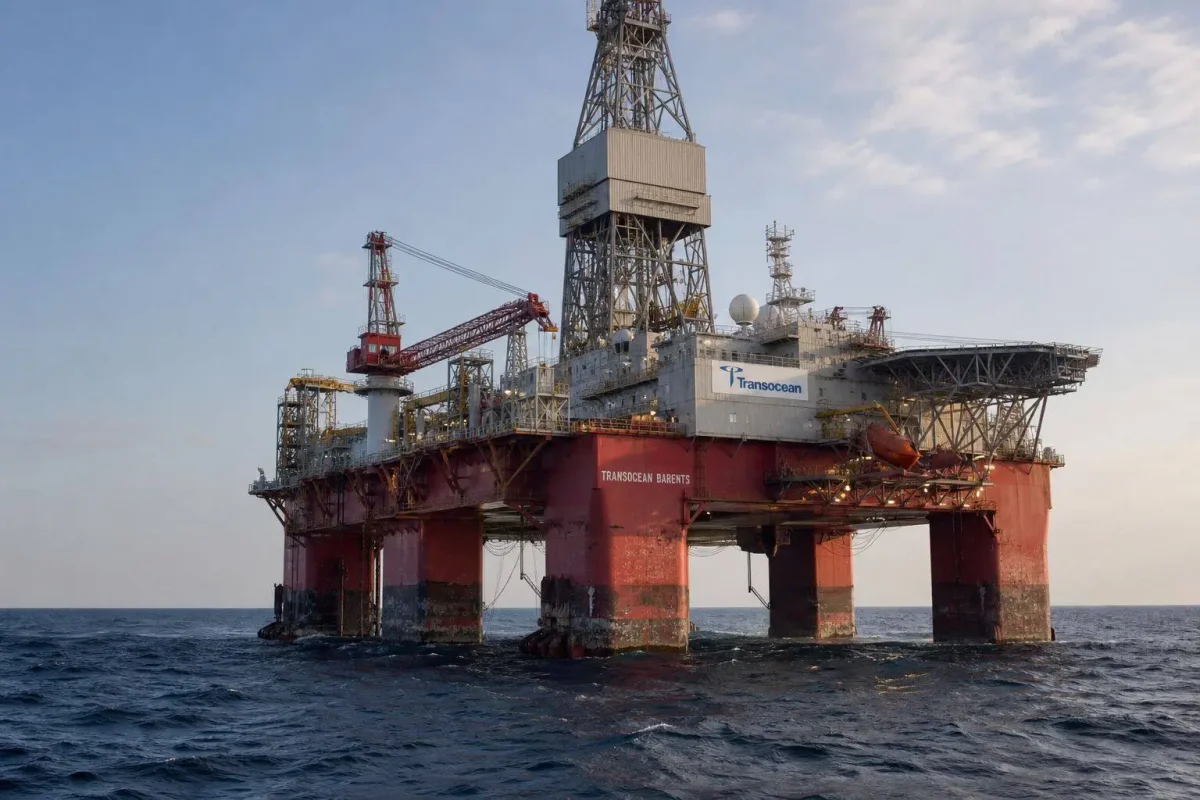
Transocean Ltd. (NYSE: RIG) saw its shares climb 1.9% on Tuesday, as rising crude prices brought renewed focus to the offshore driller's substantial $6.7 billion contract backlog. The stock closed at $5.92, up from an opening of $5.90, with a session high of $5.99. Trading volume reached 36.35 million shares, approximately 6% below the three-month daily average.
The uptick coincided with West Texas Intermediate (WTI) crude trading at $90.68 per barrel, while Brent crude stood at $95.22 as of 17:55 EDT. Oil prices have been buoyed by fresh U.S. military strikes on Iran, which have heightened concerns about potential supply disruptions in the Middle East. This geopolitical tension is providing a tailwind for energy-related equities, including offshore drillers.
Transocean's performance outpaced the broader market, with the S&P 500 slipping 0.7% on the same day. The company's gains were part of a sector-wide rally, as peers also advanced: Borr Drilling (NYSE: BORR) rose 2.7%, Valaris (NYSE: VAL) gained 1.9%, and Noble Corp. (NYSE: NE) added 1.7%. This collective movement suggests that crude prices, rather than company-specific news, are driving the sector's momentum.
Investors are increasingly scrutinizing Transocean's ability to convert its backlog into cash, a critical metric given the company's financial position. The backlog, which stood at $6.7 billion as of August 5, is just slightly above the company's equity value of $6.61 billion. Net debt remains elevated at $4.31 billion, representing about 65% of market value. This capital structure underscores the importance of disciplined cash flow generation.
Strong Second-Quarter Cash Flow
In the second quarter, Transocean reported free cash flow of $212 million, a figure that highlights the company's operational efficiency. Contract drilling revenue totaled $966 million, while adjusted EBITDA came in at $312 million, reflecting a margin of 32.2%. Revenue efficiency, a key metric for drilling contractors, was an impressive 97%.
Chief Executive Keelan Adamson described the period as a “strong second quarter,” citing “excellent cash flow and improved liquidity.” The company reduced its debt by $586 million in the first half of the year, and as of June 30, unrestricted cash stood at $509 million, with overall liquidity exceeding $1.3 billion.
Backlog Growth and Fleet Update
During the quarter, Transocean secured new contracts that added $292 million to its backlog, at a weighted average dayrate of $461,000. Additionally, a potential $1 billion contract with Equinor (NYSE: EQNR) was pending partner approval and was not included in the reported backlog. The company's fleet comprises 27 mobile offshore units, including 20 ultra-deepwater floaters and seven harsh-environment rigs.
While the recent oil price strength is a positive signal for offshore drilling demand, the impact on new rig commitments is typically delayed. Higher crude prices could encourage energy companies to increase capital spending on offshore projects, but such decisions take time to materialize.
Investor Considerations and Risks
For investors, the key challenge lies in Transocean's ability to convert its backlog into cash at a pace that outpaces rising financing and fleet expenses. The company's backlog-to-market-value ratio stands at approximately 1.01, indicating that the market is pricing in limited upside from existing contracts. Net debt, at 65% of market value, remains a significant burden that could limit financial flexibility.
Risks to the outlook include a potential pullback in oil prices if supply concerns ease, contract delays, unplanned rig outages, or higher-than-expected reactivation costs. Any of these factors could pressure cash flow and hinder debt reduction efforts.
Despite these challenges, Tuesday's price action reflects optimism that higher oil prices will eventually translate into stronger demand for offshore drilling services. As the sector continues to benefit from geopolitical tailwinds, Transocean's ability to execute on its backlog will be closely watched by investors.