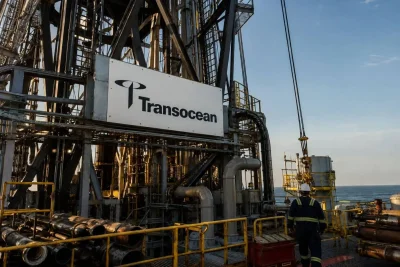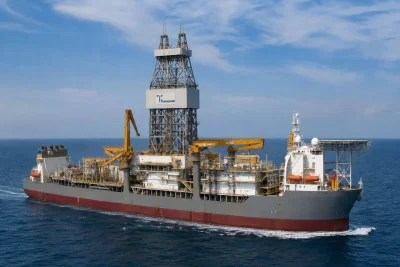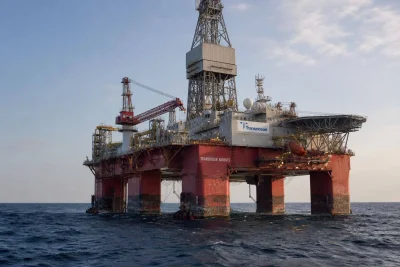
Transocean Ltd. saw its stock tumble 9.16% on Tuesday, closing at $6.25, as the offshore drilling contractor reported an adjusted net loss for the first quarter, overshadowing a significant influx of new business. The company secured approximately $1.6 billion in fresh contracts, boosting its total backlog to $7.1 billion, but the bottom-line miss weighed heavily on investor sentiment.
Financial Performance Highlights
For the quarter ended March 31, Transocean posted contract drilling revenue of $1.081 billion, up from $906 million in the same period last year. Net income came in at $71 million, or 6 cents per diluted share. However, after adjusting for one-time items such as tax impacts and debt-retirement charges, the company recorded an adjusted net loss of $28 million, or 3 cents per share. Adjusted EBITDA surged to $440 million from $244 million a year earlier, while free cash flow turned positive at $136 million, compared to negative $34 million in the first quarter of 2025.
Contract Wins and Backlog Growth
The jump in backlog was driven by five major deals. The Transocean Barents secured a 1,095-day contract with Vår Energi in Norway. In Brazil, Petrobras extended contracts on the Deepwater Orion, Deepwater Aquila, and Deepwater Corcovado. Meanwhile, the Deepwater Asgard booked a five-well job in the Eastern Mediterranean. The average dayrate for these new awards is approximately $410,000, reflecting strong demand for high-specification rigs.
CEO Keelan Adamson noted that average daily revenue reached $476,000, a more than ten-year high, with uptime at 98%. He emphasized that the company is still in the "early days of a multi-year upcycle" for offshore exploration and development drilling. Transocean continues to target $250 million in cost reductions from its 2024 base through 2026.
Debt Reduction and Balance Sheet
The company paid off its remaining $358 million in 8.375% Deepwater Titan notes in March, a move that will save nearly $40 million in interest costs through maturity. Total debt fell to $5.137 billion at quarter-end, down sharply from $6.734 billion a year ago.
Valaris Acquisition and Regulatory Hurdles
Transocean's proposed all-stock acquisition of Valaris, valued at $5.8 billion, faces a potential delay. Valaris disclosed that the U.S. Department of Justice issued a "Second Request" for additional information, extending the antitrust review period to 30 days after both companies fully comply. While the request does not block the deal, it introduces uncertainty around the timeline. The transaction still requires regulatory and shareholder approvals, and there is no guarantee it will close as scheduled.
Outlook and Market Context
For the second quarter, Transocean projects contract drilling revenue between $930 million and $970 million. Full-year 2026 revenue is expected to land in the $3.8 billion to $3.9 billion range, with total liquidity estimated at $1.25 billion to $1.35 billion, including its undrawn credit facility. Investors remain cautious, as any downturn in oil prices or dayrates could pressure the company's free cash flow generation.