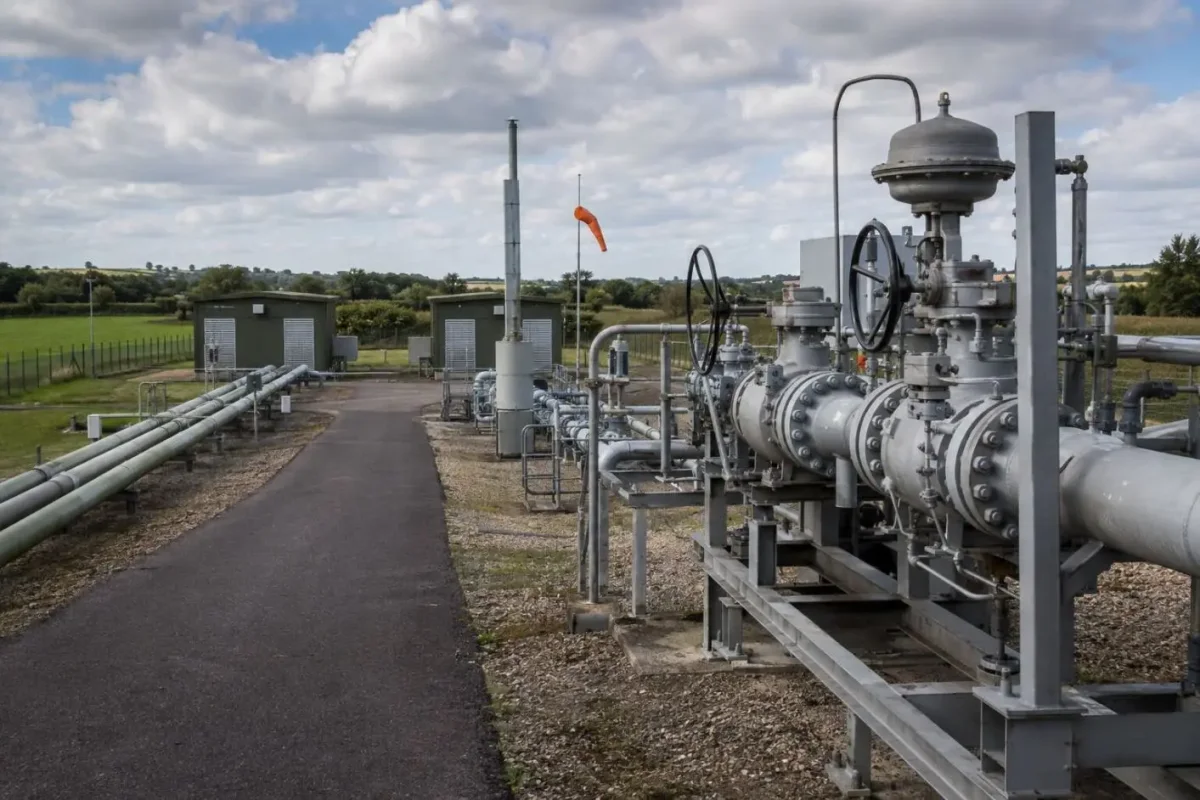
London, September 3, 2026 – The UK natural gas market displayed a pronounced split on Thursday morning, as near-term prices retreated while longer-dated contracts advanced. At 09:19 BST, the National Balancing Point (NBP) day-ahead gas traded at 176.80 pence per therm, a 2.1% decline from Wednesday's close. This short-term weakness contrasted sharply with the Winter 2027 contract, which climbed 2.5% to 121.00 pence per therm, and Summer 2028, which surged 7.3% to 84.99 pence per therm.
The divergence underscores a market caught between immediate supply comfort and lingering concerns over future winter storage adequacy. Front-month and near-curve contracts reacted to softer demand and robust wind generation, while the far end of the curve remained sensitive to depleted European stockpiles and intensifying competition for liquefied natural gas (LNG) cargoes.
Near-Term Weakness on Looser System
The UK system opened with a surplus of 6 million cubic metres per day (mcm/d), reflecting a sharp drop in overall demand. Total system demand fell by 17.3% to 92.45 mcm/d, with gas-for-power demand projected at just 13 mcm/d, a mere 14.1% of the total. This looser balance pulled down the front of the curve, with October 2026 trading at 177.93 pence, down 2.3%, and Winter 2026 slipping 2.1% to 178.63 pence.
Linepack stood at 329.66 mcm, providing a comfortable intraday buffer. The demand reduction was partly attributed to higher wind output, which reduced the need for gas-fired generation.
Supply Concerns Persist at the Back End
Despite the near-term ease, supply-side worries continued to underpin longer-dated contracts. Norwegian nominations reached 279.3 mcm/d, but a process issue at the Kollsnes processing plant reduced output by a further 6 mcm/d, equivalent to about 4.2% of the plant's declared capacity. Such outages highlight the fragility of the supply chain, especially as the UK becomes more reliant on imports.
Meanwhile, rising competition in Asian LNG markets added to the pressure. The Japan-Korea Marker (JKM) benchmark climbed to $25.52 per million British thermal units, making it more expensive for European buyers to attract cargoes. As of August 31, EU storage levels stood at 65.4% of capacity, a significant 18.2 percentage points below the five-year average of 83.6%. This deficit raises concerns about the region's ability to build adequate reserves before winter.
Household Bills to Rise in October
The wholesale price pressures are set to feed through to consumers in October, when Ofgem's new price cap takes effect. The standard annual cap for a typical household will rise by 4% to £1,723. The gas unit rate will climb 8.7% to 7.97 pence per kilowatt-hour, while electricity unit rates will rise a more modest 0.8% to 26.32 pence per kilowatt-hour. Standing charges are also changing, with gas increasing 2.2% and electricity falling 4.1%.
National Gas has projected that domestic sources and Norway will supply 86% of the anticipated 25.3 billion cubic metres for summer, with storage and LNG making up the remaining 14%. However, the mix is becoming less favourable as domestic production declines. National Gas executive Ian Radley warned of "future risks arising from declining domestic production and an increasing reliance on imports."
Market Outlook and Risks
For investors, the current curve offers greater rewards for accurate hedging than for relying on a single gas-price outlook. Short-term consumers benefit from wind generation and reduced demand, but those purchasing for winter face costs tied to storage, outages, and LNG-related risks.
Key risks include sparse trading at the far end, which can amplify curve movements. A reversal could occur quickly if Norwegian supply increases, weather turns warmer, or storage injections accelerate. Upcoming catalysts include Kollsnes repairs, Troll output updates after September 6, and the weekly storage report. EU regulations require storage to reach 90% capacity between October and December, a target that appears challenging given current levels.