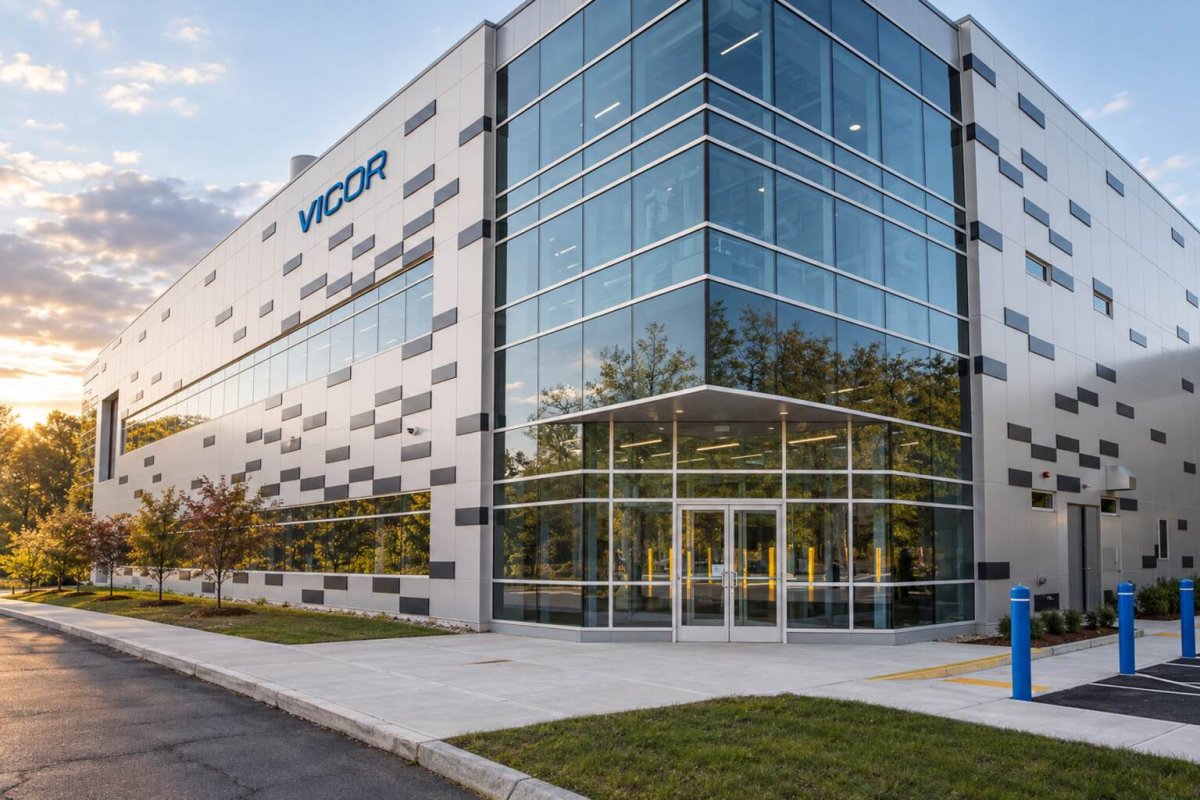
Vicor Corporation (VICR) experienced a significant stock surge on Thursday, climbing 18.2% to $217.29, after the company announced a new patent licensing agreement with an undisclosed artificial intelligence hardware manufacturer. The deal, which covers Vicor's Vertical Power Delivery (VPD) technology, has ignited investor enthusiasm despite the absence of key financial details.
The announcement, made after Wednesday's market close, revealed that the licensee is a "leading AI OEM," but no name, royalty rate, contract value, or expected revenue timeline were provided. This lack of specificity has led analysts to view the agreement primarily as a validation of Vicor's intellectual property strategy rather than a concrete financial commitment.
The Significance of Vertical Power Delivery
Vicor's VPD technology addresses a critical challenge in modern AI processors: efficiently delivering high current at low voltages. By moving voltage conversion closer to the processor, VPD reduces the distance that high current must travel across a circuit board, mitigating the "last inch" constraint that can bottleneck performance. This technological edge is crucial as AI chips demand increasingly more power.
The non-exclusive nature of the license allows the OEM to source modules from suppliers that have not individually licensed Vicor's patents. This arrangement provides the customer with more sourcing flexibility while enabling Vicor to earn royalties on patented designs even when it is not the manufacturer. Furthermore, Vicor is offering licensees substantial discounts on royalties for commodity modules if they also purchase its high-performance modules for AI accelerators, a strategy designed to preserve its product sales while expanding its licensing revenue base.
Royalty Revenue Already a Key Driver
Royalty income is no longer a minor component of Vicor's business. In the June quarter, royalty revenue reached $30.4 million, accounting for 21% of total net revenue of $143.4 million. Product revenue contributed $112.9 million, and the company reported a gross margin of 58.0%. Backlog also surged to $380 million, up 145% year-over-year, indicating robust demand for its products.
Thursday's market response reflects the potential of this licensing model to extend Vicor's profitability beyond its own manufacturing capacity. The increase in share price, which added $33.38 per share, translates to an illustrative $1.53 billion increase in equity value based on the company's weighted-average share count of 45.9 million. This figure underscores how much future licensing income the market is anticipating.
Unanswered Questions and Future Outlook
While the deal is a positive signal, several unknowns remain. The identity of the customer and the exact terms of the agreement are undisclosed, which is common in the semiconductor industry to protect supply chain relationships. However, the non-exclusive nature of the license means that the OEM could purchase modules from competitors, potentially displacing Vicor's own product sales. The balance between licensing income and product revenue will only be clarified in future financial disclosures.
Capacity expansion is another part of the growth story. On September 11, Vicor announced the acquisition of a 334,000-square-foot building and 54 acres in New Hampshire for two additional fabrication facilities. Management noted that its first Andover fab is nearing capacity, and deployment at the second facility is expected to take about a year. This expansion signals confidence in sustained demand for its VPD solutions.
Investors now have two key metrics to monitor: royalty revenue and backlog. Growth in both would support the thesis that this license is part of a broader industry shift toward VPD. If neither shows significant improvement, Thursday's rally may be based more on sentiment than substance.
As of 3:23 p.m. Eastern time on September 17, 2026, Vicor's stock was trading at $217.29, up 18.2% on the day, with volume reaching 1.23 million shares, 43% above the average daily volume. The stock hit an intraday high of $218.72.