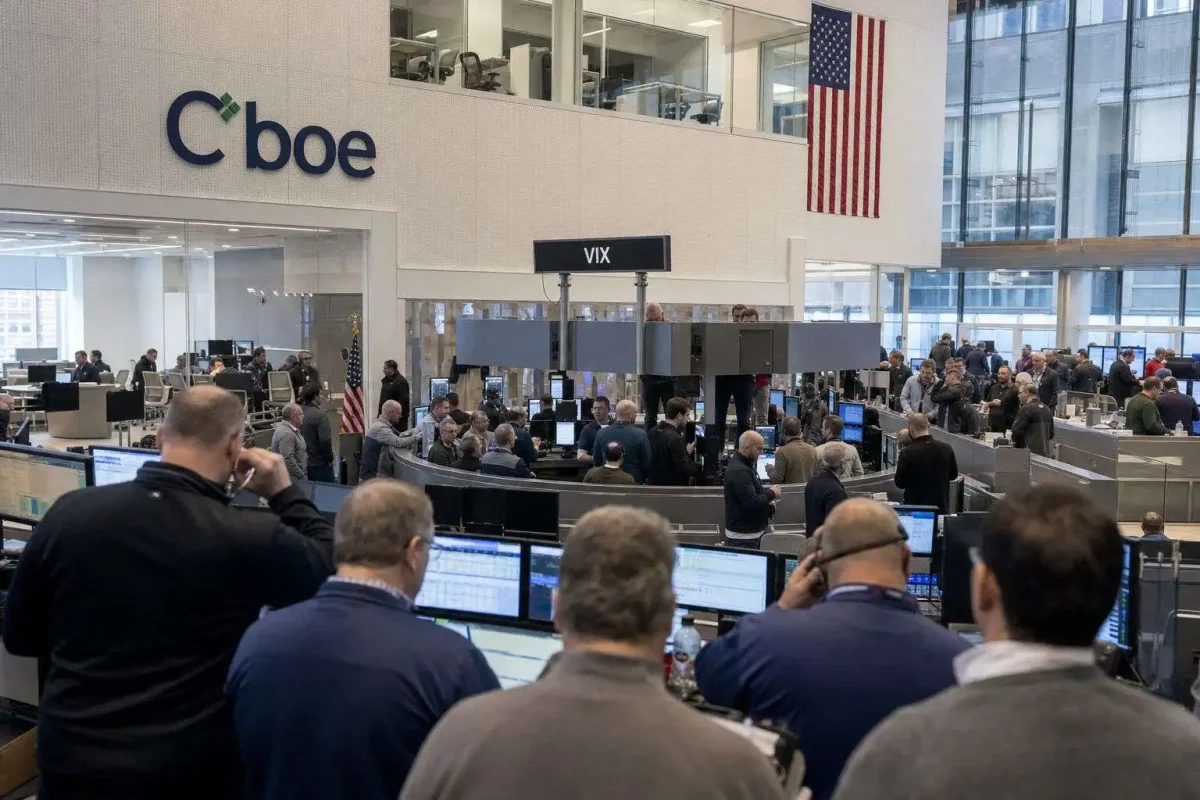
The Cboe Volatility Index (VIX) surged 9.52% on Tuesday, closing at 16.34, as rising oil prices and climbing Treasury yields prompted investors to seek short-term equity protection. The move marks a notable break from the calm that had prevailed in recent sessions, though the index remains well below its 52-week high.
The spike in volatility was disproportionately large compared to the decline in cash equities. The VIX rose 13.4 times more, in percentage terms, than the S&P 500's drop, signaling a rapid repricing of options rather than a broad market selloff. The S&P 500 ended the day at 7,631.47, down 0.71%, while the Nasdaq Composite slipped 1.03% and the Dow Jones Industrial Average fell 0.79%.
Oil prices continued their upward trajectory, with West Texas Intermediate (WTI) crude last trading at $90.77, up 0.61%, at 17:45 EDT. The Cboe 10-year Treasury yield index (TNX) rose to 47.96, equivalent to a 4.796% yield, an increase of 3.8 basis points. A fresh wave of U.S. strikes targeting Iran further escalated oil prices, with Brent crude up 2.3% at $92.61 by midday, heightening inflationary concerns.
"It is the perfect cocktail for a risk-off day in a market that is trading near all-time highs," said Ross Mayfield, investment strategy analyst at Baird, in a comment to Reuters.
Despite the sharp daily jump, the VIX remains just 13.5% above its 52-week low of 13.38, with the high at 35.30. Tuesday's increase in hedging interest, while notable, still leaves volatility pricing well below this year's peaks. The index had closed at 14.43 on Friday and 14.92 on Monday, making Tuesday's level 13.2% higher than Friday's close.
The appetite for volatility protection extended to the VIX options market as well. The Cboe VVIX index, which measures expected volatility in VIX options, climbed 5.75% to 91.25 from 86.29.
Looking ahead, the next major test for market volatility comes on Friday at 08:30 EDT, when the U.S. Bureau of Labor Statistics releases its August payrolls report. A significant shift in yields could impact discount rates for growth stocks and influence option premiums. Investors trading VIX futures or options should note that the spot VIX cannot be directly invested in, and futures prices may vary as volatility often reverts to the mean.
Risks to the current volatility level include a de-escalation in tensions involving Iran, which could lead to lower oil prices and yields, potentially reducing implied volatility. Conversely, higher-than-expected inflation readings or softer employment figures might amplify equity moves. Products tied to the VIX could also move out of sync with the spot level.