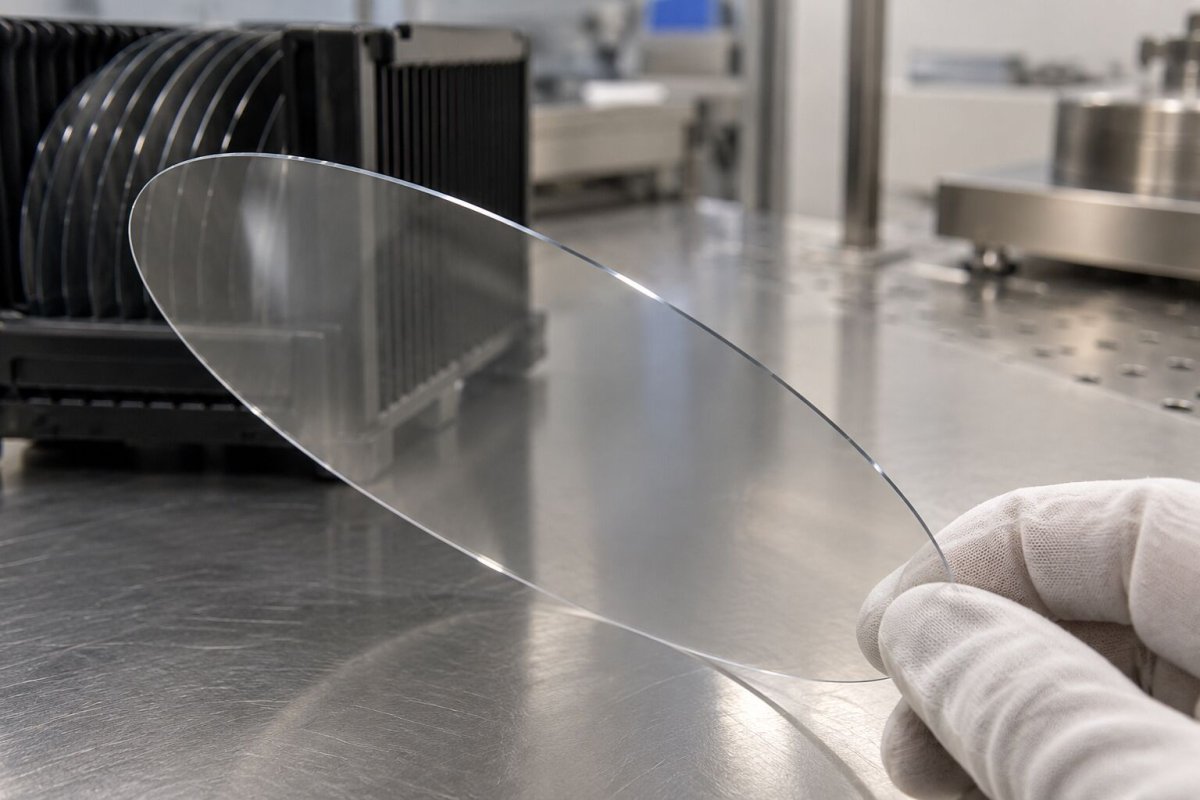
Wolfspeed (NYSE: WOLF) has introduced transparent silicon-carbide (SiC) substrates, aiming at augmented-reality (AR) optics and quantum technology applications. The Durham-based company announced the launch on October 29, with commercial listings for 150mm and 200mm wafers. However, 300mm material remains in the sampling phase, signaling that larger-diameter production is not yet qualified.
Wafer Sizes and Commercial Status
The distinction between commercial and sampling wafers is critical for manufacturers looking to transition from optical demonstrations to repeatable production. A 300mm wafer offers 2.25 times the nominal area of a 200mm wafer, but that geometric advantage does not guarantee usable yield or lower cost per lens. Wolfspeed’s commercial offerings include 150mm wafers with a nominal area of 176.7 cm² and 200mm wafers at 314.2 cm². The 300mm wafers, still in sampling, have a nominal area of 706.9 cm². These areas are calculated as π(d/2)², excluding edge exclusions and yield losses.
The wafers are produced in the 4H crystal form with double-sided polished surfaces. The target thickness is 500 micrometers with a tolerance of ±20 micrometers, though specifications can vary by diameter.
Optical Performance and Challenges
Wolfspeed specifies a bulk absorption ceiling of 0.05 cm⁻¹ at wavelengths of 450–650 nanometers. Based on this, the theoretical transmission through a 0.5mm thickness would be 99.75%. Over a 1cm path, transmission drops to 95.12%, and over 10cm, it falls to 60.65%. However, these figures account only for bulk absorption and exclude surface reflections, scattering, and coupling losses, which are significant in real-world optical systems.
In waveguides, light follows an optical path rather than simply crossing the thickness, making the route length a key factor in the absorption budget. Therefore, actual performance in finished devices could be lower.
Industry Context and Research
The push for transparent SiC is driven by its exceptionally high refractive index, which allows single-layer waveguides to replace stacked optics, according to Barry Silverstein, an optics specialist at the University of Rochester. Meta (NASDAQ: META) has associated silicon carbide with its Orion AR glasses, which feature an approximately 70-degree field of view, but has noted production complexity and cost as ongoing hurdles.
A September preprint by Xiaoxuan Li and colleagues described a 0.35mm SiC waveguide weighing 1.98 grams, with four lens pairs patterned on an eight-inch wafer. They reported 92% see-through transmission after adding a magnesium-fluoride planarization layer and a 30-degree full-color field of view in optical simulations. These results are not directly comparable to Orion’s figures due to different devices and test methods.
Market Implications and Risks
For potential buyers, Wolfspeed’s announcement provides a substrate specification and a path to request samples, but lacks pricing, shipment volumes, or named customers. This leaves the manufacturing economics uncertain. Qualification will need to establish optical consistency, usable yield, and finished-waveguide performance at each diameter. Sampling alone does not prove a reliable 300mm production process.
Wolfspeed lists separate product numbers for 150mm and 200mm optical wafers, but no corresponding 300mm part number. The question remains whether 300mm will reach a defined production specification with published qualification results.