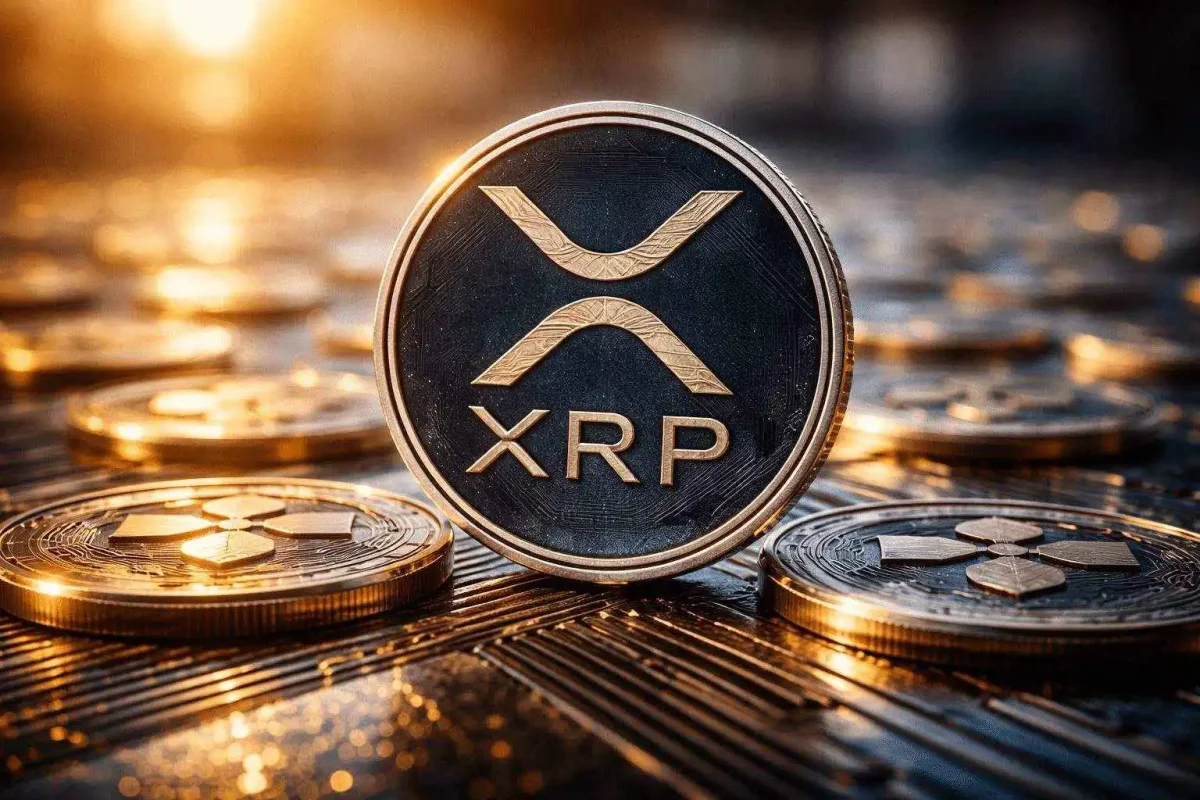
WARSAW, July 30, 2026 – As U.S. cash markets closed, cryptocurrency trading commenced with XRP hovering near $1.08, marking a 2% gain over the past 24 hours. The session saw prices fluctuate between $1.06 and $1.09, according to CoinMarketCap.
Despite the modest uptick, a deeper look at institutional flows reveals a stark disconnect. U.S. spot exchange-traded funds (ETFs) for XRP currently hold $989 million in net assets, significantly below the total net inflows of $1.496 billion accumulated since launch. This $507 million gap represents 33.9% of cumulative inflows. The shortfall is not a realized loss but a mark-to-market measure that accounts for fees and the timing of capital movements, underscoring that the growth of regulated access has outpaced the actual value retained within these funds.
New investment has slowed considerably. On Wednesday, inflows totaled just $584,700, a mere 0.039% of all subscriptions to date. During the prior full week (July 20–24), net additions reached $8.153 million, equivalent to 0.545% of cumulative inflows. Single-day inflows accounted for only 5.6% of ETF trading activity and a negligible 0.05% of XRP's total daily token volume, which stood at approximately $1.1 billion. This suggests that while market participants remain optimistic, the conviction behind fresh capital is weak.
XRP's price action largely mirrored broader market trends without significant divergence. Among major cryptocurrencies, Bitcoin led with a 2% rise to $64,822, while Ether and Solana each gained 1.8%, trading at $1,923 and $74.57, respectively. XRP's turnover ratio—a measure of trading volume relative to market capitalization—was the lowest among the group at 1.62%, indicating reduced risk appetite despite its $68.11 billion market cap, which exceeds Solana's $43.22 billion.
The Federal Reserve's decision to hold interest rates steady at 3.50%–3.75% on Wednesday added a layer of uncertainty. Three committee members favored a 25-basis-point hike due to persistent inflation, leaving the door open for tighter monetary policy. This divided stance is particularly challenging for yield-less assets like cryptocurrencies. The meeting triggered leveraged market liquidations totaling roughly $286 million across 87,294 traders, with long positions suffering $186 million in losses and shorts losing $100 million.
Regulated derivatives activity offers a window into genuine institutional engagement with XRP. CME Group (NASDAQ:CME) reported an average of 36,600 daily XRP contracts in the second quarter, with a notional value of $10.8 billion. While this volume trails Solana's $12.8 billion, it reflects broad participation, albeit with limited capital depth. For context, Bitcoin saw 115,900 contracts worth $320.9 billion, and Ether had 89,700 contracts valued at $114.2 billion.
Regulatory developments remain a key catalyst. Analysts at JPMorgan Chase (NYSE:JPM), led by Nikolaos Panigirtzoglou, noted that prediction markets assign a 37% probability to the Clarity Act passing by year-end. The proposed legislation would allocate oversight responsibilities between the SEC and CFTC. "The longer the approval of the Clarity Act is postponed, the greater the threat to crypto markets," Panigirtzoglou said. For XRP, a favorable regulatory outcome could prove more impactful than incremental inflows of less than $1 million.
Risks to XRP include its current price, which is approximately 72% below CoinMarketCap's all-time high of $3.84. Further rate hikes, reduced liquidity, or legislative delays could trigger renewed selling. Conversely, policy progress or increased fund interest could shift the outlook. At present, XRP's institutional appeal stems more from a diverse range of available products than from price strength. A substantial increase in incremental demand will be needed for the next significant move, as increased accessibility alone has not been sufficient.