Zcash (ZEC) held above the $1,000 mark on Friday evening, capping a week of intense volatility that saw the privacy-focused cryptocurrency reach its highest sustained price in nearly a decade. The token traded at $1,023.49 as of 6:54 p.m. EDT, up 7.9% over the past 24 hours, according to CoinGecko. Earlier in the session, it touched an intraday high of $1,046.30, with a market capitalization of $17.32 billion.
The psychological significance of the $1,000 level is clear, but the underlying market dynamics are more complex. Grayscale's newly launched Zcash exchange-traded fund (ETF), trading under the ticker ZCSH, has attracted approximately $34.4 million in net inflows since its debut on August 25. Meanwhile, Friday's rally triggered an estimated $34.5 million in short liquidations, a striking coincidence that underscores the confluence of new investment vehicles and leveraged trading activity.
These figures, while nearly identical, represent different forces. The ETF inflows are a slow, steady accumulation of exposure by investors seeking regulated access to ZEC. The short liquidations, by contrast, are a mechanical response to price movements, forcing bearish traders to cover their positions and fueling the upward momentum. Together, they have landed in a market where futures exposure and momentum had already reached unusually high levels.
ZEC's Meteoric Rise
Over the past 30 days, ZEC has nearly doubled in value, posting a gain of 97.6%. The token's price chart from August 5 to September 4 shows a steady climb from around $500 to over $1,000, with the latest observation at $1,023.49. This dramatic appreciation has caught the attention of both retail and institutional investors, though the sustainability of the move remains a key question.
The Grayscale Zcash ETF, which converted from a private trust, is the first U.S. exchange-traded fund to offer direct ZEC exposure, according to The Block. Its cumulative inflows represent just 0.20% of ZEC's current market value, a figure that alone cannot explain the token's 97.6% monthly gain. However, asset prices are determined by the next trade, not by dividing new cash into the total market capitalization. A steady buyer can have an outsized impact when available supply is limited.
Leverage and Liquidity
The faster impulse came from the derivatives market. Approximately $36.6 million of ZEC positions were liquidated over the 24-hour period, with shorts accounting for $34.5 million, or 94% of the total. Forced short closures require purchases, creating mechanical buying pressure that can disappear once the weakest bearish positions are wiped out.
Futures open interest reached about 2.3 million ZEC, worth roughly $2.35 billion at Friday evening's price, representing about 13.6% of ZEC's market capitalization. This level of derivatives exposure suggests that the market is primed for amplified moves in either direction, as futures contracts have two sides and can exacerbate volatility.
ETF Access and Costs
The ZCSH ETF brings ZEC into ordinary brokerage accounts, removing the need for wallet custody and exchange onboarding for investors who prefer a regulated security. However, this convenience comes at a price: ZCSH charges an annual fee of 2.5%, according to Grayscale's launch information. Direct holders of ZEC do not pay this fee but assume custody and trading risks.
Before the ETF debut, the converted trust held $313.5 million in assets, much of which represented existing exposure rather than new buying. Net creations since launch provide a cleaner signal of fresh demand. Grayscale's Head of Index, Steve Vanourny, linked the product to growing demand for "genuine financial privacy," citing artificial intelligence and financial surveillance as drivers. This long-duration thesis contrasts with the short-term trading dynamics that dominated Friday's action.
Mining and Network Response
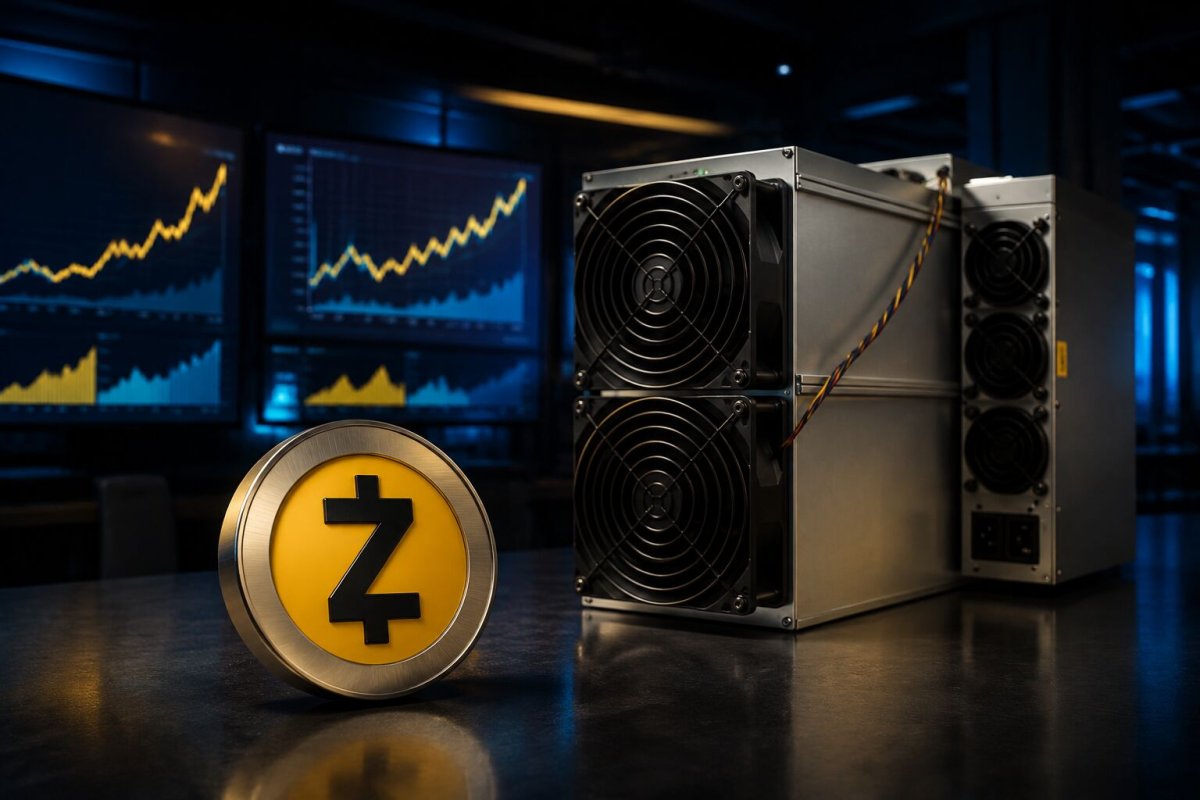
Zcash's network computing power has risen from roughly 25 GSol/s in late August to more than 30 GSol/s, an increase of at least 20%, according to data reported by The Block. While this enhances network security, it also intensifies competition among miners, diluting revenue per machine. Estimated gross revenue for a top Z15 Pro miner slipped about 3% per megawatt-hour from late August, despite ZEC's higher price.
Bitmain rates the Z15 Pro at 840 KSol/s and 2,780 watts under typical conditions, making power costs and network difficulty central to mining profitability. The weekend presents a unique challenge: crypto trades continuously, but the ETF does not, creating a two-day gap between ZEC price discovery and ZCSH's next opening print.
Risks and Outlook
ZEC's 24-hour low-to-high range was 12.1%, signaling elevated execution and gap risk. A sharp weekend move could leave ZCSH shareholders unable to respond until U.S. markets reopen. The token remains 67.9% below its brief 2016 launch-era peak of $3,191.93, a comparison that is imperfect due to thin early trading but highlights how quickly scarcity narratives can reverse.
Privacy coins also carry additional policy risk. Exchange access can change as platforms assess anti-money-laundering rules, and reduced access would weaken liquidity and make derivatives-driven moves harsher. The next useful evidence will be complete ZCSH flow data for Thursday and Friday, along with proof that ZEC can maintain its gains once the forced short buying fades.