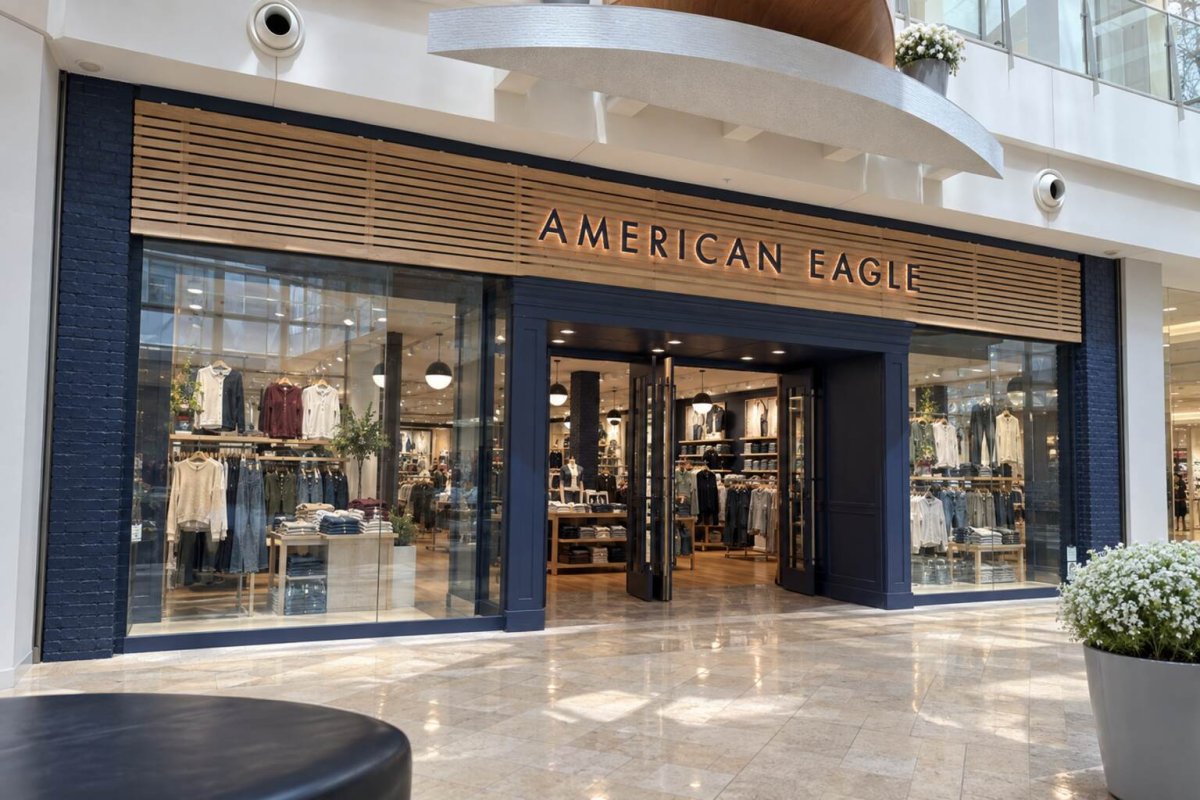
American Eagle Outfitters (AEO) saw its shares tumble approximately 10.4% in after-hours trading on Wednesday, as investors focused on the fact that the retailer's headline earnings beat was largely driven by a one-time tariff refund, not operational strength. The stock was trading at $15.15 by 6:20 p.m. Eastern, down from a regular-session close of $16.91, according to Nasdaq data. Including the regular session's decline, the shares were roughly 12% below Tuesday's closing price of $17.22.
The 1 Million Issue Within the Beat
At first glance, the quarter appeared robust. Revenue reached a record $1.380 billion, up 8% year-over-year, and diluted earnings per share came in at $0.79. Analysts had anticipated earnings of roughly $0.21 to $0.22 per share on revenue of $1.37 billion, according to estimates compiled by Zacks and Investing.com.
However, the company's SEC filings reveal that AEO received $196 million in tariff refunds, including interest. After accounting for refund-related incentive compensation, the net benefit to operating income was $161 million. Reported operating profit was $211.4 million, more than double the prior year's $103.1 million. Subtracting the disclosed refund benefit leaves approximately $50.4 million, a calculation by TS2, implying an operating margin of roughly 3.7%, down from 8.0% a year ago.
The same distortion appears higher up the income statement. Gross profit rose to $672.1 million, with gross margin expanding 980 basis points to 48.7%. The filing attributes $179 million of the refund benefit to adding 1,300 basis points. Without it, gross profit would have been approximately $493.1 million, and the margin would have been about 35.7%. Management separately disclosed that merchandise margin deleveraged by 330 basis points.
Aerie Carries the Growth
The bearish reading isn't the full story. Aerie and OFFLINE remain a powerful growth engine: Aerie revenue jumped 25% to $535.8 million, with comparable sales up 19%. The American Eagle brand generated $805.9 million, up less than 1%, while its comparable sales declined 1%.
Aerie added about $106.7 million in revenue year-over-year, more than the entire company's $96.7 million increase. This arithmetic underscores the portfolio's growing reliance on Aerie. While Aerie can support the stock if momentum persists, it also has to outrun a much larger namesake brand whose women's business management admits still needs greater consistency.
Inventory adds another constraint. Inventory costs were 14% higher year-over-year, with units up 9%, both outpacing the 8% sales increase. Part of the cost increase reflects tariffs, yet elevated units could translate into markdown risk if demand falters.
Why the Raised Forecast Didn't Rescue the Stock
AEO now expects fiscal-year operating income of $540 million to $550 million, but that guidance includes the tariff-refund benefit. At the $545 million midpoint, subtracting the $161 million already booked leaves roughly $384 million. Again, this is an analytical bridge rather than official adjusted guidance.
The comparison matters because AEO's previous full-year forecast called for $390 million to $410 million of operating income and explicitly excluded tariff refunds. On a like-for-like basis, the new midpoint sits below the old $400 million midpoint. The company also says it has received substantially all the refunds for which it submitted claims, limiting the case for treating this quarter's lift as recurring.
There's one more cost attached to the refund story: AEO recorded $45 million in interest expense tied to a prior agreement to sell certain refund claims. The windfall was real cash and materially strengthened the reported quarter, but neither its timing nor its accounting makes it a clean signal of retail earnings power.
What Investors Should Watch Next
For the third quarter, management forecasts mid-to-high-single-digit comparable-sales growth, a roughly flat gross margin, and operating income of $110 million to $115 million. These targets provide a cleaner test of the business after the refund-heavy second quarter.
The path to a better stock reaction is straightforward but demanding: Aerie must sustain double-digit momentum, American Eagle comps need to turn positive, and inventory growth must converge with sales without heavier promotions. If those pieces arrive together, Wednesday's selloff may prove too skeptical. If they don't, the apparent earnings beat will look exactly as the after-hours market treated it—a temporary boost that obscured weaker underlying margins.