AeroVironment's fiscal first-quarter results were better than the pre-earnings selloff indicated, yet the stock's after-hours recovery only partially offset the day's losses. The defense-technology firm posted record revenue and a funded backlog of $1.5 billion, but a closer look reveals a divergence in performance across its business segments.
After-Hours Movement
Following the earnings release, AVAV shares climbed 2.7% to $144.65 in after-hours trading on Wednesday, recovering a slice of the 5.36% decline to $140.80 seen during the regular session. The bounce suggests investors were relieved by the headline numbers, but the stock remained roughly 2.8% below Tuesday's close of $148.78 at the Nasdaq snapshot.
Quarterly Results and Guidance
For the fiscal first quarter, AeroVironment generated revenue of $480.5 million, up 6% year-over-year from $454.7 million. Adjusted earnings per share came in at $0.59, up from $0.32 in the prior-year quarter. Both figures surpassed the consensus estimates of $459.9 million in revenue and $0.30 in adjusted EPS, as compiled by Kiplinger.
Despite the beat, management left its full-year fiscal 2027 outlook unchanged. The company still expects revenue in the range of $2.125 billion to $2.225 billion, adjusted EBITDA between $305 million and $325 million, and adjusted EPS of $3.02 to $3.34. The decision to hold guidance steady may indicate management sees timing risks ahead or simply prefers to avoid revising government-contract forecasts after just one quarter.
Backlog and Bookings
The strongest element of the bull case is the backlog. Bookings reached roughly $700 million during the quarter, resulting in a book-to-bill ratio of 1.4, meaning orders outpaced recognized revenue. Funded backlog increased to $1.5 billion as of August 1, up from $1.2 billion at the end of April and 37% higher than a year ago. This metric is particularly meaningful as it represents firm orders with appropriated funding, though it does not eliminate delivery or acceptance risks.
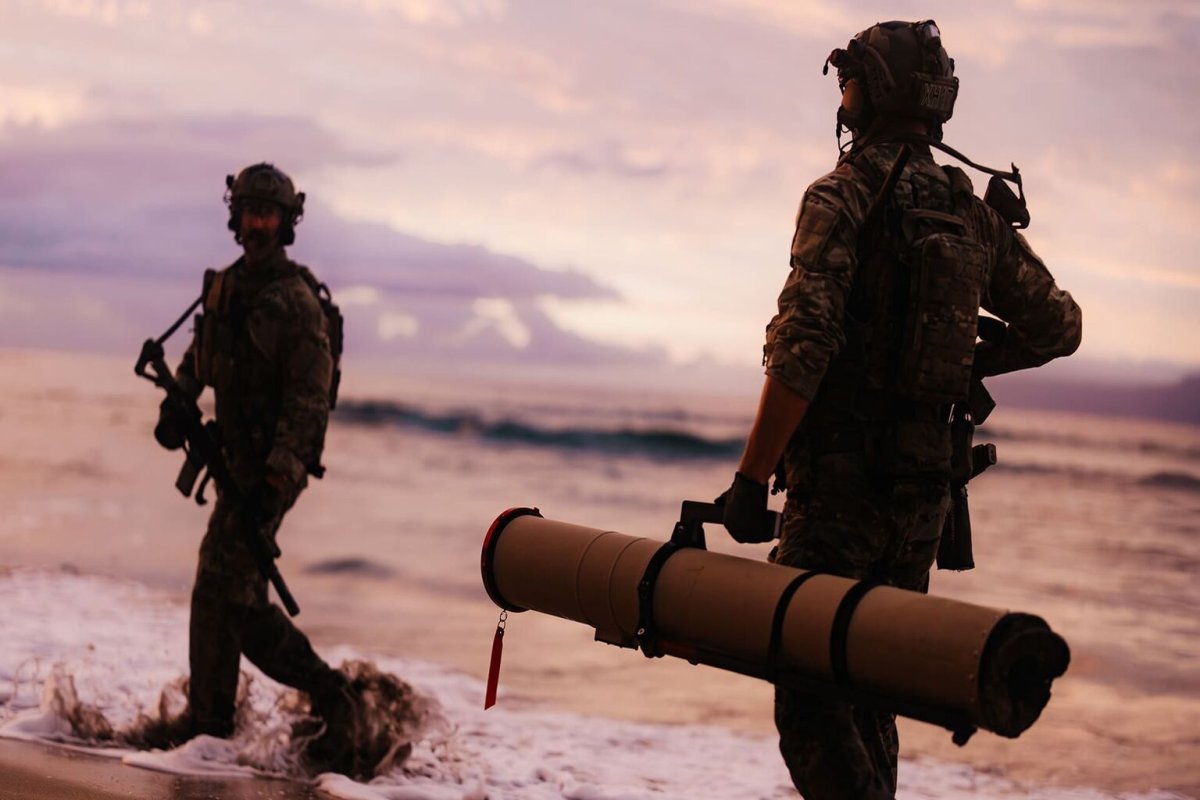
Recent contract awards underpin the demand picture. In August, the U.S. Army placed a $51 million order for Switchblade 600 loitering munitions under a five-year, $990 million contract vehicle. The Switchblade 600 is designed for hardened targets with over 40 minutes of endurance and a range beyond 40 kilometers. The investment thesis hinges on these programs converting into repeat production at sustainable margins.
Segment Performance
Growth was concentrated in the Autonomous Systems segment, where revenue rose 21% to $346.0 million and adjusted EBITDA increased 18% to $62.3 million. In contrast, the Space, Cyber, and Directed Energy (SCDE) segment saw revenue fall 21% to $134.5 million, and it swung to an adjusted EBITDA loss of $8.9 million, compared with a $3.8 million profit a year earlier.
Companywide gross margin expanded to 26% from 21%, but much of that improvement came from lower intangible amortization and purchase-accounting charges. Adjusted EBITDA slipped to $53.4 million from $56.6 million, and the adjusted EBITDA margin contracted to 11.1% from 12.4% despite revenue growth. This margin pressure is a key counterweight to the headline EPS beat.
Cash Flow and Balance Sheet
Operating cash flow turned positive at $13.5 million, a sharp improvement from a $123.7 million outflow in the prior-year period. However, capital spending of $44.0 million and inventory consumption of $100.3 million weighed on cash, which fell by $98.9 million to $278.4 million. The company also made net investment purchases of $58.8 million.
The balance sheet remains manageable, with $730.1 million in long-term debt against $278.4 million in cash and $396.6 million in short- and long-term investments. Based on 50.8 million shares outstanding and the after-hours price, the equity value is approximately $7.35 billion, translating to an enterprise value of roughly $7.4 billion. The stock trades at about 3.4 times the midpoint of fiscal 2027 revenue guidance and roughly 23.5 times the midpoint of adjusted EBITDA guidance.
What to Watch
Looking ahead, the bullish scenario would feature another quarter of book-to-bill above one, positive operating cash flow, and a narrowing SCDE loss, ideally followed by a guidance increase. Conversely, the bear case strengthens if inventory continues to outpace deliveries, funded orders slip, or margins remain below prior-year levels.
Wednesday's report cleared a low bar after the regular-session decline. The $1.5 billion backlog supports the growth narrative, but the segment split and unchanged forecast remind investors that evidence of broader profit expansion is still needed.