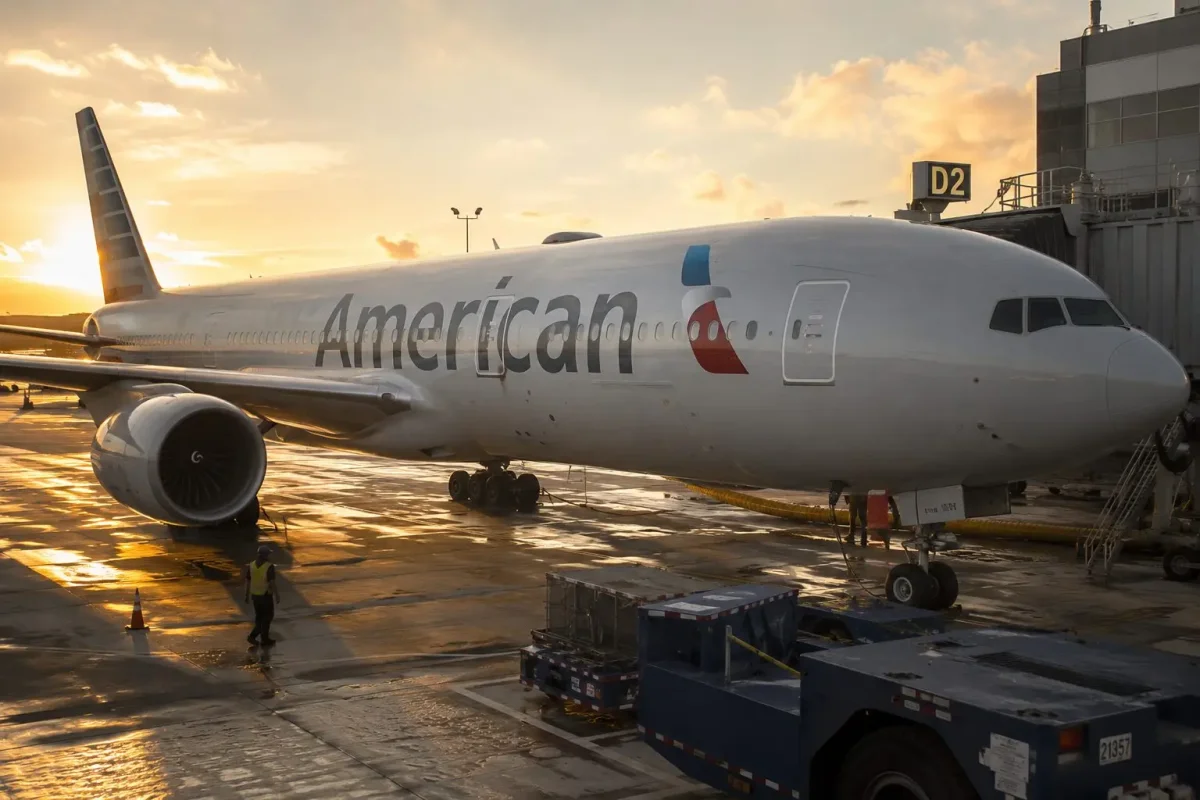
American Airlines Group Inc. (NASDAQ:AAL) is set to release its second-quarter earnings on Thursday, following a significant 11.6% decline in its stock price over the past week. The shares closed at $14.98 on Friday, July 17, after falling 3.97% in that session. U.S. markets were closed on Saturday, July 18.
The airline's stock performance has lagged behind its peers and the broader market. Over the past week, American Airlines underperformed a three-peer average by 7.3 percentage points and trailed the S&P 500 by 10.1 points. This disparity highlights the intense focus on margin conversion as the company's earnings report approaches.
In April, American Airlines projected second-quarter revenue growth of 13.5% to 16.5%. However, its adjusted earnings outlook ranged from a loss of 20 cents per share to a gain of 20 cents per share, with a midpoint of zero. This narrow range provides little buffer if fuel cost recovery proves weaker than anticipated.
Friday's market action saw renewed pressure on airline stocks. The S&P 500 declined 1.01%, while all major airline peers fell, albeit by smaller margins than American. United Airlines Holdings Inc. (NASDAQ:UAL) dropped 2.9% for the day and 8.4% for the week. Delta Air Lines Inc. (NYSE:DAL) fell 2.9% on Friday and 3.7% weekly. Southwest Airlines Co. (NYSE:LUV) slipped 2.7% and 0.7%, respectively. The average decline for the three-stock peer group was 4.3%.
American Airlines' full-year outlook projects a loss of $0.40 to a profit of $1.10 per share, with anticipated additional fuel costs exceeding $4 billion. For the second quarter, the company's assumptions were based on fuel prices near $4 per gallon, partially offset by higher fares.
Leverage remains a key risk. At the end of March, American Airlines' total debt stood at $34.7 billion, its lowest level since mid-2015. This figure includes leases and pension liabilities and represents roughly 3.5 times the company's $9.91 billion market capitalization as of Friday.
United Airlines has set a new benchmark for the industry. The carrier reported a 16% increase in second-quarter revenue, approaching the upper end of American's guidance. United posted adjusted earnings of $1.99 per share and raised its full-year forecast to $9-$11 per share. The company expects nearly $6 billion in additional fuel costs. United CEO Scott Kirby noted that yields are expected to return to "reasonable pre-pandemic levels," with higher fares having minimal impact on demand.
American Airlines CEO Robert Isom stated in April that the company expects "modest profitability for the year" given fuel prices at the time. That forecast will be closely scrutinized in Thursday's update. Fuel prices have remained volatile, with United reporting that July's increase alone raised anticipated third-quarter expenses by $575 million, or $1.12 per share.
American's earnings call is scheduled for July 23 at 7:30 a.m. CDT. Investors will focus on third-quarter unit revenue, fuel cost expectations, and progress on debt reduction. The outlook may carry more weight than a slight quarterly beat. Risks persist: a decline in oil prices could rapidly close the stock gap, higher fares might boost guidance, while softer demand could delay debt repayment. The zero-cent midpoint sets a low bar for earnings, placing greater emphasis on fuel recovery and debt-related cash flow.