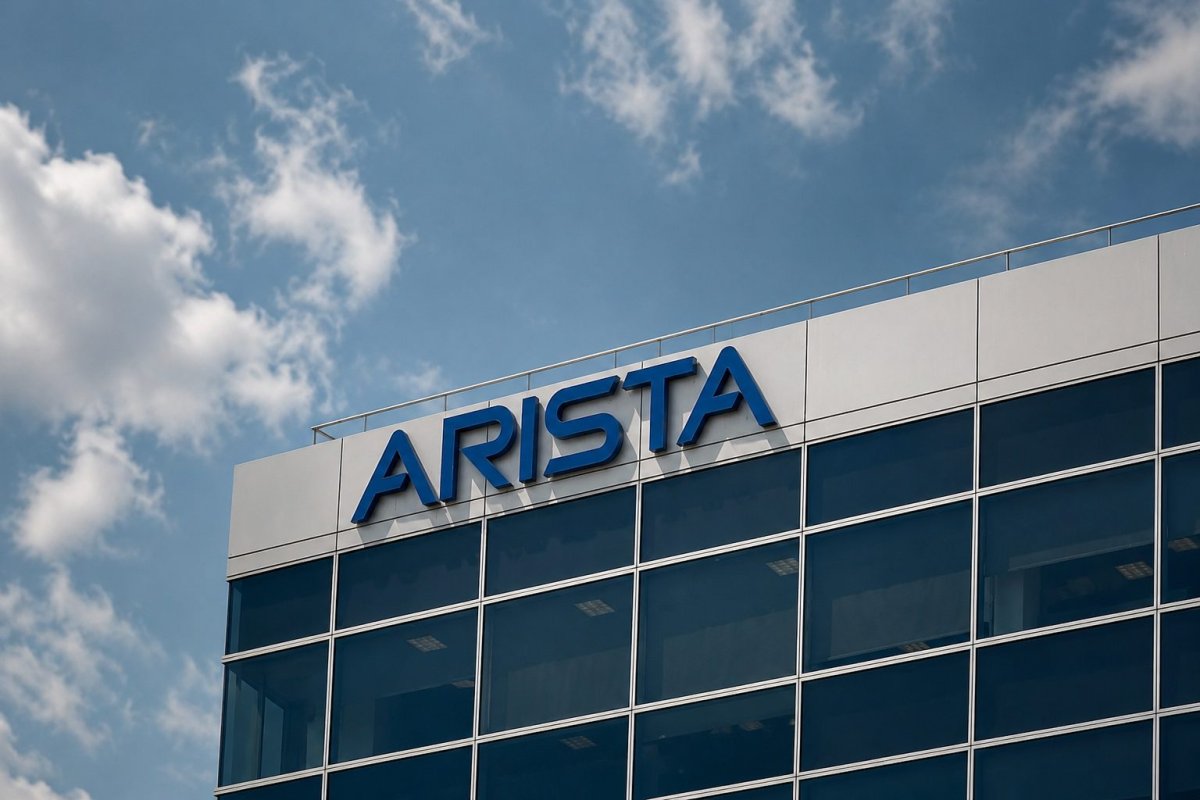
Arista Networks (ANET) shares closed up 7.65% at $171.68 on Monday, pushing the networking equipment maker within 4.5% of its 52-week high. The rally added roughly $15 billion to the company's market capitalization, as investors continued to pile into artificial intelligence infrastructure plays.
The move came on a day when technology stocks broadly outperformed. The S&P 500 rose 0.43% and the Nasdaq Composite gained 0.69%, while Nvidia (NVDA) jumped 5.8% after unveiling a new AI-focused PC chip, according to Reuters.
AI Networking at the Core
Arista occupies a critical niche in the AI buildout, supplying switches, routers, and software that manage data flow within large data centers. Ethernet, the standard networking protocol, has become central to the debate over how AI clusters will be wired at scale. The company's first-quarter results, released last month, showed revenue of $2.709 billion, up 35.1% year-over-year, with operating cash flow of $1.69 billion. CEO Jayshree Ullal said Arista was "off to a strong start" and positioned across campus, cloud, and AI networking.
Analyst Optimism and Key Products
Rosenblatt Securities analyst Mike Genovese upgraded Arista to buy in April, raising his price target to $180. He wrote that revenue growth could move "closer to 40%" in 2026 and 2027 if Arista maintains share at key cloud customers like Microsoft (MSFT) and Meta (META) and gains ground at Alphabet (GOOGL). Investors have also focused on Arista's XPO, a high-density, liquid-cooled optics module that delivers 12.8 terabits per second per module and targets AI networking fabrics.
Competitive Landscape
Arista faces competition from Cisco (CSCO), which it cites as a historic force in data-center and campus networking, and Nvidia, which sells not only chips but also networking gear and systems. The competitive environment remains intense as AI spending drives demand.
Risks and Challenges
The company warned in its 2025 annual report that some key components come from sole or limited sources, and that large purchases by a small number of customers make up a significant portion of revenue. Two customers each accounted for more than 10% of revenue in each of the last three years. Supply shortages or extended lead times could hurt results. Additionally, gross margin faces pressure from rising costs of memory, silicon, or optics, and Arista noted that material scarcity and tighter memory supply have already impacted margins.
The stock's current valuation reflects expectations of continued AI data-center spending, increased Ethernet adoption, and Arista's ability to ship into demand without significant margin erosion. The next test will be order trends, lead times, and customer concentration. If large cloud buyers maintain spending and XPO gains traction, Monday's move could mark a new base. However, if supply tightens or a major customer pauses, the same concentration that lifted shares could reverse the gains.