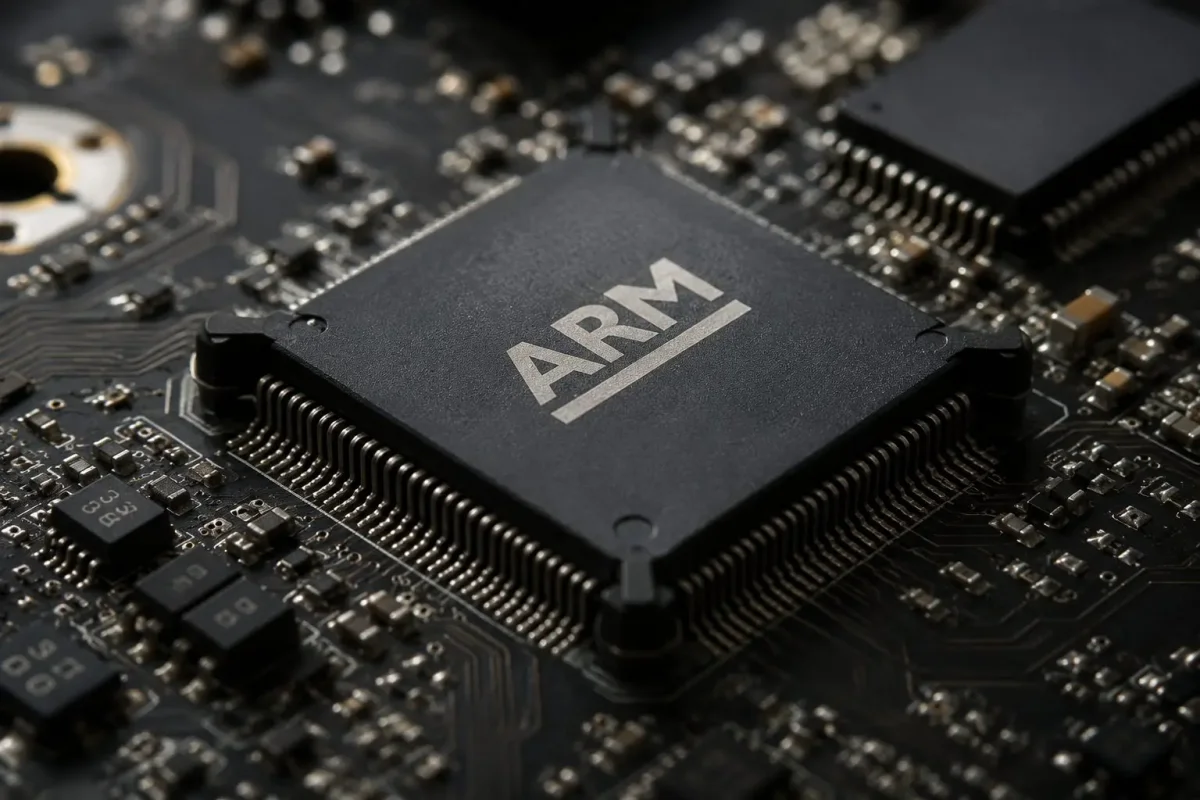
Arm Holdings shares edged lower in New York trading on Tuesday, retreating 1.3% to $302.44 after touching an intraday high of $323.89. The pullback comes on the heels of a blistering 46.5% surge last week that propelled the stock past Bernstein's $300 price target and near record levels.
The decline underscores growing investor scrutiny as Arm's recent rally positions the company as a bellwether for a potential new chip cycle centered on central processing units (CPUs). These server chips are increasingly critical for managing data and orchestrating workloads in AI data centers, a shift that is broadening spending beyond graphics processing units (GPUs).
Arm's fiscal fourth-quarter results provided strong fundamental support. The company reported record quarterly revenue of $1.49 billion, up 20% year-over-year, with licensing revenue climbing 29% to $819 million and royalties rising 11% to $671 million. For the full fiscal year, revenue reached $4.92 billion. CEO Rene Haas highlighted that demand for Arm's AGI CPU, its first data-center chip, "exceeded expectations."
Arm disclosed that customer demand for its AGI CPU has more than doubled in just six weeks, with over $2 billion in committed orders across fiscal 2027 and 2028. The company named Meta as its lead partner and co-developer, and said more than 50 companies—including AWS, Google Cloud, Microsoft, Nvidia, Oracle, Samsung, SK Hynix, and TSMC—are backing its silicon plans.
Nvidia, however, turned up the competitive heat. The GPU giant posted record fiscal first-quarter revenue of $81.6 billion, up 85% from a year ago, with data-center revenue hitting a new high of $75.2 billion. CEO Jensen Huang described the push to build AI factories as the "largest infrastructure expansion in human history."
Nvidia is also pushing into the CPU market. On its earnings call, the company introduced Vera, a CPU built on custom Arm cores designed for agentic AI workloads. Nvidia said Vera unlocks a $200 billion total addressable market and expects nearly $20 billion in CPU revenue this year. This positions Nvidia simultaneously as a partner, customer, and rival to Arm.
Arm's stock now trades just above Bernstein analyst David Dai's $300 target, which he set when initiating coverage with an outperform rating last week. Dai called Arm "unparalleled in power efficiency" and said the company is at the "center of the renaissance of CPUs" as AI workloads shift toward autonomous agents.
But the easy gains may be over for now. Critics point to Arm's forward price-to-earnings ratio, now near 191, and the stock's relative strength index (RSI) has climbed into the high 60s, approaching overbought territory. Options traders on Moomoo described the 38% rally over three sessions as "running into a wall."
Investors are now focused on execution. Arm expects initial AGI CPU production revenue in the fiscal fourth quarter, with longer-term targets of $15 billion from AGI CPUs and $10 billion in intellectual-property revenue by fiscal 2031. Having already hit one of Wall Street's most aggressive price targets, meeting these milestones will be critical for sustaining momentum.