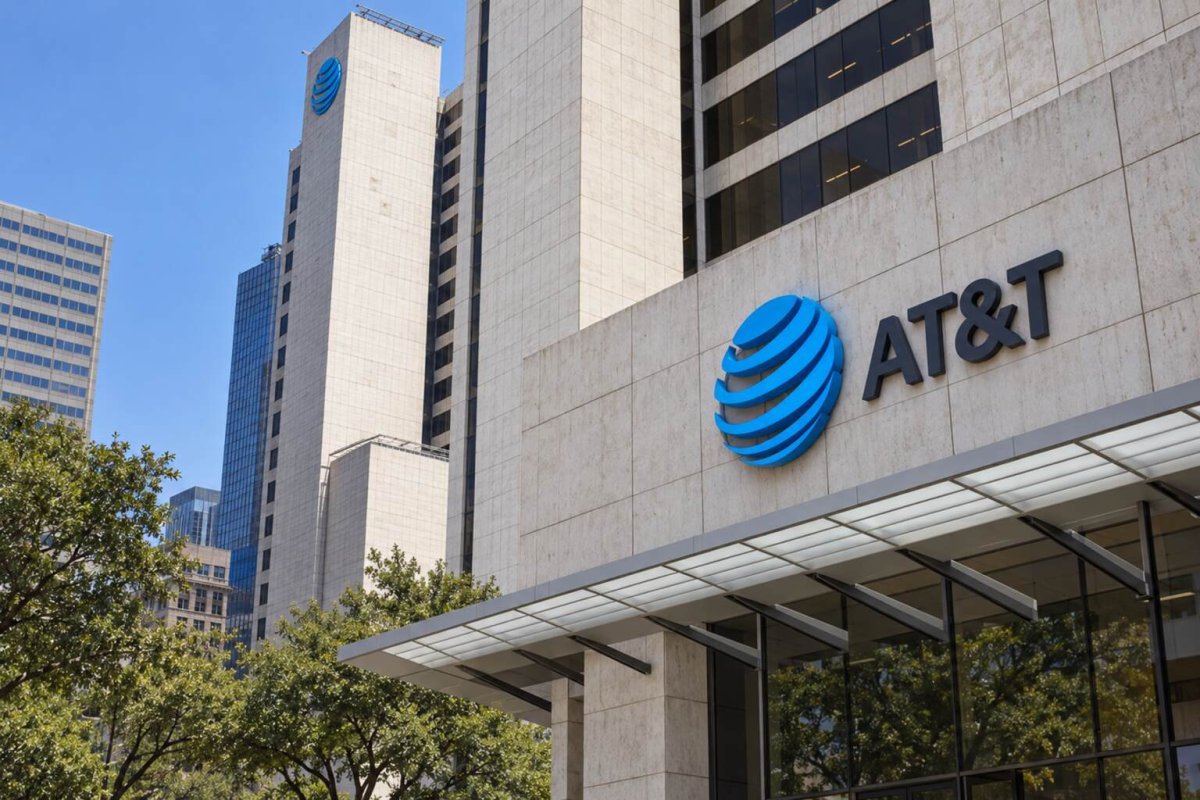
AT&T (NYSE: T) has accelerated its share repurchase program with a $10 billion buyback, representing roughly 5.6% of its market capitalization. Combined with a dividend yield of approximately 4.3%, the stock now offers a gross cash-return proposition of nearly 10% based on Friday's closing price of $26.06. However, this attractive return hinges on the company's ability to generate sufficient cash flow while simultaneously reducing its leverage.
The Cash Return Equation
Management has outlined plans to return more than $45 billion to shareholders through dividends and buybacks over the 2026-2028 period. The buyback component alone is projected at approximately $24 billion, with $10 billion slated for 2026. At Friday's market close, AT&T's market capitalization stood at $178.6 billion, making the $10 billion buyback equivalent to 5.6% of the company's value.
The dividend, set at $1.11 annually, yields 4.26% at the current price. Estimated dividend cash costs are around $7.6 billion, based on the implied share count. Together, the 2026 shareholder returns amount to roughly $17.6 billion, which is nearly 98% of the company's $18 billion-plus free cash flow target. These figures underscore the tightrope AT&T is walking—almost all of its projected free cash flow is already earmarked for shareholder returns, leaving little margin for error.
Management's Bullish Case
AT&T's second-quarter results showed improvement, with revenue rising 2.3% to $31.6 billion and adjusted EBITDA up 5.2% to $12.3 billion. Free cash flow reached $4.7 billion, and the company added 432,000 postpaid phone customers and 646,000 fiber internet customers. CFO Pascal Desroches described the quarter as a “tipping point” during a Bank of America conference, highlighting the successful closure of the Lumen fiber assets and EchoStar spectrum acquisitions.
The strategic bet is on convergence: using fiber to win homes and then attaching wireless services to create longer-lasting customer relationships. Management acknowledges this may initially dilute fiber ARPU as they use competitive pricing to anchor customers, particularly in the newly acquired Lumen footprint. This trade-off could be rational if it leads to lower churn and higher wireless attachment, but it could also mask weak pricing if the strategy underperforms.
The Debt Challenge
AT&T ended June with $144 billion in total debt and $126.4 billion in net debt. The recent EchoStar spectrum purchase, valued at roughly $23 billion, was financed with cash and incremental borrowing, adding to the balance sheet burden. CEO John Stankey defended the accelerated buyback, citing undervaluation, but reiterated the company's commitment to reducing net debt to approximately 2.5 times adjusted EBITDA.
The bullish scenario sees free cash flow growing to at least $19 billion in 2027 and $21 billion in 2028, with double-digit adjusted EPS growth. If fiber penetration improves and wireless service revenue continues to grow, the company could repurchase stock while deleveraging. However, the risk is that the buyback is front-loaded, the spectrum payment is now on the books, and the fiber strategy intentionally accepts lower initial ARPU. Any shortfall in cash conversion could force tough choices among buybacks, investment, and debt reduction.
Investors will be watching the October 21 third-quarter report closely for evidence that EBITDA and free cash flow are accelerating enough to sustain the payout without pushing the leverage target further away. The yield is visible today, but its durability depends on execution.