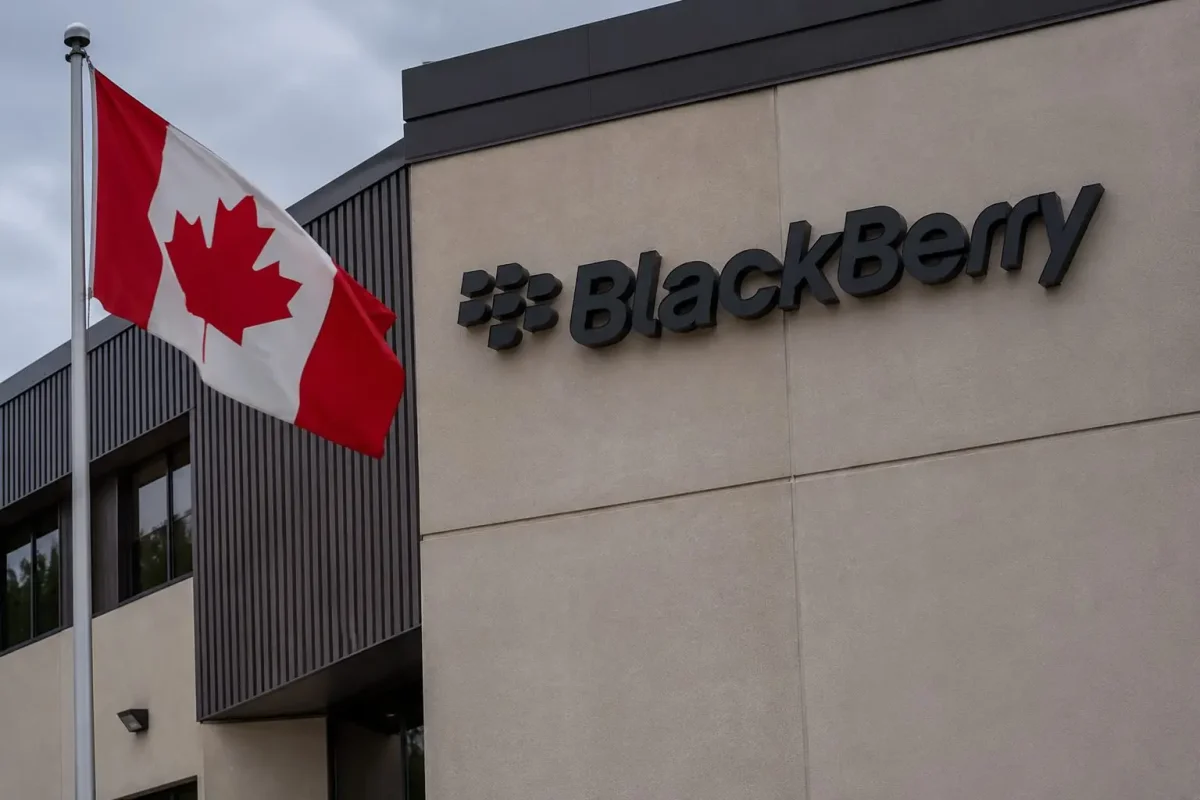
BlackBerry Ltd. shares ended Friday at $9.00 on the New York Stock Exchange, gaining 2.5% on the day and capping a 13.8% weekly advance during a holiday-shortened U.S. trading period. The stock has now risen for six consecutive sessions, approaching its 52-week high.
The rally reflects a fundamental shift in investor perception. BlackBerry is no longer viewed primarily as a defunct smartphone maker; the focus is now on its QNX real-time operating system and secure communications business, both of which cater to government and industrial clients.
Broader market conditions provided a tailwind. The Nasdaq Composite added 0.2% on Friday, the S&P 500 rose 0.2%, and Canada's S&P/TSX Composite gained 0.7%. BlackBerry's performance outstripped these benchmarks.
Trading volume was notably heavy. Google Finance reported 45.1 million shares changed hands on Friday, well above the average volume of 28.9 million. The stock oscillated between $8.72 and $9.30 during the session.
The rally's foundation rests on the company's April earnings report. BlackBerry posted QNX quarterly revenue of $78.7 million, a 20% year-over-year increase, and disclosed that its QNX royalty backlog—future royalties from customer programs not yet converted to revenue—stood at approximately $950 million.
Chief Executive John Giamatteo told Reuters last month that QNX's role in regulated systems provides some insulation from generic artificial intelligence disruption, describing the deployments as "mission-critical solutions." Reuters also reported that BlackBerry forecast fiscal first-quarter revenue of $132 million to $140 million, exceeding LSEG estimates of $129.9 million.
In secure communications, BlackBerry announced on May 20 that its AtHoc emergency-communications platform received 2026 FedRAMP Class D High re-certification. FedRAMP is the U.S. government's cloud security assessment program, and Class D High covers sensitive unclassified data where failure could severely harm operations or public safety. Ramon Pinero, general manager of BlackBerry AtHoc, said the re-certification demonstrates "operational maturity and security rigor." Dubhe Beinhorn, senior vice president for public sector at BlackBerry Secure Communications, emphasized that it signals "security, compliance, and operational resilience" to public-sector customers.
QNX also advanced its robotics narrative. At the Robotics Summit in Boston on May 27, QNX President John Wall participated in a keynote panel on robot autonomy alongside executives from Amazon Robotics, Locus Robotics, and Universal Robots, and QNX showcased factory and robotic-arm demonstrations. In April, ABI Research named QNX, Wind River, SYSGO, and Green Hills Software as leaders in commercial real-time operating systems for robotics functional safety, with QNX leading on architecture, safety certifications, and partner ecosystem.
The coming week presents a key test. BlackBerry is scheduled to present at the Baird Global Consumer, Technology & Services Conference in New York on Tuesday, June 2, at 9:40 a.m. ET. Investors will look for evidence that management can convert the QNX and robotics narrative into concrete bookings rather than conference buzz. A more comprehensive update is expected on June 25, when BlackBerry plans to report fiscal first-quarter results, though the date is approximate and usually confirmed by a press release about two weeks prior.
The risk remains that the stock has outpaced confirmed new revenue. If QNX backlog conversion proves slower than anticipated, auto or robotics programs encounter delays, or government secure-communications spending takes longer to close, Friday's rally could appear more like a crowded momentum trade than a clean re-rating.