D-Wave Quantum Inc. (QBTS) saw its shares climb approximately 6% in premarket trading Thursday, reaching $19.30, following the announcement that it has secured a letter of intent for up to $100 million in proposed funding under the U.S. CHIPS and Science Act. This deal marks a significant milestone for the quantum computing firm, as it would also make the federal government a shareholder in the company.
The funding, which is part of a broader government push to bolster domestic semiconductor and quantum technology capabilities, would see the U.S. Commerce Department receive common stock in D-Wave upon the finalization of the award documents. The company plans to allocate these funds toward the development of its annealing and gate-model quantum systems, with operations based at research centers in Boca Raton, Florida; New Haven, Connecticut; and Burnaby, British Columbia.
D-Wave's annealing systems are specialized quantum machines designed for optimization tasks, while its gate-model systems, which use circuits, represent the more widely recognized form of quantum computing. The proposed funding aims to support the construction of a 100,000-qubit annealing machine and a 10,000-qubit gate-model system, with qubits being the fundamental units of quantum information.
CEO Alan Baratz emphasized that the award will help D-Wave 'scale quantum innovation domestically' and support 'real-world quantum applications.' Commerce Secretary Howard Lutnick described the investments as a boost for 'American quantum capabilities,' while Bill Frauenhofer, executive director of Semiconductor Investment and Innovation, highlighted potential applications in 'national defense' and 'biopharmaceutical discovery.'
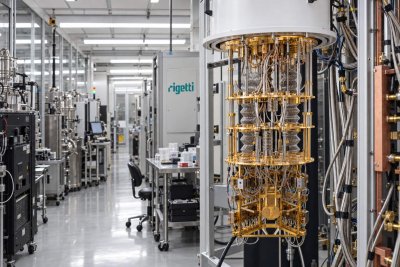
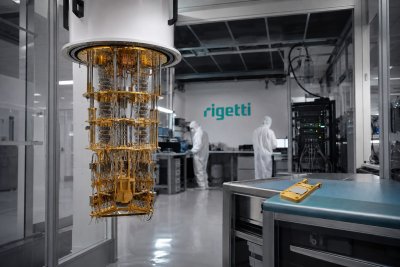
The broader context includes a reported $2 billion in grants from the Trump administration to nine quantum-computing firms, with the government taking equity stakes. According to reports from Reuters and the Wall Street Journal, IBM is set to receive $1 billion, GlobalFoundries $375 million, and D-Wave and Rigetti approximately $100 million each.
D-Wave recently reported mixed first-quarter results. Bookings surged to $33.4 million, a nearly 2,000% increase year-over-year, driven by a surge in customer orders that are expected to convert into future revenue. However, revenue fell 81% to $2.9 million, as the prior-year quarter benefited from a large system sale. The net loss widened to $18.4 million, and as of March 31, the company held $588.4 million in cash and marketable securities.
The disconnect between robust order growth and declining revenue remains a key concern for investors. While market participants are betting that government funding and enterprise deals will accelerate the scalability of quantum systems, the current financials indicate a company still burning through cash before the market fully matures.
Investors should note that the letter of intent is non-binding, and D-Wave has cautioned that negotiations could break down or stall, milestones may not be met, and there is a risk the Commerce Department may not have the funds available. If the deal proceeds and shares are issued to the government, existing shareholders could face dilution.
Technical challenges persist in the quantum computing sector. Reuters notes that current quantum computers still spend most of their computational power on error correction, meaning they have yet to outperform classical computers in most practical applications. This remains a fundamental hurdle for the industry's long-term prospects.