Infleqtion (INFQ) shares moved higher in premarket trading on Thursday after the U.S. Department of Commerce signed a preliminary funding letter committing $100 million to the company's neutral-atom quantum computing initiative. The proposed award, which is not yet final, also includes a provision that would give the U.S. government equity in the company. INFQ was last quoted at $11.18, up 5.1%, ahead of the regular New York cash session.
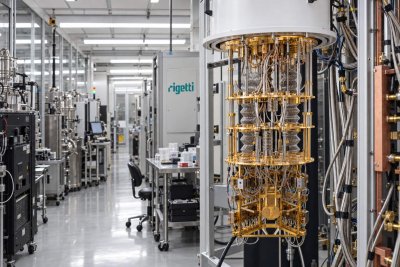
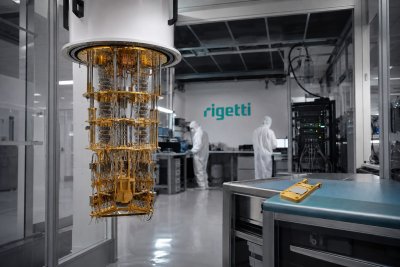
The funding is part of a broader push by Washington to support quantum technology companies as investors seek to identify which firms can transition from laboratory research to commercially viable machines. The Commerce Department disclosed that it has signed nine letters of intent totaling $2.013 billion under the CHIPS and Science Act. Infleqtion is slated to receive $100 million to develop large-scale neutral-atom quantum computers, including optical systems, readout mechanisms, and error-correction systems. Other quantum companies, including D-Wave and Rigetti, were also listed for planned funding, while IBM was named for a larger foundry award.
A letter of intent is not a binding grant. Infleqtion stated that the proposed award is contingent on meeting specific milestones, completing due diligence, finalizing documents, and obtaining U.S. government approvals. The structure also contemplates issuing common stock to the Commerce Department valued at $100 million at a 15% discount to market, with the securities expected to be held passively.
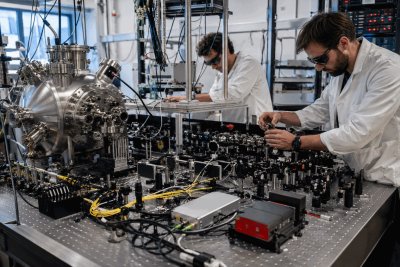
Chief Executive Matt Kinsella described quantum computing as a “foundational technology” for U.S. competitiveness and national security. Commerce Secretary Howard Lutnick said the investments would usher in a “new era of American innovation.” Infleqtion’s approach uses neutral atoms as qubits, the basic units of data in a quantum computer, trapping and controlling them with lasers rather than relying solely on conventional chip circuits. The goal is to build machines capable of solving complex problems faster or more efficiently than classical computers.
The stock move was part of a broader quantum rally in premarket trading. D-Wave was quoted up 6.0%, Rigetti up 5.7%, and IBM up 1.2%, based on the latest available premarket prices.
Infleqtion remains a relatively small player by public-market standards. The company reported first-quarter revenue of $9.5 million last week, up 14% from a year earlier, while posting a GAAP operating loss of $33.6 million. It ended March with $569 million in cash, cash equivalents, and available-for-sale securities, and raised its 2026 revenue outlook to at least $40 million. CFO Ilan Hart said the cash position provides “flexibility to invest in R&D.”
The funding letter followed another announcement on Wednesday, in which Infleqtion highlighted technical progress, including an open-source resource-estimation tool and a dual-species rubidium-cesium entangling gate with reported fidelity of 0.975 ± 0.002. Chief Technology Officer Pranav Gokhale said the company was “moving the needle” across software, hardware, and theory simultaneously.
Infleqtion entered the public market only recently. Its common stock and warrants began trading on the NYSE on February 17 after a business combination, with shares listed under INFQ and warrants under INFQ WS, according to a regulatory filing.
However, the trade is not without risks. The Commerce letter may not become a final award, the proposed stock issuance could dilute existing holders, and Infleqtion remains lossmaking. Quantum computing also faces a persistent technical challenge: current machines require significant computing power to correct errors, limiting their advantage over classical computers. For now, investors have a near-term catalyst and a long-term question. The next test is whether federal backing helps Infleqtion convert a promising technology base into contracts, revenue, and machines that customers can use beyond the research cycle.