The Dow Jones Industrial Average breached the 54,000 threshold for the first time in history on Tuesday, propelled by outsized gains in Caterpillar and Goldman Sachs. The blue-chip index climbed as much as 882.71 points, or 1.66%, to reach a record intraday high of 54,108.46 before settling at 54,061.12 during midday trading.
The surge was notably concentrated, with Caterpillar (NYSE: CAT) and Goldman Sachs (NYSE: GS) together contributing approximately 531 points—roughly 60% of the Dow's total advance. The top five gainers, including Microsoft (NASDAQ: MSFT), JPMorgan Chase (NYSE: JPM), and Home Depot (NYSE: HD), accounted for about 77% of the index's move.
This concentration highlights the Dow's price-weighted methodology, where stocks with higher share prices exert a disproportionate influence. A $1 change in any component moves the index by nearly 5.94 points. For instance, Caterpillar's $54.40 gain added roughly 323 points, while Goldman's $34.94 rise contributed 208 points. In contrast, Cisco Systems (NASDAQ: CSCO) advanced 3.99% but only added about 27 points due to its lower share price.
Caterpillar's Earnings Boost
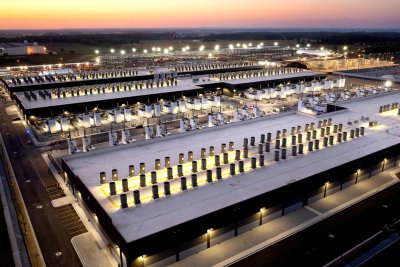
Caterpillar led the rally after raising its full-year revenue growth forecast, citing robust demand for generators and backup power systems driven by AI data-center construction. The company also trimmed its projected 2026 tariff expenses to approximately $2.2 billion, down from an earlier estimate of $2.2 billion to $2.6 billion. Its quarterly orders reached $9.4 billion, lifting the backlog to $72.1 billion.
CEO Joe Creed noted that "strong order rates and a growing backlog reflect broadening momentum across all three of our primary segments." The construction and power segments accounted for 81% of revenue in the quarter, with total sales climbing 24% to $20.543 billion.
Market Breadth and Mixed Moves
Despite the Dow's strength, market breadth was positive but not universal. Twenty-three of the Dow's 30 components advanced, while seven declined. Amazon (NASDAQ: AMZN) dropped 2.32%, UnitedHealth (NYSE: UNH) slipped 1.59%, and Nike (NYSE: NKE) fell 1.52%, collectively shaving roughly 82 points off the index.
The broader market also rallied, with the Nasdaq Composite adding 2.06% and the S&P 500 rising 1.47%. The Russell 2000 gained 1.49%. However, energy shares underperformed as Brent crude fell over 4% to $80.35 a barrel amid diplomatic efforts to ease Middle East tensions and restore access to the Strait of Hormuz.
Economic Data and Earnings Outlook
The rally persisted despite softer-than-expected economic data. June job openings fell to 7.359 million, below the anticipated 7.4 million, while hiring rose to 5.348 million. Treasury yields eased, with the 10-year yield down 4.5 basis points to 4.639%, and gold climbed 1.36% to $4,088.70 an ounce.
Corporate earnings continue to provide support, with 85.2% of S&P 500 companies beating estimates so far, well above the historical average of 67.5%. Investors now look ahead to Friday's jobs report, where economists expect 80,000 new positions and a 4.2% unemployment rate.
Risks and Outlook
While the Dow's milestone is a positive signal, the concentration of gains in a few high-priced stocks poses risks. A pullback in Caterpillar or Goldman could trigger a swift decline in the index. Additionally, renewed geopolitical tensions or a stronger-than-expected jobs report could reignite inflation concerns and pressure yields.
As the AI-driven rally broadens beyond software and chipmakers to industrial and financial names, strategists caution that investors must differentiate sustainable leaders from those with less resilience. "The AI earnings performance has been fantastic," noted Eric Parnell of Great Valley Advisor Group, "but now it's about identifying the winners that can sustain growth."