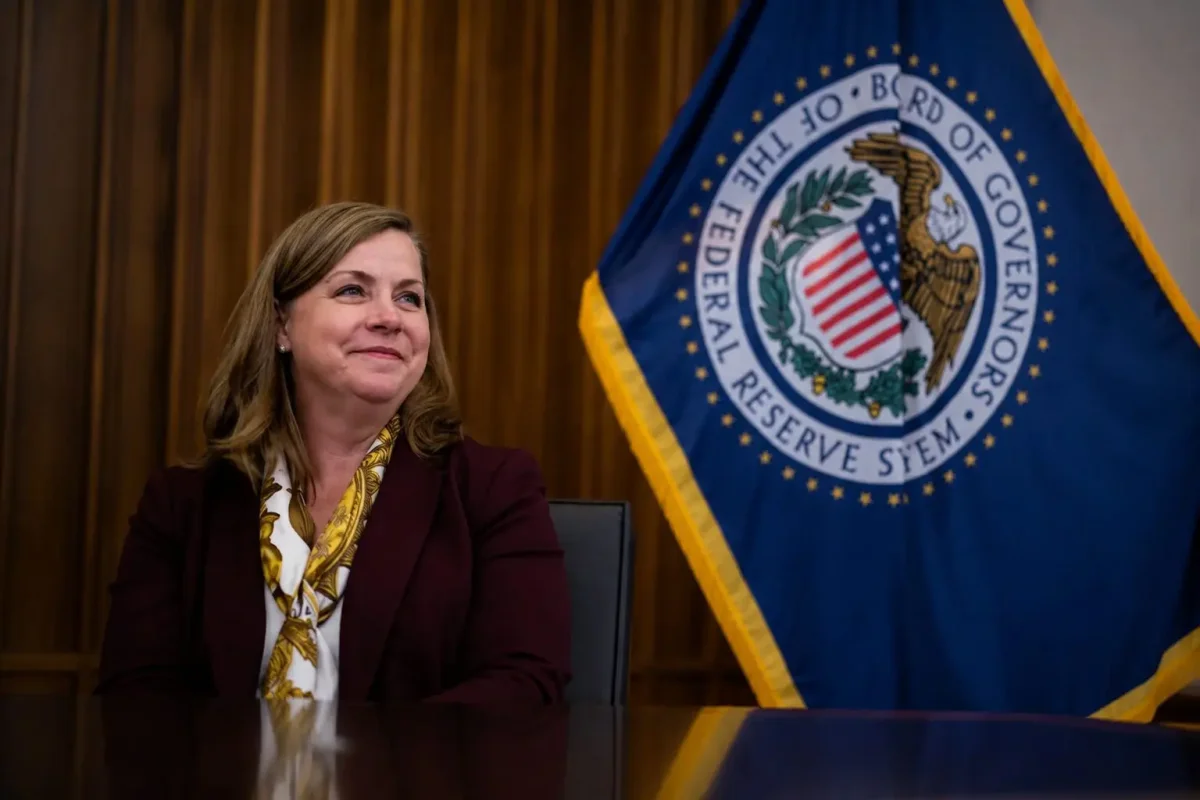
London, July 13, 2026 – Federal Reserve Vice Chair for Supervision Michelle Bowman addressed the Financial Stability Board (FSB) on Monday, urging a shift toward flexible, risk-based global regulatory standards rather than rigid, one-size-fits-all rules. Speaking in London, Bowman cautioned that inflexible standards undermine the FSB's effectiveness in coordinating financial regulation across major economies.
The FSB is preparing to release draft modernization principles for public consultation this fall, with a final report expected to be submitted to the Group of 20 (G20) nations. Bowman's comments come as the U.S. reworks Basel III, the post-2008 global bank-capital framework, with significant implications for capital requirements.
According to Fed staff analysis, aggregate Common Equity Tier 1 (CET1) capital—the highest-quality loss-absorbing capital—would decline by 4.8% for the largest internationally active banks (Category I-II), 5.2% for other big banks (Category III-IV), and 7.8% for banks with assets under $100 billion. The reductions are driven by changes in systemic surcharges, stress test assumptions, and capital treatment for certain assets.
Morgan Stanley analysts, led by Manan Gosalia, estimated in April that 36 U.S. banks could accumulate $320 billion in excess capital if the draft rules are implemented, a 20% increase from the $266 billion estimated under current rules. JPMorgan Chase CEO Jamie Dimon indicated his bank might have around $40 billion in excess capital but called the draft “flawed.” JPMorgan CFO Jeremy Barnum noted that the bank’s required capital would rise by about 4%, contrasting with an average 4.8% decline for peers, questioning the uneven impact.
Citigroup CFO Gonzalo Luchetti described the new rules as a “moderate positive” but did not specify the amount of capital that could be released. The overall estimates mask significant disparities among banks, highlighting the complexity of the regulatory overhaul.
Bowman also addressed the regulation of artificial intelligence (AI) in finance, advocating for flexible oversight. The FSB has proposed 12 suggested practices: six focus on AI development and deployment, four on organization-wide governance and management, and two on cyber, technology, and third-party risk. Bowman recommended a lighter regulatory touch for lower-risk AI applications while maintaining stricter rules for higher-risk uses. The FSB is accepting comments until July 22, with a final report expected in October.
The Bank of England is moving in a similar but distinct direction, proposing a 0.2 percentage point reduction in leverage requirements for large banks. The leverage ratio, which serves as a non-risk-weighted capital-to-exposure limit, currently binds three of the seven largest UK banks, illustrating how local rules can affect lending capacity and balance-sheet flexibility.
However, increased flexibility risks fragmenting the rulebook or triggering a “race to the bottom” in regulatory standards. Fed Governor Michael Barr criticized the planned global systemically important bank surcharge, which would reduce CET1 demands by $33 billion, calling it unjustified and warning of potential competitive deregulation. Divergent national rules could also force global banks to maintain separate compliance systems while reducing overall capital buffers.
Major banks face a near-term test with earnings reports this week: JPMorgan and Citigroup report on Tuesday, July 14, followed by Morgan Stanley on Wednesday. Coalition Greenwich’s Angad Chhatwal expects sales-and-trading revenue at the largest global banks to rise at least 15% year-over-year. Investors are seeking clarity on buybacks, lending capacity, and dividend sustainability amid the regulatory uncertainty.