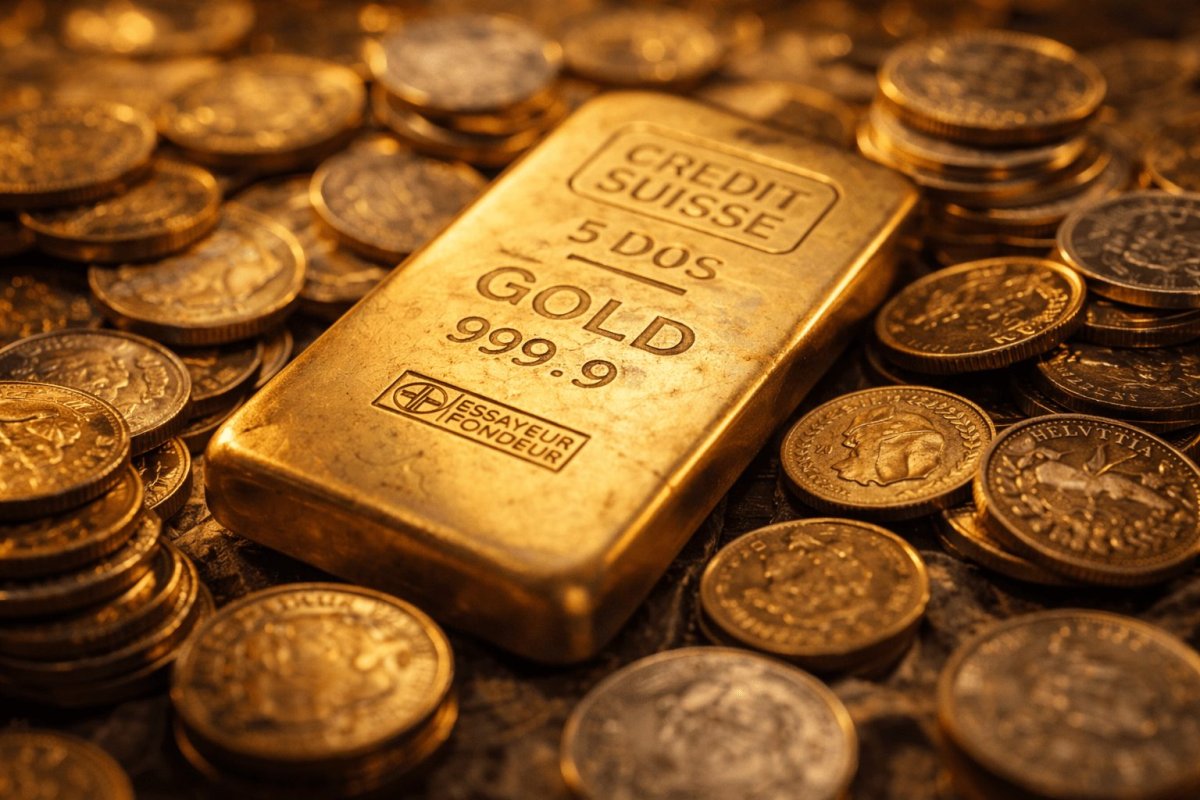
Gold prices stabilized just below the $4,670 per ounce level on Monday, recovering from earlier declines as financial markets navigated a complex landscape of geopolitical uncertainty and evolving monetary policy expectations. The precious metal found itself caught between opposing forces: ongoing tensions in the Middle East provided some support, while diminishing prospects for near-term Federal Reserve interest rate cuts applied downward pressure.
Market Performance and Key Levels
Spot gold showed minimal movement, trading essentially flat at $4,669.27 per ounce by late morning Eastern Time. This followed an earlier session decline of approximately 1%. Meanwhile, U.S. gold futures demonstrated slightly more strength, advancing 0.3% to reach $4,694.50. The market's resilience came despite gold's difficult March, which saw the metal slump over 11%—marking its most severe monthly decline since the global financial crisis in October 2008.
Geopolitical Focus: Iran and the Strait of Hormuz
Traders maintained a sharp focus on geopolitical developments, particularly the Tuesday deadline set by the U.S. administration for Iran to reach an agreement concerning the strategic Strait of Hormuz. Diplomatic discussions between Washington and Tehran continued, though Iran rejected proposals for a temporary ceasefire in the ongoing conflict. The U.S. administration emphasized the deadline was firm with no extensions anticipated. Given that approximately 20% of global energy supplies transit through the Strait, every diplomatic development carries significant implications for oil markets, inflation expectations, and consequently, gold prices.
Interest Rate Expectations Shift
Concurrently, major financial institutions revised their outlooks for Federal Reserve policy. The Wells Fargo Investment Institute notably withdrew its previous projection for two rate cuts in 2026, now anticipating no reductions that year. Citigroup adjusted its forecast as well, pushing back its expected timing for Fed easing and now predicting rate cuts in September, October, and December. These revisions followed robust economic data, including Friday's employment report showing 178,000 new jobs added in March and unemployment dipping to 4.3%. Further inflation concerns emerged from Monday's ISM services survey, where the prices-paid index surged to 70.7, a level not seen since October 2022.
Analyst Perspectives and Market Dynamics
Market analysts highlighted the dual forces influencing bullion. "Focus is likely to remain on the war and interest rates," stated Bart Melek, global head of commodity strategy at TD Securities. He explained that a prolonged conflict would likely elevate oil prices, fuel inflationary pressures, and consequently restrict the Federal Reserve's capacity to lower interest rates—a scenario typically negative for non-yielding assets like gold.
Robert Pavlik, senior portfolio manager at Dakota Wealth, noted, "The market was on edge over this ultimatum." He suggested this underlying tension helped prevent a more severe decline in gold prices, even as hopes for monetary policy easing continued to fade. Trading volume was somewhat subdued, with several global markets closed for Easter Monday and Tomb Sweeping Day holidays.
Cross-Asset Movements and the Dollar
Activity in related markets reflected the prevailing uncertainty. U.S. crude oil prices declined 0.56% to $110.92 per barrel, while Brent crude fell 0.27% to $108.74. The U.S. dollar index, which often moves inversely to gold, slipped 0.37%. A weaker dollar typically makes gold less expensive for holders of other currencies, but this supportive effect was muted as investor attention remained fixed on interest rate trajectories.
Broader Precious Metals and the Week Ahead
The cautious sentiment extended across the precious metals complex. Spot silver declined 0.9% to $72.32 an ounce. Platinum retreated 0.9% to $1,971.04, and palladium shed 1.1% to $1,486.03.
Market participants now look toward a data-heavy week that could further clarify gold's path. The Federal Reserve will release the minutes from its March policy meeting on Wednesday. Thursday brings the U.S. Personal Consumption Expenditures (PCE) price index data, followed by the Consumer Price Index (CPI) report on Friday. These inflation metrics will be scrutinized to determine whether economic data, rather than geopolitical headlines, will dictate gold's near-term direction. The fundamental dilemma for gold persists: a ceasefire and reopening of the Strait of Hormuz could reduce safe-haven demand, while lower oil prices might ease inflation and strengthen the case for rate cuts. Conversely, a protracted conflict with spiking energy prices could still challenge gold if it leads to sustained higher interest rates.