Drivers in the Greater Toronto Area will see a modest reprieve at the pumps this Friday, but the price action is far from a straightforward inflation win. Regular gasoline is expected to drop 7 cents to C$1.809 per litre on September 11, while diesel is set to climb 9 cents to C$2.459. Premium gasoline is also forecast to fall 7 cents, to C$2.109.
The split between gasoline and diesel is more telling for investors than the direction of either price alone. A typical 50-litre fill-up of regular gas would cost C$3.50 less after the decline. But a business purchasing 1,000 litres of diesel would face an additional C$90. While the first figure eases household cash flow, the second can ripple through freight bills, food distribution, and wider supply chains.
Gasoline relief, diesel pressure
Friday's estimates come from Canadians for Affordable Energy’s GTA forecast, compared with Thursday’s figures of C$1.879 for regular gasoline and C$2.369 for diesel. That translates to a one-day move of approximately -3.7% for gasoline and +3.8% for diesel. These are forecasts, not guaranteed station postings, and a separate CityNews/En-Pro tracker pegged Thursday’s GTA regular-gasoline average at C$1.879, with a caution that daily predictions can be revised during volatile periods.
Local pump prices often diverge from same-day commodity futures because benchmarks, delivery points, currencies, wholesale timing, taxes, and retail margins differ. The Canada Energy Regulator’s price breakdown separates crude costs from refining margins, marketing margins, and taxes. An overnight GTA price reset should not be read as a real-time quote for crude oil or as a direct proxy for a refiner’s profit.
That warning is especially pertinent today. Near 4 p.m. ET, delayed NYMEX data showed RBOB gasoline futures at about US$3.212 a gallon, up 5.4% from the prior close, and heating-oil futures—the widely watched middle-distillate benchmark—near US$5.09, up 6.0%. Brent crude was around US$107.95 a barrel, up 6.7%. The GTA forecast and those futures are snapshots of different links in the same chain, taken on different clocks.
What the split says about Canadian inflation
Gasoline carries a 4.01% weight in Canada’s current consumer-price basket. If a 3.7% decline were sustained nationwide for a full pricing period, a simple weight-times-price calculation would equal roughly 0.15 percentage point of downward pressure on the price level, all else equal. Friday’s move is only a one-day GTA forecast, so that arithmetic is a scale check—not a CPI prediction.
The offsetting diesel rise is harder to see in a household CPI line but potentially broader in the economy. Statistics Canada reported in July that 33.7% of transportation and warehousing businesses expected input costs to be an obstacle over the following three months; among those businesses, energy was the most frequently cited input-cost concern. StatCan also found that long-distance general-freight trucking prices had risen 4.5% from February to March, an early sign of fuel costs moving through the supply chain.
Canada’s latest headline CPI reading was 3.0% for July, and Statistics Canada is due to release August data on September 14. Friday’s gasoline decline will not be in that report, but investors will be watching whether elevated fuel prices persist long enough to influence later readings and rate expectations.
The read-through for Suncor, Imperial Oil and Cenovus
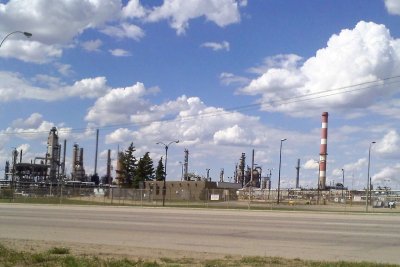
The closest listed-company exposure is not a simple bet on the price at one Toronto station. Suncor Energy, Imperial Oil, and Cenovus Energy combine upstream production with refining and, in Suncor’s and Imperial’s cases, large branded retail networks. Higher crude can lift upstream realizations while also raising refinery feedstock costs; the profit outcome depends on product cracks, utilization, crude differentials, currency, and operating reliability.
Suncor’s current refining nameplate capacity is 511,000 barrels a day, and its first-quarter presentation counted 1,731 Petro-Canada sites at the end of 2025. More revealing than the site count is the company’s disclosed sensitivity: normalized 2025 annual funds from operations after tax would change by about C$170 million for each US$1-a-barrel move in the New York Harbor 2-1-1 crack spread, under the stated assumptions. That company sensitivity is not guidance, but it shows why the gasoline-versus-distillate margin mix is financially material.
Imperial reported 331,000 barrels a day of refinery throughput in the second quarter and operates Canada’s largest branded retail network through roughly 2,600 Esso and Mobil sites. Cenovus said second-quarter refining revenue rose to C$6.5 billion from C$4.2 billion in the first quarter as refined-product prices increased; its latest results also put downstream throughput at 451,500 barrels a day. Those numbers make product margins consequential, but they do not make a single GTA retail move an earnings forecast.
U.S.-listed shares of Suncor, Imperial, and Cenovus were all modestly lower near 4 p.m. ET even as Brent and fuel futures rose sharply. That is a useful check against the temptation to trade the pump-price headline in isolation.
What would change the thesis
Three follow-ups matter. First is whether GTA stations actually post C$1.809 regular and C$2.459 diesel Friday. Second is whether the gasoline-distillate divergence persists in wholesale markets rather than reversing after one daily reset. Third is whether refinery outages, maintenance, or logistics tighten one product more than the other.
For drivers, waiting until Friday to buy regular gasoline has a clear, if limited, payoff. For investors, diesel is the more consequential number: cheaper gasoline offers visible consumer relief, but costlier freight fuel keeps pressure in the parts of inflation that arrive later and are harder to trace.