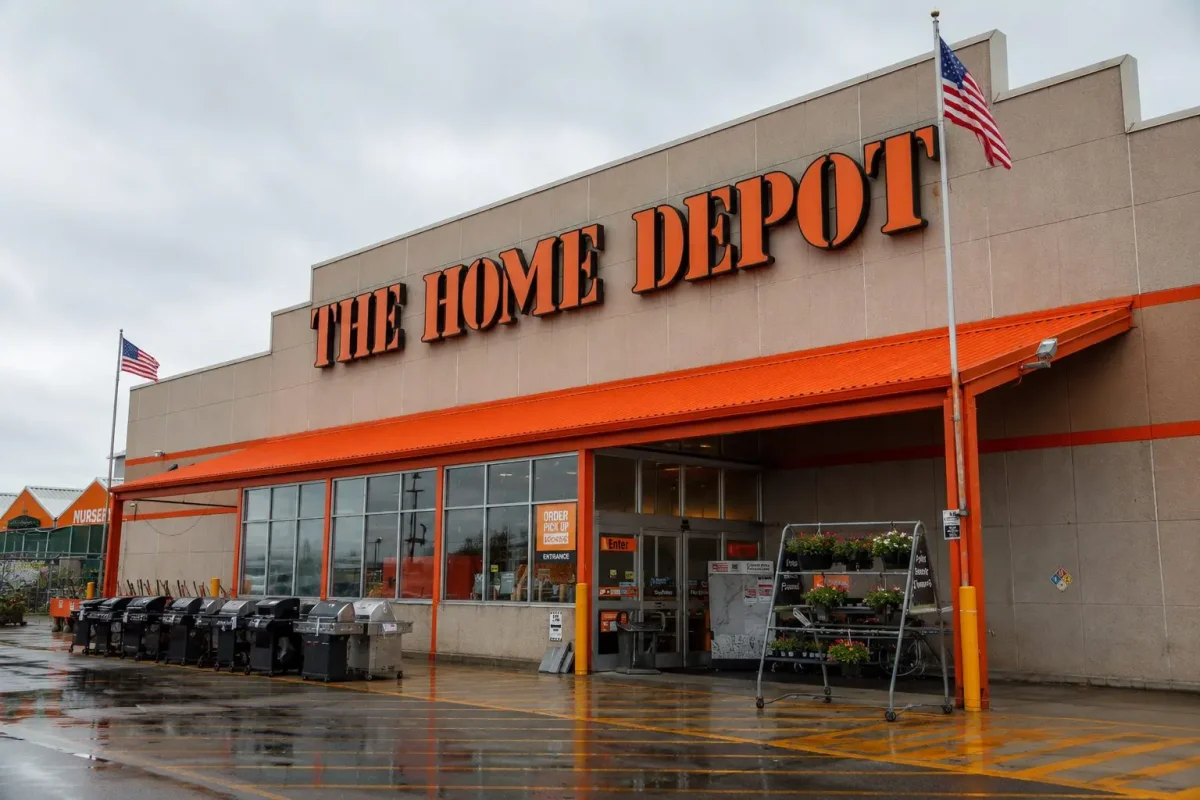
Home Depot (NYSE: HD) shares closed Thursday at $334.28, marking a 2.1% increase on the day and a roughly 1.8% gain from last Friday's close. The advance came during a holiday-shortened trading week, with markets closed Friday for Juneteenth and remaining shut Saturday. The stock, a component of both the Dow Jones Industrial Average and the S&P 500, benefited from a broader market rally as investors grew more comfortable with oil prices and interest rate expectations.
The broader market posted solid gains Thursday, with the S&P 500 rising 1.08%, the Nasdaq climbing 1.91%, and the Dow edging up 0.14%. Consumer discretionary shares jumped 1.8%, lifting Home Depot and its main rival Lowe's (NYSE: LOW), which gained 2.3% to finish at $222.20. However, the positive sentiment was tempered by lingering concerns about the housing market's trajectory.
U.S. single-family housing starts fell in May to their lowest level in eight months, with total starts hitting a six-year low, according to Reuters. Sal Guatieri of BMO Capital Markets noted there is little indication that homebuilding will recover quickly. This weakness in housing activity weighs on the outlook for home-improvement demand, a key driver for Home Depot's business. The market is now awaiting May new-home sales data, due Wednesday at 10 a.m. Eastern from the Census Bureau, which could either alleviate or amplify these concerns.
Despite the uncertain environment, Home Depot has maintained its fiscal 2026 guidance. In May, the retailer reported first-quarter sales of $41.8 billion, up 4.8% year-over-year, with comparable sales rising 0.6%. The company continues to expect total sales growth of 2.5% to 4.5%, comparable sales ranging from flat to up 2.0%, and diluted earnings per share to be flat to up 4.0%. Chair, President, and CEO Ted Decker described the first-quarter results as in line with expectations, but acknowledged ongoing housing affordability pressure.
Chief Financial Officer Richard McPhail, speaking during the company's earnings call, reiterated the comparable sales outlook of flat to 2% growth, noting that the external environment has become more volatile. He emphasized that Home Depot is just entering the key selling weeks of its second quarter, suggesting that the full impact of current conditions remains to be seen. McPhail also highlighted unpredictable costs from fuel, commodities, and tariffs, which add further uncertainty to the outlook.
The bull case for Home Depot hinges significantly on its professional customer segment—contractors and builders—rather than just do-it-yourself homeowners. The company is pursuing market share gains through acquisitions such as SRS Distribution and GMS, as well as through its HD Supply business and expanded trade credit offerings. Executive Vice President for Pro, Mike Rowe, reported continued momentum in Pro Trade Credit, with strong adoption from builders and remodelers in the first quarter.
While a single weak housing data point is unlikely to derail Home Depot's outlook, a sustained soft patch could stoke fears that rising borrowing costs are dampening demand for major home improvement projects. The stock's near-term direction will likely depend on the upcoming new-home sales report and the company's second-quarter earnings, expected in August. For now, Home Depot remains a bellwether for the housing and renovation sectors, navigating a volatile landscape with cautious optimism.